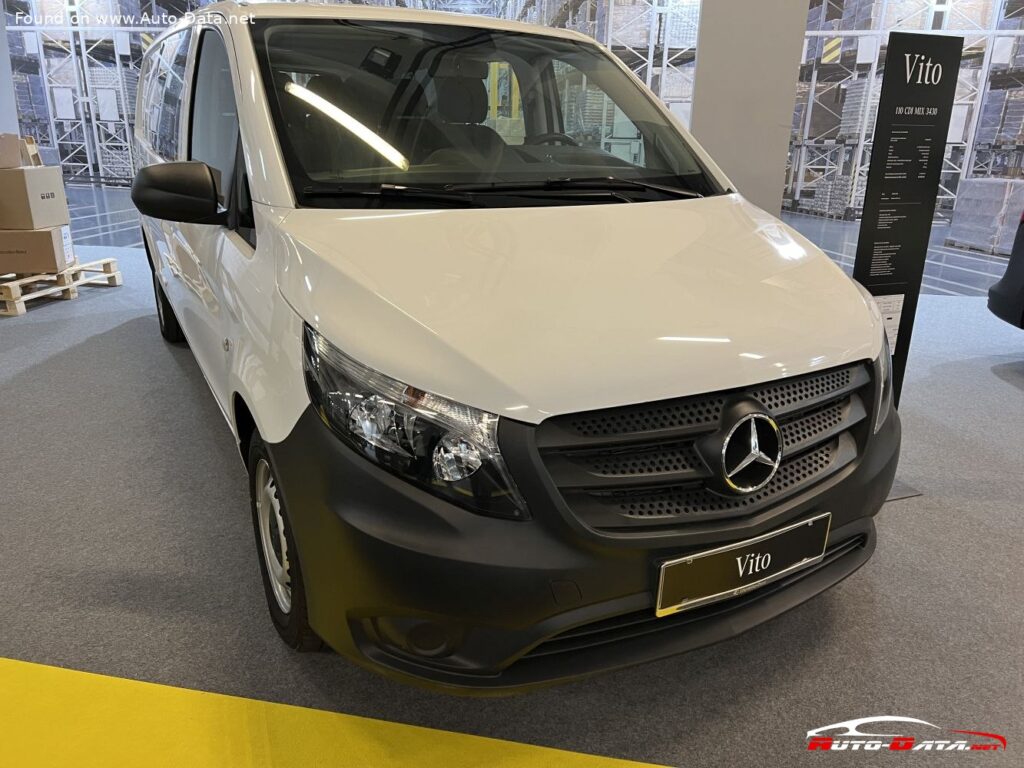
The Mercedes-Benz Vito (W447), particularly the facelifted version introduced in 2020, represents the third generation of this popular commercial vehicle. Positioned within the mid-size van segment, the Vito caters to businesses and individuals requiring a versatile and practical vehicle for cargo transport and specialized applications. The “Extra Long” configuration, combined with the 114 CDI 1.7 engine producing 136 horsepower, offers a balance of cargo capacity and fuel efficiency. While primarily sold in Europe and other international markets, the Vito’s design and engineering reflect Mercedes-Benz’s commitment to quality and functionality in the commercial vehicle sector.
Mercedes-Benz Vito W447 (2020 Facelift) 114 CDI: An Overview
The W447 generation of the Vito, launched in 2014, received a significant facelift in 2020, bringing updated styling, enhanced technology, and improved efficiency. The 114 CDI 1.7 variant, equipped with a 1.7-liter turbocharged diesel engine, is a common choice for those prioritizing fuel economy and adequate power for typical commercial duties. The “Extra Long” wheelbase provides a substantial cargo area, making it suitable for a wide range of applications, from delivery services to mobile workshops. This model is not officially sold in the United States, but its European popularity stems from its robust build quality, comfortable driving experience (for a van), and comprehensive feature set.
Engine & Performance
The heart of the Vito 114 CDI is the OM 622.851, a 1.7-liter inline-four cylinder diesel engine. This engine produces 136 horsepower at 3800 rpm and 330 Nm (243.4 lb.-ft.) of torque between 1750 and 2500 rpm. The engine utilizes a diesel commonrail fuel injection system and is equipped with a turbocharger and intercooler to optimize performance and efficiency. Power is delivered to the front wheels via a six-speed manual transmission. The weight-to-power ratio of 14.7 kg/Hp and a weight-to-torque ratio of 6.1 kg/Nm contribute to respectable acceleration and load-carrying capability. Fuel consumption figures, measured using the WLTP cycle, range from 7.4 to 7.5 liters per 100 kilometers (31.8-31.4 US mpg) combined, with lower figures achievable at higher speeds. The inclusion of a Start & Stop system and a particulate filter helps to minimize emissions, meeting Euro 6d-TEMP N1 standards with CO2 emissions of 193-195 g/km.
Design & Features
The 2020 facelifted Vito boasts a more modern and refined exterior design, with a revised front grille, updated headlights, and a redesigned bumper. The “Extra Long” body style measures 5370 mm (211.42 in.) in length, providing a generous cargo volume of 6600 liters (233.08 cu. ft.). The van offers seating for three occupants and features four or five doors for convenient access. Inside, the Vito prioritizes practicality and durability. The cabin is designed for ease of use and features a functional dashboard layout. Standard features typically include air conditioning, a basic audio system, and various driver assistance systems such as ABS (Anti-lock Braking System). The Vito’s suspension – independent McPherson struts at the front and an independent coil spring trailing arm setup at the rear – provides a comfortable ride, even when fully loaded. The vehicle’s robust construction and comprehensive safety features contribute to its reputation as a reliable and dependable workhorse.
Technical Specifications
| Brand | Mercedes-Benz |
| Model | Vito |
| Generation | Vito (W447, facelift 2020) Panel Van Extra Long |
| Type (Engine) | 114 CDI 1.7 (136 Hp) |
| Start of production | March, 2020 |
| End of production | 2021 |
| Powertrain Architecture | Internal Combustion engine |
| Body type | Van |
| Seats | 3 |
| Doors | 4-5 |
| Fuel consumption at Low speed (WLTP) | 9-9.2 l/100 km (26.1 – 25.6 US mpg) |
| Fuel consumption at Medium speed (WLTP) | 7.1-7.3 l/100 km (33.1 – 32.2 US mpg) |
| Fuel consumption at high speed (WLTP) | 6.4-6.6 l/100 km (36.8 – 35.6 US mpg) |
| Fuel consumption at very high speed (WLTP) | 7.7-7.8 l/100 km (30.5 – 30.2 US mpg) |
| Combined fuel consumption (WLTP) | 7.4-7.5 l/100 km (31.8 – 31.4 US mpg) |
| CO2 emissions (WLTP) | 193-195 g/km |
| Fuel Type | Diesel |
| Emission standard | Euro 6d-TEMP N1 |
| Weight-to-power ratio | 14.7 kg/Hp |
| Weight-to-torque ratio | 6.1 kg/Nm |
| Power | 136 Hp @ 3800 rpm |
| Torque | 330 Nm @ 1750-2500 rpm (243.4 lb.-ft. @ 1750-2500 rpm) |
| Engine layout | Front, Transverse |
| Engine Model/Code | OM 622.851 |
| Engine displacement | 1749 cm3 (106.73 cu. in.) |
| Number of cylinders | 4 |
| Engine configuration | Inline |
| Fuel injection system | Diesel Commonrail |
| Engine aspiration | Turbocharger, Intercooler |
| Engine oil capacity | 6.8 l (7.19 US qt | 5.98 UK qt) |
| Coolant | 10.4 l (10.99 US qt | 9.15 UK qt) |
| Kerb Weight | 2002-2154 kg (4413.65 – 4748.76 lbs.) |
| Max. weight | 2800-3050 kg (6172.94 – 6724.1 lbs.) |
| Max load | 798-896 kg (1759.29 – 1975.34 lbs.) |
| Trunk (boot) space – minimum | 6600 l (233.08 cu. ft.) |
| Fuel tank capacity | 57 l (15.06 US gal | 12.54 UK gal) |
| AdBlue tank | 24 l (6.34 US gal | 5.28 UK gal) |
| Max. roof load | 150 kg (330.69 lbs.) |
| Permitted trailer load with brakes (12%) | 1200 kg (2645.55 lbs.) |
| Permitted trailer load without brakes | 750 kg (1653.47 lbs.) |
| Length | 5370 mm (211.42 in.) |
| Width | 1928 mm (75.91 in.) |
| Height | 1910 mm (75.2 in.) |
| Wheelbase | 3430 mm (135.04 in.) |
| Drive wheel | Front wheel drive |
| Number of gears and type of gearbox | 6 gears, manual transmission |