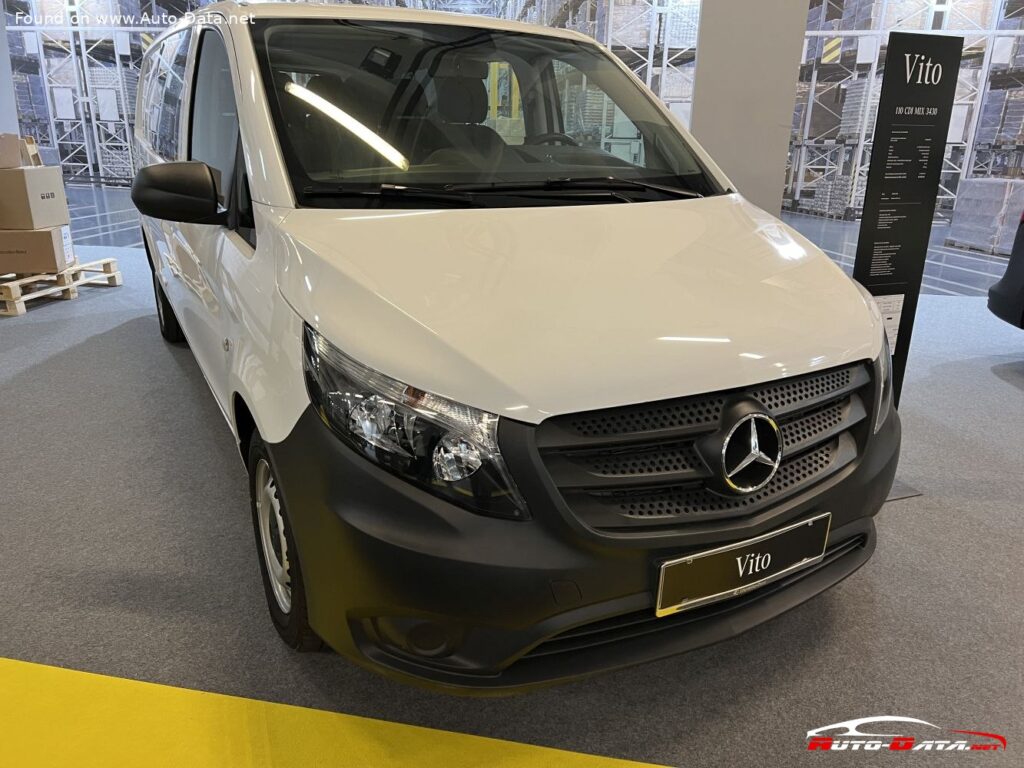
The Mercedes-Benz Vito (W447), particularly the facelifted version introduced in 2020, represents the third generation of this popular mid-size van. Marketed primarily in Europe, the Vito serves a crucial role as a versatile commercial vehicle, available in numerous configurations to suit a wide range of business and personal transport needs. The Extra Long Panel Van variant, equipped with the 114 CDI 2.0-liter diesel engine producing 136 horsepower and paired with the 9G-TRONIC automatic transmission, is a common specification offering a balance of efficiency, practicality, and load-carrying capacity. This model caters to businesses requiring substantial cargo space and reliable performance.
Mercedes-Benz Vito W447 (2020 Facelift) Overview
The W447 generation of the Vito, launched in 2014, received a significant facelift in 2020, bringing updated styling, enhanced technology, and improved efficiency. The facelift focused on modernizing the vehicle’s appearance, refining the interior, and integrating advanced driver-assistance systems. The 114 CDI variant, as detailed here, is a key component of the Vito lineup, offering a compelling option for those prioritizing fuel economy and torque for demanding workloads. While not officially sold in the United States, the Vito is a mainstay in European commercial fleets and among individuals seeking a spacious and adaptable vehicle.
Engine & Performance
The heart of the Vito 114 CDI is a 2.0-liter inline-four cylinder diesel engine, designated OM 654.920. This engine produces 136 horsepower at 4200 rpm and a substantial 330 Nm (243.4 lb.-ft.) of torque available from a low 1100-2400 rpm. This broad torque band is particularly beneficial for commercial applications, providing strong pulling power and effortless acceleration even when heavily loaded. The engine features a turbocharger with intercooler and a diesel commonrail fuel injection system, contributing to both performance and efficiency. The 9G-TRONIC nine-speed automatic transmission delivers smooth and efficient gear changes, optimizing fuel consumption and enhancing the driving experience. The engine’s power-to-weight ratio is 15.3 kg/Hp, and its torque-to-weight ratio is 6.3 kg/Nm, indicating a responsive and capable powertrain. The Vito 114 CDI achieves combined fuel consumption figures ranging from 7.2 to 7.3 liters per 100 kilometers (32.7-32.2 US mpg), with CO2 emissions between 187-188 g/km (WLTP).
Design & Features
The Vito W447, in its Extra Long Panel Van configuration, is characterized by its extended wheelbase and body length, maximizing cargo space. The van boasts a length of 5370 mm (211.42 in) and a width of 1928 mm (75.91 in), providing a substantial interior volume of 6600 liters (233.08 cu. ft.) for cargo. The vehicle offers seating for three occupants and features 4-5 doors for convenient access. The 2020 facelift brought subtle but noticeable styling updates, including a revised front grille, updated headlights, and a more modern interior design. Key features include a robust chassis designed for durability, independent suspension on both the front (McPherson strut) and rear (trailing arm) axles, and a comprehensive suite of safety systems, including ABS (Anti-lock Braking System). The Vito also incorporates a Start & Stop system and a particulate filter to reduce emissions, complying with Euro 6d emission standards. Practicality is further enhanced by features like a 57-liter (15.06 US gal) fuel tank and a 24-liter (6.34 US gal) AdBlue tank for selective catalytic reduction.
Technical Specifications
| Brand | Mercedes-Benz |
| Model | Vito |
| Generation | Vito (W447, facelift 2020) Panel Van Extra Long |
| Type (Engine) | 114 CDI 2.0 (136 Hp) 9G-TRONIC |
| Start of production | March, 2020 |
| End of production | July, 2023 |
| Powertrain Architecture | Internal Combustion engine |
| Body type | Van |
| Seats | 3 |
| Doors | 4-5 |
| Fuel consumption at Low speed (WLTP) | 8.6-8.8 l/100 km (27.4 – 26.7 US mpg) |
| Fuel consumption at Medium speed (WLTP) | 7.1-7.2 l/100 km (33.1 – 32.7 US mpg) |
| Fuel consumption at high speed (WLTP) | 6.1-6.3 l/100 km (38.6 – 37.3 US mpg) |
| Fuel consumption at very high speed (WLTP) | 7.5-7.7 l/100 km (31.4 – 30.5 US mpg) |
| Combined fuel consumption (WLTP) | 7.2-7.3 l/100 km (32.7 – 32.2 US mpg) |
| CO2 emissions (WLTP) | 187-188 g/km |
| Fuel Type | Diesel |
| Emission standard | Euro 6d |
| Weight-to-power ratio | 15.3 kg/Hp |
| Weight-to-torque ratio | 6.3 kg/Nm |
| Power | 136 Hp @ 4200 rpm |
| Torque | 330 Nm @ 1100-2400 rpm (243.4 lb.-ft. @ 1100-2400 rpm) |
| Engine layout | Front, Longitudinal |
| Engine Model/Code | OM 654.920 |
| Engine displacement | 1950 cm3 (119 cu. in.) |
| Number of cylinders | 4 |
| Engine configuration | Inline |
| Cylinder Bore | 82 mm (3.23 in.) |
| Piston Stroke | 92.3 mm (3.63 in.) |
| Number of valves per cylinder | 4 |
| Fuel injection system | Diesel Commonrail |
| Engine aspiration | Turbocharger, Intercooler |
| Valvetrain | DOHC |
| Engine oil capacity | 9 l (9.51 US qt | 7.92 UK qt) |
| Coolant | 10.4 l (10.99 US qt | 9.15 UK qt) |
| Kerb Weight | 2080-2154 kg (4585.62 – 4748.76 lbs.) |
| Max. weight | 2800-3200 kg (6172.94 – 7054.79 lbs.) |
| Max load | 720-1046 kg (1587.33 – 2306.04 lbs.) |
| Trunk (boot) space – minimum | 6600 l (233.08 cu. ft.) |
| Fuel tank capacity | 57 l (15.06 US gal | 12.54 UK gal) |
| AdBlue tank | 24 l (6.34 US gal | 5.28 UK gal) |
| Max. roof load | 150 kg (330.69 lbs.) |
| Permitted trailer load with brakes (12%) | 2000 kg (4409.25 lbs.) |
| Permitted trailer load without brakes | 750 kg (1653.47 lbs.) |
| Permitted towbar download | 100 kg (220.46 lbs.) |
| Length | 5370 mm (211.42 in.) |
| Width | 1928 mm (75.91 in.) |
| Width including mirrors | 2244 mm (88.35 in.) |
| Height | 1910 mm (75.2 in.) |
| Wheelbase | 3430 mm (135.04 in.) |
| Front track | 1666 mm (65.59 in.) |
| Rear (Back) track | 1646 mm (64.8 in.) |
| Number of gears and type of gearbox | 9 gears, automatic transmission G-TRONIC |