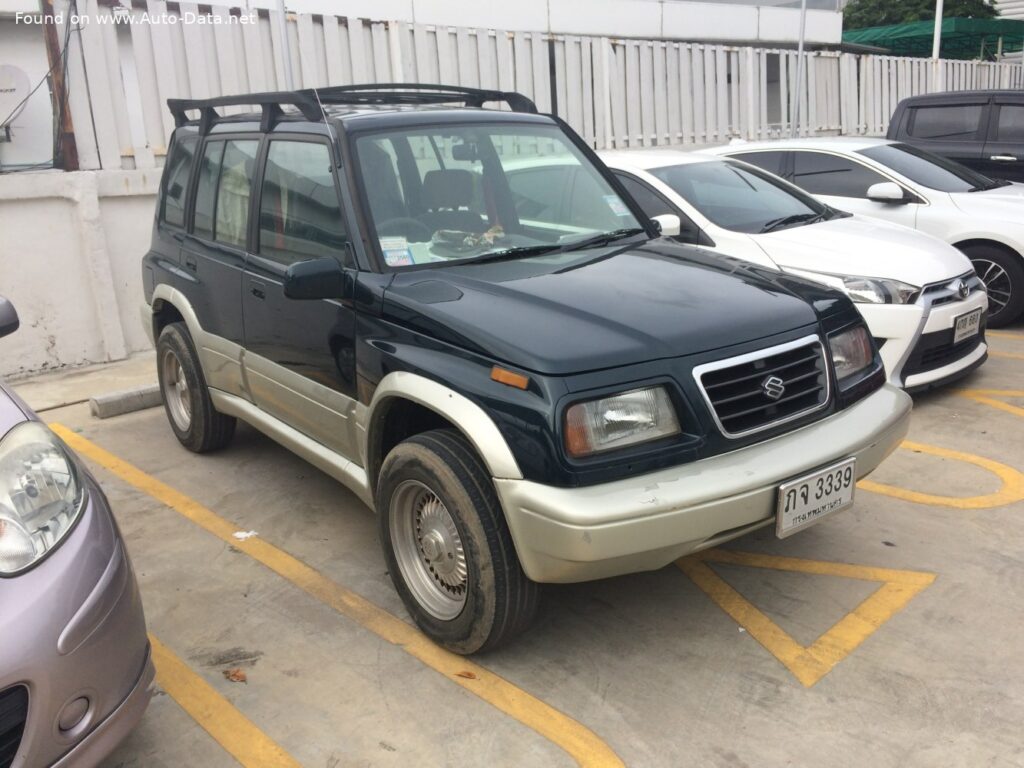
The Suzuki Vitara Cabrio (ET, TA) represents a unique offering from the Japanese automaker, primarily marketed in Europe and other international markets between 1990 and 1999. This compact SUV distinguished itself with a fully retractable soft-top, blending the practicality of a four-wheel-drive vehicle with the open-air enjoyment of a convertible. While not officially sold in the United States, the Vitara Cabrio exemplifies a growing trend in the early 1990s towards versatile, lifestyle-oriented vehicles. It’s important to note that the Vitara nameplate has a long history with Suzuki, evolving through several generations, but the Cabrio model remains a particularly distinctive iteration.
Suzuki Vitara Cabrio: A Niche Offering
The Vitara Cabrio, identified by the chassis codes ET and TA, was built upon the second-generation Vitara platform. It catered to a specific segment of buyers seeking a compact, capable, and stylish vehicle. Unlike many contemporary SUVs focused solely on off-road prowess, the Cabrio emphasized a balance between on-road comfort and open-top driving. Its three-door configuration and relatively small dimensions made it well-suited for navigating urban environments, while its four-wheel-drive system provided added traction in inclement weather or on light off-road trails. The Cabrio was positioned as a recreational vehicle, appealing to those with active lifestyles.
Engine & Performance
The most common engine offered in the Suzuki Vitara Cabrio (ET, TA) was the 1.6-liter, 16-valve inline-four cylinder engine, designated as the G16B. This naturally aspirated engine produced 97 horsepower at 5,600 rpm and 132 Nm (97.36 lb.-ft.) of torque at 4,000 rpm. While not a performance powerhouse, the engine provided adequate power for everyday driving and moderate off-road use. The engine’s power-to-weight ratio was 10.7 kg/Hp, and the torque-to-weight ratio was 7.9 kg/Nm. The engine featured multi-port fuel injection and an overhead camshaft (OHC) valvetrain. The 1.6-liter engine displaced 1589 cm3 (96.97 cu. in.) and had a compression ratio of 9.5:1. The engine was paired with a four-speed automatic transmission, delivering power to all four wheels via a selectable four-wheel-drive system. Fuel economy figures were approximately 9.5 liters per 100 kilometers (24.8 US mpg) combined, with 12 l/100 km (19.6 US mpg) in urban settings and 8 l/100 km (29.4 US mpg) on the open road. The vehicle had a maximum speed of 152 km/h (94.45 mph).
Design & Features
The Vitara Cabrio’s defining feature was, of course, its retractable soft-top. The top was manually operated, offering a relatively quick and easy transition between open-air motoring and enclosed protection from the elements. The body style is classified as a Cabriolet SUV, with three doors and seating for five passengers, although rear passenger space was somewhat limited. The vehicle’s design was typical of early 1990s SUVs – boxy and utilitarian, but with rounded edges for a more modern aesthetic. Safety features were relatively basic by today’s standards, consisting primarily of seatbelts and a robust chassis construction. The interior was functional and durable, with cloth upholstery and basic instrumentation. Key dimensions included a length of 3632 mm (142.99 in.), a width of 1630 mm (64.17 in.), and a height of 1665 mm (65.55 in.). The wheelbase measured 2200 mm (86.61 in.). Trunk space was modest at 230 liters (8.12 cu. ft.), reflecting the compromises inherent in a convertible design. The vehicle’s kerb weight was 1040 kg (2292.81 lbs), with a maximum permissible weight of 1500 kg (3306.93 lbs).
Technical Specifications
| Brand | Suzuki |
| Model | Vitara |
| Generation | Vitara Cabrio (ET,TA) |
| Type (Engine) | 1.6 16V (ET) (97 Hp) Automatic |
| Start of production | 1990 year |
| End of production | 1999 year |
| Powertrain Architecture | Internal Combustion engine |
| Body type | Cabriolet, SUV |
| Seats | 5 |
| Doors | 3 |
| Fuel consumption (urban) | 12 l/100 km (19.6 US mpg) |
| Fuel consumption (extra urban) | 8 l/100 km (29.4 US mpg) |
| Fuel consumption (combined) | 9.5 l/100 km (24.8 US mpg) |
| Fuel Type | Petrol (Gasoline) |
| Maximum speed | 152 km/h (94.45 mph) |
| Weight-to-power ratio | 10.7 kg/Hp |
| Weight-to-torque ratio | 7.9 kg/Nm |
| Power | 97 Hp @ 5600 rpm |
| Torque | 132 Nm @ 4000 rpm (97.36 lb.-ft. @ 4000 rpm) |
| Engine layout | Front, Longitudinal |
| Engine Model/Code | G16B |
| Engine displacement | 1589 cm3 (96.97 cu. in.) |
| Number of cylinders | 4 |
| Engine configuration | Inline |
| Cylinder Bore | 75 mm (2.95 in.) |
| Piston Stroke | 90 mm (3.54 in.) |
| Compression ratio | 9.5:1 |
| Number of valves per cylinder | 4 |
| Fuel injection system | Multi-port manifold injection |
| Engine aspiration | Naturally aspirated engine |
| Valvetrain | OHC |
| Engine oil capacity | 4.2 l (4.44 US qt | 3.7 UK qt) |
| Coolant capacity | 5.3 l (5.6 US qt | 4.66 UK qt) |
| Kerb Weight | 1040 kg (2292.81 lbs.) |
| Max. weight | 1500 kg (3306.93 lbs.) |
| Max load | 460 kg (1014.13 lbs.) |
| Trunk (boot) space – minimum | 230 l (8.12 cu. ft.) |
| Fuel tank capacity | 42 l (11.1 US gal | 9.24 UK gal) |
| Length | 3632 mm (142.99 in.) |
| Width | 1630 mm (64.17 in.) |
| Height | 1665 mm (65.55 in.) |
| Wheelbase | 2200 mm (86.61 in.) |
| Front track | 1395 mm (54.92 in.) |
| Rear (Back) track | 1400 mm (55.12 in.) |
| Drive wheel | All wheel drive (4×4) |
| Number of gears and type of gearbox | 4 gears, automatic transmission |
| Front suspension | Wishbone |
| Rear suspension | Coil spring |
| Front brakes | Ventilated discs |
| Rear brakes | Drum |
| Steering type | Steering rack and pinion |
| Power steering | Hydraulic Steering |
| Tires size | 205/70 R15 S |
The Suzuki Vitara Cabrio (ET, TA) remains a fondly remembered vehicle for those seeking a unique and versatile SUV experience. Its combination of open-top fun, four-wheel-drive capability, and compact dimensions made it a standout offering in its era.