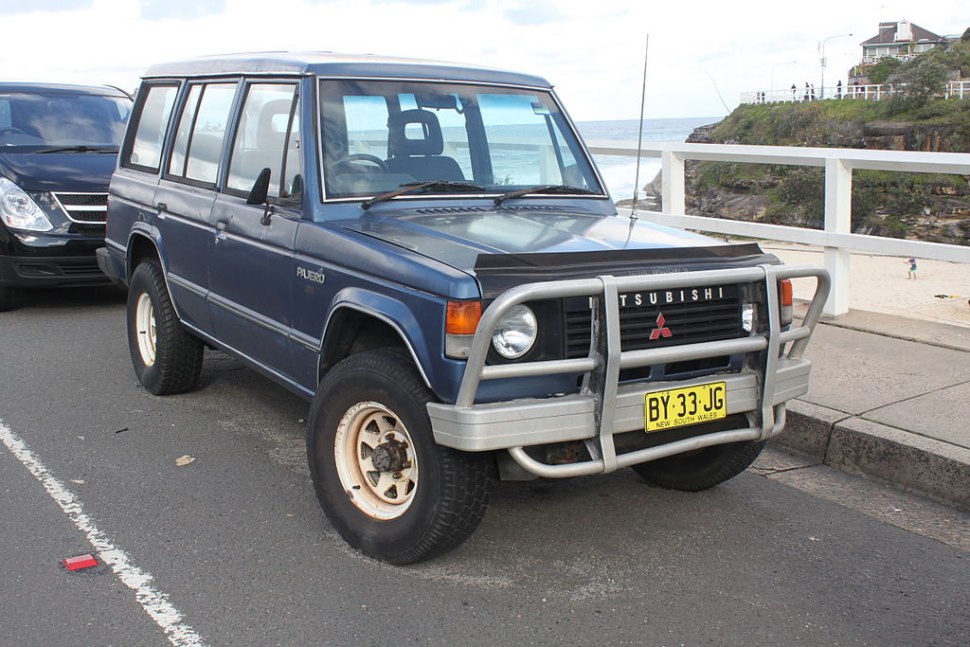
The Mitsubishi Pajero II Metal Top (V2_W, V4_W) 3.5 i V6 24V, produced between 1994 and 2000, represents a significant evolution in Mitsubishi’s renowned off-road vehicle lineage. This iteration of the Pajero, primarily marketed outside of North America, solidified the model’s reputation for robust construction, capable four-wheel drive systems, and a blend of on-road comfort and off-road prowess. The “Metal Top” designation refers to the removable hardtop, offering open-air driving experiences. The Pajero II was a key player in the growing SUV market in Europe, Australia, and Asia, offering a compelling alternative to established European and Japanese competitors.
Mitsubishi Pajero II Metal Top: An Overview
The Pajero II, launched in 1994, built upon the success of the original Pajero, offering increased refinement, improved performance, and enhanced safety features. The V2_W and V4_W chassis codes denote variations within the second-generation Pajero range, often relating to engine options and specific market configurations. This particular model, equipped with the 3.5-liter V6 engine and automatic transmission, was positioned as a premium offering within the Pajero lineup, appealing to buyers seeking a capable and comfortable SUV for both daily driving and adventurous excursions.
Engine & Performance
At the heart of the Pajero II Metal Top 3.5 i V6 lies a naturally aspirated 3.5-liter V6 engine, producing 208 horsepower at 5000 rpm and 300 Nm (221.27 lb-ft) of torque at 3000 rpm. This engine, with its 60.5 horsepower per liter, provided a substantial power output for its time, enabling a 0-100 km/h (0-62 mph) acceleration time of 9.5 seconds and a 0-60 mph time of approximately 9 seconds. The engine’s longitudinal front-engine layout contributes to balanced weight distribution, enhancing handling characteristics. The automatic transmission, featuring four gears, delivers smooth and convenient gear changes. The Pajero II’s weight-to-power ratio of 8.9 kg/Hp and weight-to-torque ratio of 6.2 kg/Nm demonstrate a respectable balance between power and mass. Fuel consumption is rated at 14.2 liters per 100 kilometers (16.6 US mpg, 19.9 UK mpg, 7 km/l), typical for a vehicle of this size and capability from the mid-1990s.
Design & Features
The Pajero II Metal Top is a classic three-door SUV, seating five passengers. Its body-on-frame construction provides exceptional durability and off-road capability. The removable metal hardtop is a defining feature, allowing for open-air driving during favorable weather conditions. The vehicle’s design emphasizes practicality and ruggedness, with a relatively boxy silhouette and generous ground clearance. Inside, the Pajero II offers a functional and comfortable interior, although it lacks the luxury appointments found in some contemporary SUVs. Key features include hydraulic power steering and an Anti-lock Braking System (ABS), enhancing both driver control and safety. The trunk space is versatile, ranging from a minimum of 330 liters (11.65 cu. ft.) to a maximum of 1100 liters (38.85 cu. ft.) with the rear seats folded down. The Pajero II’s robust suspension system, featuring double wishbones at the front and coil springs at the rear, ensures a comfortable ride both on and off-road.
Technical Specifications
| Brand | Mitsubishi |
| Model | Pajero |
| Generation | Pajero II Metal Top (V2_W, V4_W) |
| Type (Engine) | 3.5 i V6 24V (208 Hp) Automatic |
| Start of production | 1994 |
| End of production | 2000 |
| Powertrain Architecture | Internal Combustion engine |
| Body type | SUV |
| Seats | 5 |
| Doors | 3 |
| Fuel consumption (combined) | 14.2 l/100 km |
| Fuel consumption (US mpg) | 16.6 US mpg |
| Fuel consumption (UK mpg) | 19.9 UK mpg |
| Fuel consumption (km/l) | 7 km/l |
| Fuel Type | Petrol (Gasoline) |
| Acceleration 0 – 100 km/h | 9.5 sec |
| Acceleration 0 – 62 mph | 9.5 sec |
| Acceleration 0 – 60 mph | 9 sec |
| Weight-to-power ratio | 8.9 kg/Hp |
| Weight-to-torque ratio | 6.2 kg/Nm |
| Power | 208 Hp @ 5000 rpm |
| Power per litre | 59.5 Hp/l |
| Torque | 300 Nm @ 3000 rpm |
| Torque (lb.-ft.) | 221.27 lb.-ft. @ 3000 rpm |
| Engine layout | Front, Longitudinal |
| Engine displacement | 3497 cm3 |
| Engine displacement (cu. in.) | 213.4 cu. in. |
| Number of cylinders | 6 |
| Engine configuration | V-engine |
| Cylinder Bore | 93 mm |
| Cylinder Bore (in.) | 3.66 in. |
| Piston Stroke | 85.8 mm |
| Piston Stroke (in.) | 3.38 in. |
| Compression ratio | 9.5:1 |
| Number of valves per cylinder | 4 |
| Fuel injection system | Multi-port manifold injection |
| Engine aspiration | Naturally aspirated engine |
| Valvetrain | DOHC |
| Kerb Weight | 1850 kg |
| Kerb Weight (lbs.) | 4078.55 lbs. |
| Max. weight | 2350 kg |
| Max. weight (lbs.) | 5180.86 lbs. |
| Max load | 500 kg |
| Max load (lbs.) | 1102.31 lbs. |
| Trunk (boot) space – minimum | 330 l |
| Trunk (boot) space – minimum (cu. ft.) | 11.65 cu. ft. |
| Trunk (boot) space – maximum | 1100 l |
| Trunk (boot) space – maximum (cu. ft.) | 38.85 cu. ft. |
| Fuel tank capacity | 75 l |
| Fuel tank capacity (US gal) | 19.81 US gal |
| Fuel tank capacity (UK gal) | 16.5 UK gal |
| Length | 4145 mm |
| Length (in.) | 163.19 in. |
| Width | 1785 mm |
| Width (in.) | 70.28 in. |
| Height | 1845 mm |
| Height (in.) | 72.64 in. |
| Wheelbase | 2420 mm |
| Wheelbase (in.) | 95.28 in. |
| Front track | 1465 mm |
| Front track (in.) | 57.68 in. |
| Rear (Back) track | 1480 mm |
| Rear (Back) track (in.) | 58.27 in. |
| Drive wheel | All wheel drive (4×4) |
| Number of gears | 4 |
| Type of gearbox | automatic transmission |
| Front suspension | Double wishbone |
| Rear suspension | Coil spring |
| Front brakes | Ventilated discs |
| Rear brakes | Disc |
| Assisting systems | ABS (Anti-lock braking system) |
| Power steering | Hydraulic Steering |
| Tires size | 265/70 R15 |
| Wheel rims size | 15 |