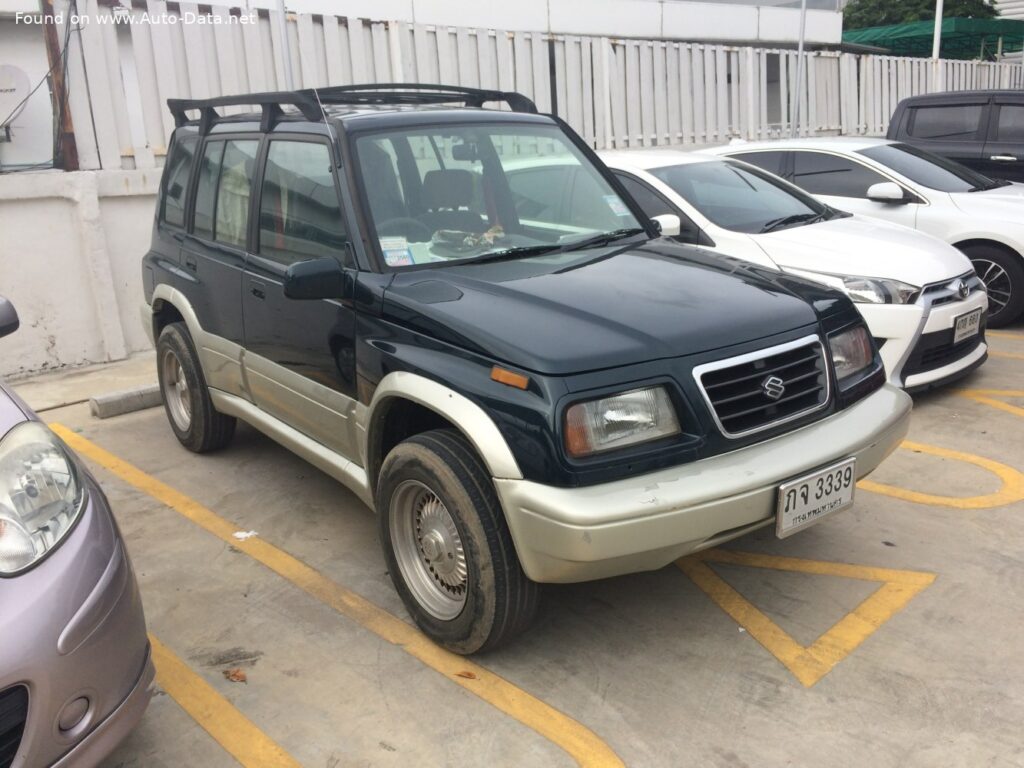
The Suzuki Vitara Cabrio (ET, TA) represents a unique and somewhat niche offering from the Japanese automaker, produced between 1988 and 1995. This model, based on the second-generation Vitara, distinguished itself as a compact, affordable, and surprisingly capable open-top SUV. While the Vitara nameplate enjoyed considerable success in markets like Europe and Japan, the Cabriolet version was less common, primarily aimed at recreational drivers seeking a blend of off-road ability and open-air motoring. It occupied a segment largely of its own, bridging the gap between small, sporty convertibles and more rugged, utilitarian 4x4s. The 1.6-liter (TA) variant, producing 80 horsepower, was a mainstay of the range, offering a balance of performance and fuel economy.
Suzuki Vitara Cabrio: A Unique Offering
The Vitara Cabrio was a product of its time, capitalizing on the growing popularity of both SUVs and convertibles in the late 1980s and early 1990s. Unlike many contemporary convertibles focused solely on on-road performance, the Vitara retained the robust four-wheel-drive system of its hardtop siblings, making it a genuinely versatile vehicle. Its removable roof, available in either a soft-top or a more elaborate hard-top configuration, provided a degree of flexibility not often found in this class. The vehicle was primarily sold in Europe, Australia, and Japan, where the demand for compact, capable 4x4s was strong. It wasn’t officially offered in the United States.
Engine & Performance
The heart of the Vitara Cabrio 1.6 (TA) is the G16A inline-four cylinder engine, displacing 1589 cubic centimeters (96.97 cubic inches). This naturally aspirated engine produces 80 horsepower at 5400 rpm and 127 Nm (93.67 lb.-ft.) of torque at 3000 rpm. While not a powerhouse, the engine provided adequate performance for its intended purpose, offering a power-to-weight ratio of 12.6 kg/Hp. Acceleration from 0 to 100 km/h (0-62 mph) takes approximately 15 seconds, and 0 to 60 mph is achieved in around 14.3 seconds. The top speed is rated at 144 km/h (89.48 mph). Fuel consumption is rated at 9.6 liters per 100 kilometers (24.5 US mpg), which was reasonable for a four-wheel-drive vehicle of this era. The engine utilizes a single-point fuel injection system and an overhead camshaft (OHC) valvetrain. The longitudinal engine layout contributes to the vehicle’s balanced handling characteristics.
Design & Features
The Vitara Cabrio is a three-door, five-seat vehicle, categorized as both a Cabriolet and an SUV. Its design is distinctly boxy, reflecting the styling trends of the late 1980s. The removable roof is the defining feature, transforming the vehicle from a closed SUV to an open-air experience. The soft-top version was the more common and affordable option, while the hard-top provided greater security and weather protection. The vehicle’s relatively short wheelbase (2200 mm / 86.61 in) and compact dimensions (3620 mm / 142.52 in length, 1630 mm / 64.17 in width) contribute to its maneuverability, particularly in urban environments and off-road trails. Safety features were relatively basic by modern standards, typical for vehicles of this period. The braking system consists of disc brakes on the front wheels and drum brakes on the rear. Power steering, utilizing a hydraulic system, was standard, enhancing ease of driving. The vehicle rides on 15-inch wheels with 195 R15 tires.
Technical Specifications
| Brand | Suzuki |
| Model | Vitara |
| Generation | Vitara Cabrio (ET,TA) |
| Type (Engine) | 1.6 (TA) (80 Hp) |
| Start of production | 1988 |
| End of production | 1995 |
| Powertrain Architecture | Internal Combustion engine |
| Body type | Cabriolet, SUV |
| Seats | 5 |
| Doors | 3 |
| Fuel consumption (combined) | 9.6 l/100 km |
| Fuel consumption (US mpg) | 24.5 US mpg |
| Fuel consumption (UK mpg) | 29.4 UK mpg |
| Fuel consumption (km/l) | 10.4 km/l |
| Fuel Type | Petrol (Gasoline) |
| Acceleration 0 – 100 km/h | 15 sec |
| Acceleration 0 – 62 mph | 15 sec |
| Acceleration 0 – 60 mph | 14.3 sec |
| Maximum speed | 144 km/h |
| Maximum speed (mph) | 89.48 mph |
| Weight-to-power ratio | 12.6 kg/Hp |
| Weight-to-torque ratio | 8 kg/Nm |
| Power | 80 Hp @ 5400 rpm |
| Power per litre | 50.3 Hp/l |
| Torque | 127 Nm @ 3000 rpm |
| Torque (lb.-ft.) | 93.67 lb.-ft. @ 3000 rpm |
| Engine layout | Front, Longitudinal |
| Engine Model/Code | G16A |
| Engine displacement | 1589 cm3 |
| Engine displacement (cu. in.) | 96.97 cu. in. |
| Number of cylinders | 4 |
| Engine configuration | Inline |
| Cylinder Bore | 75 mm |
| Cylinder Bore (in.) | 2.95 in. |
| Piston Stroke | 90 mm |
| Piston Stroke (in.) | 3.54 in. |
| Compression ratio | 8.9:1 |
| Number of valves per cylinder | 2 |
| Fuel injection system | Single-point injection |
| Engine aspiration | Naturally aspirated engine |
| Valvetrain | OHC |
| Engine oil capacity | 4.2 l |
| Engine oil capacity (US qt) | 4.44 US qt |
| Engine oil capacity (UK qt) | 3.7 UK qt |
| Coolant | 5.3 l |
| Coolant (US qt) | 5.6 US qt |
| Coolant (UK qt) | 4.66 UK qt |
| Kerb Weight | 1010 kg |
| Kerb Weight (lbs.) | 2226.67 lbs. |
| Max. weight | 1450 kg |
| Max. weight (lbs.) | 3196.7 lbs. |
| Max load | 440 kg |
| Max load (lbs.) | 970.03 lbs. |
| Fuel tank capacity | 42 l |
| Fuel tank capacity (US gal) | 11.1 US gal |
| Fuel tank capacity (UK gal) | 9.24 UK gal |
| Length | 3620 mm |
| Length (in.) | 142.52 in. |
| Width | 1630 mm |
| Width (in.) | 64.17 in. |
| Height | 1665 mm |
| Height (in.) | 65.55 in. |
| Wheelbase | 2200 mm |
| Wheelbase (in.) | 86.61 in. |
| Front track | 1395 mm |
| Front track (in.) | 54.92 in. |
| Rear track | 1400 mm |
| Rear track (in.) | 55.12 in. |
| Drive wheel | All wheel drive (4×4) |
| Number of gears | 5 |
| Gearbox type | Manual transmission |
| Front suspension | Wishbone |
| Rear suspension | Coil spring |
| Front brakes | Disc |
| Rear brakes | Drum |
| Steering type | Steering rack and pinion |
| Power steering | Hydraulic Steering |
| Tires size | 195 R15 |
| Wheel rims size | 15 |