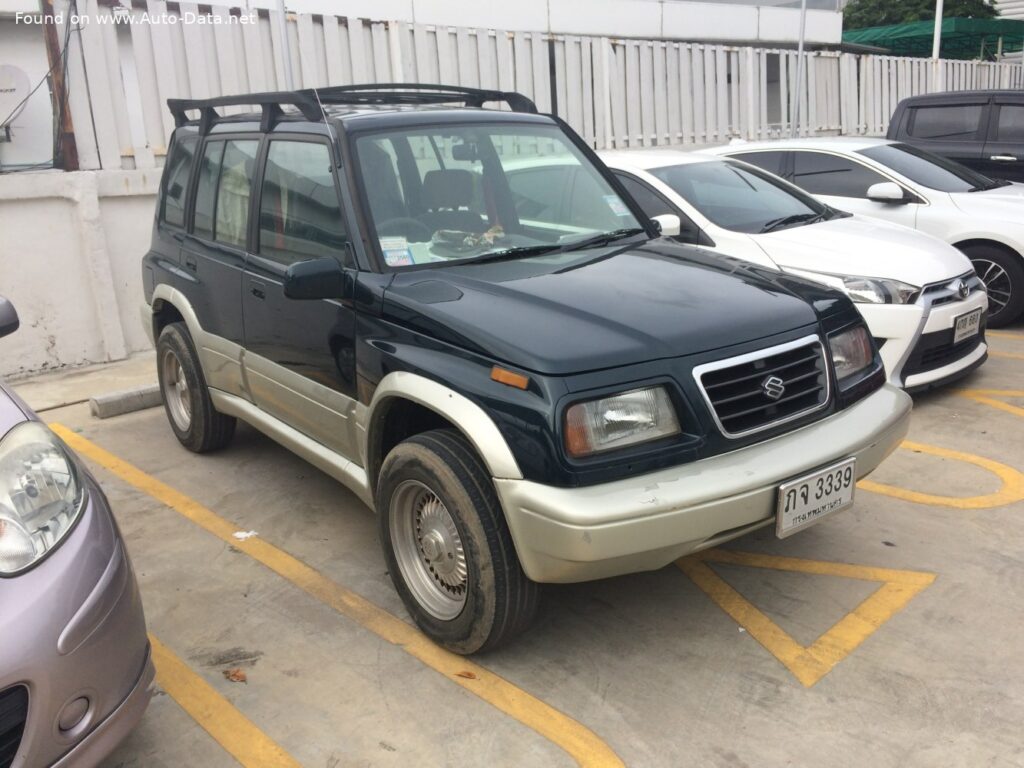
The Suzuki Vitara (ET, TA) is a compact SUV produced by the Japanese automaker Suzuki from 1990 to 1995. Representing the second generation of the Vitara line, it built upon the success of its predecessor, offering a blend of off-road capability and practicality in a relatively small package. While not initially a major player in the North American market, the Vitara gained a following for its affordability and robust four-wheel-drive system. In Europe and other international markets, it became a popular choice for those seeking a versatile and dependable vehicle for both urban and rural environments. The ET and TA designations refer to different body styles and minor variations within the second-generation range.
Suzuki Vitara (ET, TA): A Detailed Overview
The Vitara (ET, TA) was positioned as a competitor to other small SUVs and all-terrain vehicles of the era, such as the Toyota RAV4 and Honda CR-V, though it often offered a more rugged and utilitarian approach. It distinguished itself with its body-on-frame construction, a feature that contributed to its durability and off-road prowess. The model range included both short-wheelbase (ET) and long-wheelbase (TA) versions, with the TA offering increased interior space and cargo capacity. The 1.6 i 16V variant, equipped with a 1.6-liter inline-four engine and an automatic transmission, was a common configuration, balancing performance with ease of driving.
Engine & Performance
The heart of the Suzuki Vitara (ET, TA) 1.6 i 16V is a 1.6-liter (1589 cm3 or 96.97 cu. in.) inline-four cylinder gasoline engine, designated the G16B. This naturally aspirated engine produces 97 horsepower (Hp) at 5600 rpm and 132 Newton-meters (97.36 lb.-ft.) of torque at 4000 rpm. While not a powerhouse, the engine provides adequate performance for everyday driving and moderate off-road excursions. The engine features a multi-port fuel injection system and an overhead camshaft (OHC) valvetrain with four valves per cylinder. The engine’s power-to-liter ratio is 61 Hp/l. Acceleration from 0 to 100 km/h (0-62 mph) takes approximately 14 seconds, while 0 to 60 mph is achieved in around 13.3 seconds. The vehicle has a maximum speed of 152 km/h (94.45 mph). Fuel economy figures are rated at 8.3 l/100 km (28.3 US mpg or 34 UK mpg) combined, with 10.2 l/100 km (23.1 US mpg or 27.7 UK mpg) in urban settings and 7.2 l/100 km (32.7 US mpg or 39.2 UK mpg) on the extra-urban cycle.
Design & Features
The Suzuki Vitara (ET, TA) is a five-door SUV with a body-on-frame construction. This design, common in off-road vehicles, provides excellent durability and torsional rigidity. The vehicle offers seating for five passengers and a minimum trunk (boot) space of 580 liters (20.48 cu. ft.). Its exterior styling is characterized by a boxy, utilitarian shape, reflecting the design trends of the early 1990s. The vehicle’s dimensions are: length 4030 mm (158.66 in), width 1635 mm (64.37 in), and height 1700 mm (66.93 in). The wheelbase measures 2480 mm (97.64 in).
Key features of the Vitara (ET, TA) include a robust four-wheel-drive system, offering selectable 2H, 4H, and 4L modes for varying terrain conditions. The suspension system consists of an independent McPherson strut setup at the front and a dependent spring suspension at the rear. Braking is provided by ventilated discs at the front and drum brakes at the rear, with ABS (Anti-lock Braking System) as a standard safety feature. The steering system is a hydraulic power-assisted worm-reduction unit. The vehicle’s kerb weight is 1165 kg (2568.39 lbs), with a maximum weight of 1650 kg (3637.63 lbs) and a maximum load capacity of 485 kg (1069.24 lbs). The fuel tank capacity is 55 liters (14.53 US gal or 12.1 UK gal).
Technical Specifications
| Brand | Suzuki |
| Model | Vitara |
| Generation | Vitara (ET, TA) |
| Type | 1.6 i 16V (5 dr) (97 Hp) Automatic |
| Start of production | 1990 year |
| End of production | 1995 year |
| Powertrain Architecture | Internal Combustion engine |
| Body type | SUV |
| Seats | 5 |
| Doors | 5 |
| Fuel consumption (urban) | 10.2 l/100 km (23.1 US mpg, 27.7 UK mpg) |
| Fuel consumption (extra urban) | 7.2 l/100 km (32.7 US mpg, 39.2 UK mpg) |
| Fuel consumption (combined) | 8.3 l/100 km (28.3 US mpg, 34 UK mpg) |
| Fuel Type | Petrol (Gasoline) |
| Acceleration 0 – 100 km/h | 14 sec |
| Acceleration 0 – 62 mph | 14 sec |
| Acceleration 0 – 60 mph | 13.3 sec |
| Maximum speed | 152 km/h (94.45 mph) |
| Emission standard | Euro 2 |
| Weight-to-power ratio | 12 kg/Hp |
| Weight-to-torque ratio | 8.8 kg/Nm |
| Power | 97 Hp @ 5600 rpm |
| Torque | 132 Nm @ 4000 rpm (97.36 lb.-ft. @ 4000 rpm) |
| Engine layout | Front, Longitudinal |
| Engine Model/Code | G16B |
| Engine displacement | 1589 cm3 (96.97 cu. in.) |
| Number of cylinders | 4 |
| Engine configuration | Inline |
| Cylinder Bore | 75 mm (2.95 in.) |
| Piston Stroke | 90 mm (3.54 in.) |
| Compression ratio | 9.5:1 |
| Number of valves per cylinder | 4 |
| Fuel injection system | Multi-port manifold injection |
| Engine aspiration | Naturally aspirated |
| Valvetrain | OHC |
| Engine oil capacity | 4.2 l (4.44 US qt | 3.7 UK qt) |
| Coolant capacity | 5.3 l (5.6 US qt | 4.66 UK qt) |
| Kerb Weight | 1165 kg (2568.39 lbs.) |
| Max. weight | 1650 kg (3637.63 lbs.) |
| Max load | 485 kg (1069.24 lbs.) |
| Trunk (boot) space – minimum | 580 l (20.48 cu. ft.) |
| Fuel tank capacity | 55 l (14.53 US gal | 12.1 UK gal) |
| Length | 4030 mm (158.66 in.) |
| Width | 1635 mm (64.37 in.) |
| Height | 1700 mm (66.93 in.) |
| Wheelbase | 2480 mm (97.64 in.) |
| Front track | 1395 mm (54.92 in.) |
| Rear track | 1400 mm (55.12 in.) |
| Drive wheel | All wheel drive (4×4) |
| Number of gears | 4 |
| Gearbox type | Automatic transmission |
| Front suspension | Independent type McPherson |
| Rear suspension | Dependent spring suspension |
| Front brakes | Ventilated discs |
| Rear brakes | Drum |
| Assisting systems | ABS (Anti-lock braking system) |
| Steering type | Worm-reduction unit |
| Power steering | Hydraulic |
| Tires size | 195/80/15 |