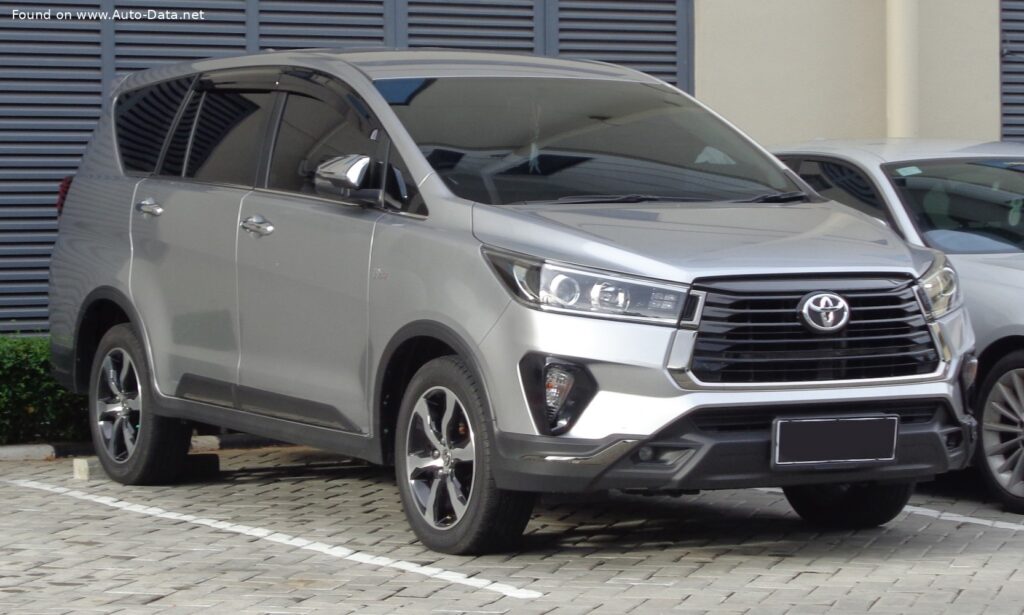
The Toyota Kijang Innova II (facelift 2020) 2.0i is a rear-wheel-drive Multi-Purpose Vehicle (MPV) produced by Toyota between October 2020 and November 2022. While not officially sold in the United States, the Kijang Innova holds a significant position in the Southeast Asian automotive market, particularly in Indonesia, the Philippines, and Thailand. It serves as a popular family vehicle, often utilized for both personal transport and commercial purposes, filling a niche similar to larger minivans in North America but at a more accessible price point. The 2020 facelift brought styling updates and refinements to the second-generation Innova, enhancing its appeal in a competitive segment.
Toyota Kijang Innova II (facelift 2020) 2.0i: An Overview
The Kijang nameplate has a long and storied history with Toyota, dating back to 1976. Originally a rugged, utilitarian vehicle based on a pickup truck chassis, the Kijang evolved over generations into the more comfortable and refined MPV it is today. The Innova, introduced in 2004, represented a significant step up in terms of features, safety, and overall driving experience. The second generation, launched in 2015, further solidified the Innova’s position as a market leader. The 2020 facelift focused on improving the vehicle’s aesthetics, adding new technology, and enhancing fuel efficiency. The 2.0i variant, powered by a 2.0-liter gasoline engine, represents a balance between performance and affordability within the Innova lineup.
Engine & Performance
The Toyota Kijang Innova II (facelift 2020) 2.0i is equipped with the 1TR-FE inline four-cylinder, naturally aspirated gasoline engine. This engine produces 139 horsepower at 5,600 rpm and 183 Nm (134.97 lb.-ft.) of torque at 4,000 rpm. The engine’s power output translates to a power-to-liter ratio of 69.6 hp/l. The engine features a dual VVT-i (Variable Valve Timing-intelligent) system, optimizing valve timing for improved performance and fuel economy across a wider range of engine speeds. Power is delivered to the rear wheels via a five-speed manual transmission. While not designed for outright speed, the 2.0i engine provides adequate power for everyday driving conditions and comfortably handles a full load of passengers and cargo. The inclusion of a Start & Stop System further contributes to improved fuel efficiency, particularly in urban environments.
Design & Features
The Kijang Innova II (facelift 2020) boasts a traditional MPV body style, prioritizing interior space and practicality. It features five doors and offers seating for six or seven passengers, depending on the configuration. The 2020 facelift brought a revised front grille, new headlight designs, and updated bumpers, giving the vehicle a more modern and sophisticated appearance. Inside, the Innova 2.0i offers a functional and comfortable cabin. While the specific features vary depending on the trim level and market, common amenities include air conditioning, power windows, and a basic audio system. Safety features, while not as comprehensive as those found in vehicles sold in North America, typically include ABS (Anti-lock Braking System) as standard equipment. The spacious interior and versatile seating arrangements make the Innova ideal for families and businesses requiring a reliable and practical people-carrier. The longitudinal engine layout contributes to maximizing cabin space.
Technical Specifications
| General Information | |
| Brand | Toyota |
| Model | Innova |
| Generation | Kijang Innova II (facelift 2020) |
| Type (Engine) | 2.0i (139 Hp) |
| Start of production | October, 2020 |
| End of production | November, 2022 |
| Powertrain Architecture | Internal Combustion engine |
| Body type | MPV |
| Seats | 6-7 |
| Doors | 5 |
| Performance Specs | |
| Fuel Type | Petrol (Gasoline) |
| Power | 139 Hp @ 5600 rpm |
| Power per litre | 69.6 Hp/l |
| Torque | 183 Nm @ 4000 rpm / 134.97 lb.-ft. @ 4000 rpm |
| Engine Specs | |
| Engine layout | Front, Longitudinal |
| Engine Model/Code | 1TR-FE |
| Engine displacement | 1998 cm3 / 121.93 cu. in. |
| Number of cylinders | 4 |
| Engine configuration | Inline |
| Cylinder Bore | 86 mm / 3.39 in. |
| Piston Stroke | 86 mm / 3.39 in. |
| Number of valves per cylinder | 4 |
| Fuel injection system | Multi-port manifold injection |
| Engine aspiration | Naturally aspirated engine |
| Valvetrain | DOHC, Dual VVT-i |
| Engine systems | Start & Stop System |
| Dimensions | |
| Length | 4735 mm / 186.42 in. |
| Width | 1830 mm / 72.05 in. |
| Height | 1795 mm / 70.67 in. |
| Wheelbase | 2750 mm / 108.27 in. |
| Front track | 1540 mm / 60.63 in. |
| Rear (Back) track | 1540 mm / 60.63 in. |
| Drivetrain, Brakes & Suspension | |
| Drivetrain Architecture | The Internal combustion engine (ICE) drives the rear wheels of the vehicle. |
| Drive wheel | Rear wheel drive |
| Number of gears and type of gearbox | 5 gears, manual transmission |
| Front suspension | Coil spring, Double wishbone, Transverse stabilizer |
| Rear suspension | Independent multi-link suspension |
| Front brakes | Ventilated discs |
| Rear brakes | Drum |
| Assisting systems | ABS (Anti-lock braking system) |
| Steering type | Steering rack and pinion |
| Power steering | Electric Steering |
| Tires size | 205/65 R16 |
| Wheel rims size | 16 |
In conclusion, the Toyota Kijang Innova II (facelift 2020) 2.0i represents a practical and reliable MPV option for families and businesses in Southeast Asia. While not available in the US market, its enduring popularity speaks to its ability to meet the specific needs of its target audience, offering a blend of space, comfort, and affordability.