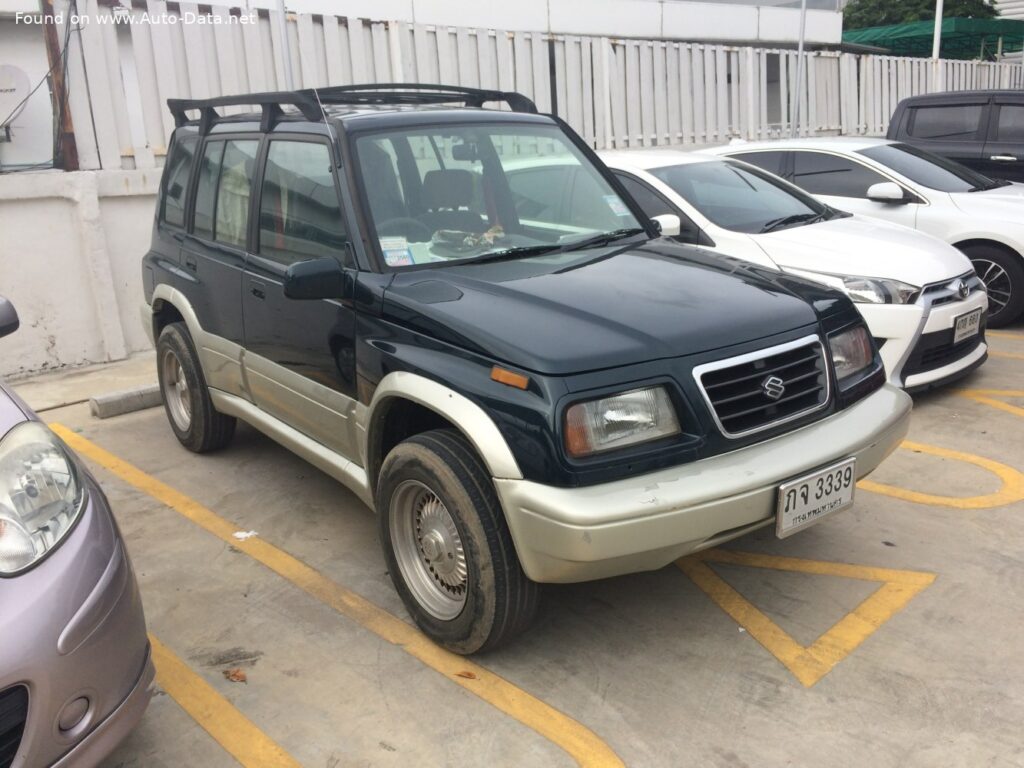
The Suzuki Vitara, specifically the ET and TA generation produced between 1998 and 2005, represents a significant entry in the compact SUV market, particularly in Europe and other international markets. While not widely sold in the United States during this period, the Vitara gained a reputation for its robust build quality, off-road capability, and affordability. This three-door variant, powered by a 1.9 TDI diesel engine producing 75 horsepower, offered a practical and economical option for buyers seeking a versatile vehicle for both urban and rural environments. The Vitara’s success stemmed from its blend of SUV practicality with a relatively compact footprint, making it easy to maneuver and park.
Suzuki Vitara (ET, TA): A Detailed Overview
The ET and TA series Vitara built upon the foundation laid by its predecessors, offering improved refinement and a more modern aesthetic. Positioned as a competitor to vehicles like the Nissan Terrano and Honda CR-V in Europe, the Vitara distinguished itself with its available four-wheel-drive system and durable mechanical components. The 1.9 TDI engine, while not known for blistering performance, provided adequate power and excellent fuel economy, making it a popular choice for long-distance driving and everyday commuting. The three-door configuration prioritized practicality and a slightly more sporty appearance, appealing to a segment of buyers who didn’t require the space of a five-door model.
Engine & Performance
The heart of this Vitara variant is the 1.9-liter XUD9 inline-four cylinder diesel engine. This engine, a common sight in European vehicles of the era, utilizes a precombustion chamber injection system and is turbocharged to deliver 75 horsepower at 4600 rpm and 135 Nm (99.57 lb.-ft.) of torque at 2250 rpm. While the power output may seem modest by modern standards, the engine’s torque characteristics provide reasonable pulling power, especially useful when combined with the vehicle’s four-wheel-drive system. Acceleration from 0 to 100 km/h (0-62 mph) takes approximately 17 seconds, and it reaches a maximum speed of 150 km/h (93.21 mph). The engine’s fuel economy is a strong point, achieving around 9.4 liters per 100 kilometers (25 US mpg) in urban driving and 6.9 liters per 100 kilometers (34.1 US mpg) on the open road. The weight-to-power ratio of 16.4 kg/Hp and weight-to-torque ratio of 9.1 kg/Nm reflect the engine’s focus on usability rather than outright performance.
Design & Features
The Suzuki Vitara (ET, TA) is a classic example of late 1990s/early 2000s SUV design. Its body-on-frame construction contributes to its durability and off-road capability. The three-door configuration offers a more compact size, making it easier to navigate in urban environments. Inside, the Vitara provides seating for five passengers, although rear passenger space is somewhat limited due to the shorter wheelbase. Key features include a hydraulic power steering system, ventilated disc brakes on the front wheels and drum brakes on the rear, and an Anti-lock Braking System (ABS) for enhanced safety. The interior is functional and utilitarian, prioritizing durability and ease of use over luxury. The trunk space ranges from 119 liters (4.2 cu. ft.) with the rear seats up to 596 liters (21.05 cu. ft.) with the rear seats folded down, offering reasonable cargo capacity for its size. The vehicle’s 42-liter (11.1 US gal) fuel tank provides a good driving range.
Technical Specifications
| Brand | Suzuki |
| Model | Vitara |
| Generation | Vitara (ET, TA) |
| Type (Engine) | 1.9 TDI (3 dr) (75 Hp) |
| Start of production | 1998 |
| End of production | 2005 |
| Powertrain Architecture | Internal Combustion engine |
| Body type | SUV |
| Seats | 5 |
| Doors | 3 |
| Fuel consumption (urban) | 9.4 l/100 km (25 US mpg) |
| Fuel consumption (extra urban) | 6.9 l/100 km (34.1 US mpg) |
| Fuel Type | Diesel |
| Acceleration 0 – 100 km/h | 17 sec |
| Acceleration 0 – 62 mph | 17 sec |
| Acceleration 0 – 60 mph | 16.2 sec |
| Maximum speed | 150 km/h (93.21 mph) |
| Weight-to-power ratio | 16.4 kg/Hp |
| Weight-to-torque ratio | 9.1 kg/Nm |
| Power | 75 Hp @ 4600 rpm |
| Torque | 135 Nm @ 2250 rpm (99.57 lb.-ft. @ 2250 rpm) |
| Engine layout | Front, Transverse |
| Engine Model/Code | XUD9 |
| Engine displacement | 1905 cm3 (116.25 cu. in.) |
| Number of cylinders | 4 |
| Engine configuration | Inline |
| Cylinder Bore | 83 mm (3.27 in.) |
| Piston Stroke | 88 mm (3.46 in.) |
| Compression ratio | 21.5:1 |
| Number of valves per cylinder | 2 |
| Fuel injection system | Precombustion chamber injection |
| Engine aspiration | Turbocharger |
| Valvetrain | DOHC |
| Engine oil capacity | 4.5 l (4.76 US qt | 3.96 UK qt) |
| Coolant | 6.6 l (6.97 US qt | 5.81 UK qt) |
| Kerb Weight | 1230 kg (2711.69 lbs.) |
| Max. weight | 1650 kg (3637.63 lbs.) |
| Max load | 420 kg (925.94 lbs.) |
| Trunk (boot) space – minimum | 119 l (4.2 cu. ft.) |
| Trunk (boot) space – maximum | 596 l (21.05 cu. ft.) |
| Fuel tank capacity | 42 l (11.1 US gal | 9.24 UK gal) |
| Length | 3650 mm (143.7 in.) |
| Width | 1630 mm (64.17 in.) |
| Height | 1665 mm (65.55 in.) |
| Wheelbase | 2200 mm (86.61 in.) |
| Front track | 1395 mm (54.92 in.) |
| Rear (Back) track | 1400 mm (55.12 in.) |
| Drive wheel | All wheel drive (4×4) |
| Number of gears | 5 gears, manual transmission |
| Front suspension | Wishbone |
| Rear suspension | Coil spring |
| Front brakes | Ventilated discs |
| Rear brakes | Drum |
| Assisting systems | ABS (Anti-lock braking system) |
| Steering type | Steering rack and pinion |
| Power steering | Hydraulic Steering |
| Tires size | 195/80 R15 |
| Wheel rims size | 15 |