
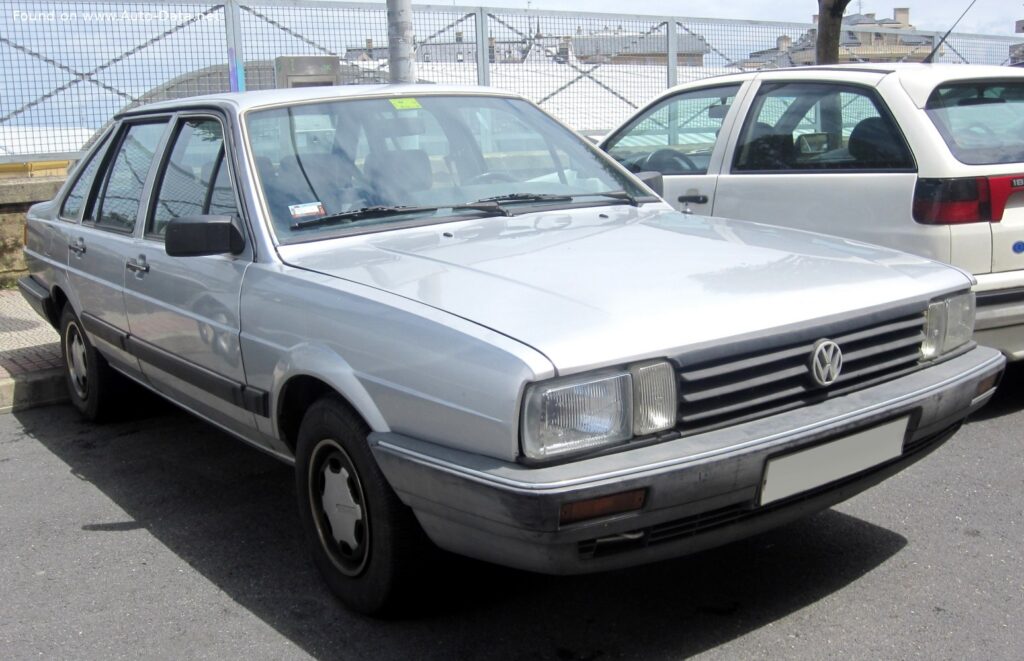
The Volkswagen Santana (32B) 1.6 TD represents a significant chapter in Volkswagen’s history, particularly its expansion into international markets. Produced from 1982 to 1984, this model was not initially intended for North America, but played a crucial role in establishing Volkswagen’s presence in regions like Mexico, Argentina, and Brazil. The Santana was essentially a rebadged and adapted version of the Volkswagen Passat (B2), tailored to meet the specific demands and preferences of these emerging automotive markets. It offered a blend of European engineering with localized production, making it a popular choice for families and businesses alike.
Volkswagen Santana (32B) 1.6 TD: A Global Strategy
The Santana’s development stemmed from Volkswagen’s need to create a globally competitive mid-size sedan. While the Passat was successful in Europe, adapting it for production in countries with different economic conditions and infrastructure required a new approach. The Santana, therefore, featured simplified construction and a greater emphasis on durability and affordability. The 1.6 TD variant, equipped with a turbocharged diesel engine, was particularly popular due to its fuel efficiency and reliability – key considerations for consumers in these markets.
Engine & Performance
The heart of the Santana 1.6 TD is its 1.6-liter inline-four cylinder diesel engine. This engine, producing 70 horsepower at 4500 rpm and 133 Nm (98.1 lb.-ft.) of torque at 2600 rpm, was a workhorse designed for longevity and economy. The use of a turbocharger significantly improved performance compared to naturally aspirated diesel engines of the time, providing a reasonable level of power for everyday driving. While acceleration figures weren’t sporty – 0 to 100 km/h (0-62 mph) took approximately 16 seconds – the engine’s strength lay in its fuel efficiency. Combined fuel economy reached 7.1 l/100 km (33.1 US mpg) in urban settings and 4.8 l/100 km (49 US mpg) on the open road. The engine featured precombustion chamber injection and a single overhead camshaft (SOHC) valvetrain. The engine’s longitudinal front-engine layout and a four-speed manual transmission completed the powertrain configuration.
Design & Features
The Santana (32B) presented a conservative, yet functional design. As a four-door sedan with seating for five, it prioritized practicality and passenger comfort. The body style was typical of European sedans of the early 1980s, characterized by clean lines and a relatively boxy silhouette. The interior was similarly straightforward, focusing on durability and ease of use. Features were modest by modern standards, but included comfortable seating and a reasonably spacious trunk with a capacity of 535 liters (18.89 cu. ft.). Safety features were limited compared to contemporary vehicles, reflecting the standards of the era. The McPherson strut front suspension and trailing arm rear suspension provided a comfortable, if not particularly dynamic, ride. Disc brakes were fitted to the front wheels, while drum brakes were used at the rear.
Technical Specifications
| Brand | Volkswagen |
| Model | Santana |
| Generation | Santana (32B) |
| Type (Engine) | 1.6 TD (70 Hp) |
| Start of production | August, 1982 |
| End of production | December, 1984 |
| Powertrain Architecture | Internal Combustion engine |
| Body type | Sedan |
| Seats | 5 |
| Doors | 4 |
| Fuel consumption (urban) | 7.1 l/100 km (33.1 US mpg) |
| Fuel consumption (extra urban) | 4.8 l/100 km (49 US mpg) |
| Fuel Type | Diesel |
| Acceleration 0 – 100 km/h | 16 sec |
| Acceleration 0 – 62 mph | 16 sec |
| Acceleration 0 – 60 mph | 15.2 sec |
| Maximum speed | 152 km/h (94.45 mph) |
| Weight-to-power ratio | 14.4 kg/Hp |
| Weight-to-torque ratio | 7.6 kg/Nm |
| Power | 70 Hp @ 4500 rpm |
| Torque | 133 Nm @ 2600 rpm (98.1 lb.-ft. @ 2600 rpm) |
| Engine layout | Front, Longitudinal |
| Engine displacement | 1588 cm3 (96.91 cu. in.) |
| Number of cylinders | 4 |
| Engine configuration | Inline |
| Cylinder Bore | 76.5 mm (3.01 in.) |
| Piston Stroke | 86.4 mm (3.4 in.) |
| Compression ratio | 23:1 |
| Number of valves per cylinder | 2 |
| Fuel injection system | Precombustion chamber injection |
| Engine aspiration | Turbocharger |
| Valvetrain | SOHC |
| Engine oil capacity | 3.5 l (3.7 US qt | 3.08 UK qt) |
| Kerb Weight | 1007 kg (2220.05 lbs.) |
| Max. weight | 1460 kg (3218.75 lbs.) |
| Max load | 453 kg (998.69 lbs.) |
| Trunk (boot) space – minimum | 535 l (18.89 cu. ft.) |
| Fuel tank capacity | 60 l (15.85 US gal | 13.2 UK gal) |
| Max. roof load | 75 kg (165.35 lbs.) |
| Permitted trailer load with brakes (12%) | 1000 kg (2204.62 lbs.) |
| Permitted trailer load without brakes | 500 kg (1102.31 lbs.) |
| Length | 4545 mm (178.94 in.) |
| Width | 1695 mm (66.73 in.) |
| Height | 1400 mm (55.12 in.) |
| Wheelbase | 2550 mm (100.39 in.) |
| Front track | 1400 mm (55.12 in.) |
| Rear (Back) track | 1408 mm (55.43 in.) |
| Minimum turning circle | 10.7 m (35.1 ft.) |
| Drivetrain Architecture | Front wheel drive |
| Number of gears and type of gearbox | 4 gears, manual transmission |
| Front suspension | Independent, type McPherson with coil spring and anti-roll bar |
| Rear suspension | Trailing arm |
| Front brakes | Disc |
| Rear brakes | Drum |
| Steering type | Steering rack and pinion |
| Wheel rims size | 5.5J x 13 |
The Volkswagen Santana (32B) 1.6 TD, while not a performance icon, represents a pragmatic and successful approach to automotive manufacturing and global market penetration. Its durability, fuel efficiency, and affordability made it a popular choice in numerous countries, solidifying Volkswagen’s reputation as a reliable and accessible automotive brand.
