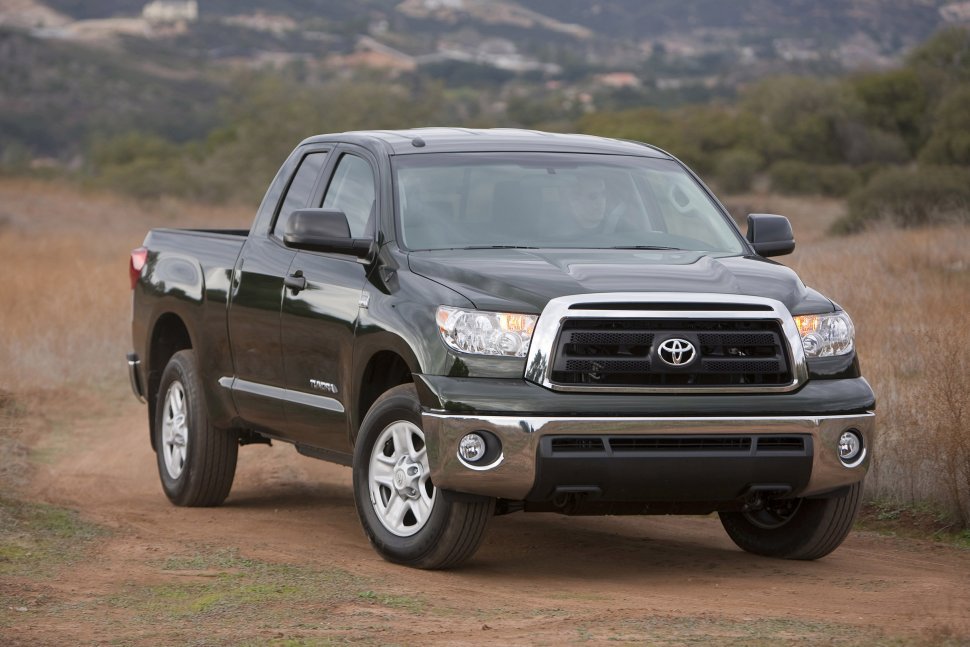
The Toyota Tundra II Double Cab (facelift 2010) represents a significant iteration of Toyota’s full-size pickup truck offering, specifically tailored for the North American market. Introduced as a response to the demands for a robust and reliable full-size truck, the Tundra aimed to challenge established domestic manufacturers like Ford, Chevrolet, and Dodge. The 2010 facelift brought updated styling, enhanced features, and continued refinement of the 5.7-liter V8 engine. Positioned within the highly competitive full-size pickup segment, the Tundra Double Cab offered a compelling combination of power, capability, and Toyota’s reputation for durability.
Toyota Tundra II Double Cab (2010-2013)
The second-generation Tundra, launched in 2007, was a complete redesign, moving away from the smaller, less capable trucks Toyota had previously offered in the US. The 2010 facelift focused on cosmetic updates and minor feature enhancements, solidifying the Tundra’s position as a serious contender in the full-size truck market. The Double Cab configuration provided increased passenger space, making it suitable for families and crews, while maintaining the truck’s inherent utility for work and recreation. This generation of Tundra was produced from 2010 through 2013, representing a key period in Toyota’s attempt to gain significant market share in the lucrative full-size truck segment.
Engine & Performance
The heart of the 2010-2013 Toyota Tundra Double Cab is the 3UR-FE 5.7-liter V8 engine. This naturally aspirated powerplant produces 381 horsepower at 5,600 rpm and 401.23 lb-ft of torque at 3,600 rpm. The engine features a robust cast-iron block, aluminum cylinder heads, and dual independent variable valve timing with intelligence (VVT-i) to optimize performance and efficiency. Power is delivered through a six-speed automatic transmission, channeling power to the rear wheels as standard. The weight-to-power ratio of 6.1 kg/Hp (163 Hp/tonne) and a weight-to-torque ratio of 4.3 kg/Nm (232.7 Nm/tonne) contribute to responsive acceleration and strong towing capabilities. Fuel economy is rated at approximately 14 US mpg in urban driving and 18.1 US mpg on the highway, reflecting the demands of a large displacement V8 engine in a full-size truck. The engine’s displacement is 5663 cm3 (345.58 cu. in.), with a bore of 94 mm (3.7 in.) and a stroke of 102 mm (4.02 in.).
Design & Features
The Toyota Tundra II Double Cab is a four-door pickup truck designed with a focus on both functionality and comfort. The body-on-frame construction provides a solid foundation for heavy-duty use, while the Double Cab configuration offers ample space for up to six passengers. The 2010 facelift included subtle styling updates to the front fascia, grille, and headlights, giving the truck a more modern appearance. Key features include ventilated front disc brakes, and an anti-lock braking system (ABS) for enhanced safety. The suspension system utilizes a double wishbone setup at the front and leaf springs at the rear, balancing ride comfort with load-carrying capacity. The truck boasts a substantial fuel tank capacity of 100 liters (26.42 US gal), and a maximum towing capacity of 3900 kg (8598.03 lbs) with brakes. Interior features varied depending on trim level, but generally included comfortable seating, a user-friendly infotainment system, and durable materials. The Tundra’s dimensions are considerable, with a length of 5809 mm (228.7 in.), a width of 2029 mm (79.88 in.), and a height of 1925 mm (75.79 in.). Ground clearance is a generous 259 mm (10.2 in.), enhancing off-road capability.
Technical Specifications
| Brand | Toyota |
| Model | Tundra |
| Generation | Tundra II Double Cab (facelift 2010) |
| Type (Engine) | 5.7 V8 32V (381 Hp) Automatic |
| Start of production | 2010 |
| End of production | 2013 |
| Powertrain Architecture | Internal Combustion engine |
| Body type | Pick-up |
| Seats | 5-6 |
| Doors | 4 |
| Fuel consumption (urban) | 16.8 l/100 km (14 US mpg, 16.8 UK mpg) |
| Fuel consumption (extra urban) | 13 l/100 km (18.1 US mpg, 21.7 UK mpg) |
| Fuel Type | Petrol (Gasoline) |
| Weight-to-power ratio | 6.1 kg/Hp |
| Weight-to-torque ratio | 4.3 kg/Nm |
| Power | 381 Hp @ 5600 rpm |
| Torque | 544 Nm @ 3600 rpm (401.23 lb.-ft. @ 3600 rpm) |
| Engine layout | Front, Longitudinal |
| Engine Model/Code | 3UR-FE |
| Engine displacement | 5663 cm3 (345.58 cu. in.) |
| Number of cylinders | 8 |
| Engine configuration | V-engine |
| Cylinder Bore | 94 mm (3.7 in.) |
| Piston Stroke | 102 mm (4.02 in.) |
| Compression ratio | 10.2:1 |
| Number of valves per cylinder | 4 |
| Fuel injection system | Multi-port manifold injection |
| Engine aspiration | Naturally aspirated engine |
| Valvetrain | DOHC, VVT-i |
| Kerb Weight | 2338 kg (5154.41 lbs.) |
| Max. weight | 3130 kg (6900.47 lbs.) |
| Max load | 792 kg (1746.06 lbs.) |
| Fuel tank capacity | 100 l (26.42 US gal | 22 UK gal) |
| Permitted trailer load with brakes (12%) | 3900 kg (8598.03 lbs.) |
| Length | 5809 mm (228.7 in.) |
| Width | 2029 mm (79.88 in.) |
| Height | 1925 mm (75.79 in.) |
| Wheelbase | 3700 mm (145.67 in.) |
| Front track | 1725 mm (67.91 in.) |
| Rear track | 1725 mm (67.91 in.) |
| Ride height (ground clearance) | 259 mm (10.2 in.) |
| Minimum turning circle | 13.4 m (43.96 ft.) |
| Approach angle | 27° |
| Departure angle | 26° |
| Drivetrain Architecture | Rear wheel drive |
| Number of gears | 6 |
| Gearbox type | Automatic transmission |
| Front suspension | Double wishbone |
| Rear suspension | Leaf spring |
| Front brakes | Ventilated discs |
| Rear brakes | Ventilated discs |
| Assisting systems | ABS (Anti-lock braking system) |
| Steering type | Steering rack and pinion |
| Power steering | Hydraulic Steering |
| Tires size | 255/70 R18 |
| Wheel rims size | 8.0J x 18 |