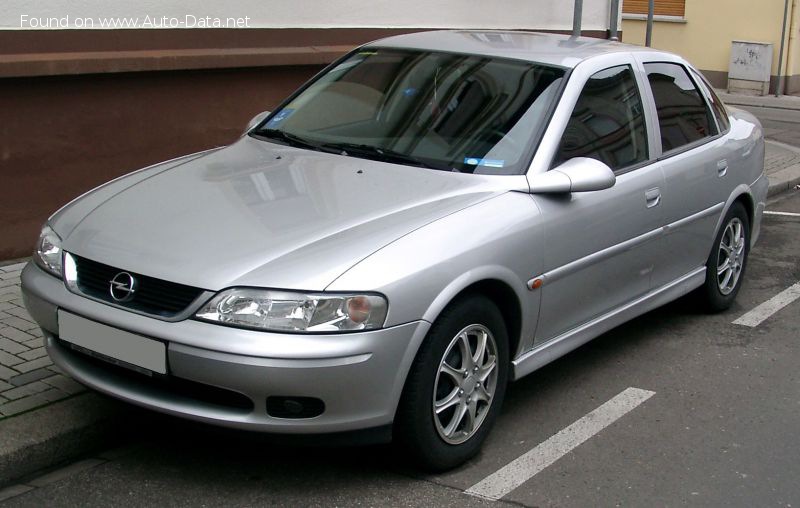
The Opel Vectra B (facelift 1999) 1.6i 16V represents a mid-cycle refresh of the second-generation Vectra, a large family car engineered by the German automaker Opel. While not officially sold in the United States, the Vectra was a significant model in Europe, competing with vehicles like the Ford Mondeo, Volkswagen Passat, and Peugeot 406. The facelifted version, produced from January 1999 to January 2000, incorporated styling and mechanical updates aimed at enhancing its appeal and competitiveness within the segment. This particular variant, powered by a 1.6-liter 16-valve engine producing 100 horsepower, was positioned as an entry-level offering within the Vectra B range, prioritizing fuel efficiency and affordability.
Opel Vectra B (facelift 1999) 1.6i 16V: An Overview
The Vectra B, launched in 1995, was a crucial model for Opel, intended to replace the aging Cavalier and move the brand further upmarket. The 1999 facelift brought revised front and rear styling, interior improvements, and refinements to the engine lineup. The 1.6i 16V model served as a practical and economical choice for buyers seeking a spacious and comfortable sedan. It offered a balance between performance and running costs, making it a popular option for families and commuters. The Vectra B was available in several body styles, including a sedan, hatchback (known as the Vectra Caravan in some markets), and coupe, but the facelifted 1.6i 16V was primarily offered as a four-door sedan.
Engine & Performance
The heart of the Vectra B 1.6i 16V is the X16XEL inline-four cylinder engine, displacing 1598 cm³ (97.52 cubic inches). This naturally aspirated engine utilizes multi-port fuel injection and a double overhead camshaft (DOHC) valvetrain with four valves per cylinder. It produces a maximum power output of 100 horsepower at 6200 rpm and 150 Nm (110.63 lb.-ft.) of torque at 3600 rpm. While not a performance-oriented engine, it provides adequate power for everyday driving. The engine’s power-to-liter ratio is 62.6 hp/l.
Power is delivered to the front wheels via a five-speed manual transmission. Acceleration from 0 to 100 km/h (0-62 mph) takes 12.5 seconds, while 0 to 60 mph is achieved in approximately 11.9 seconds. The vehicle has a maximum speed of 188 km/h (116.82 mph). The weight-to-power ratio of 12.8 kg/Hp and weight-to-torque ratio of 8.5 kg/Nm indicate a relatively modest performance profile. Fuel economy is a strong point, with combined fuel consumption rated at 7.2 l/100 km (32.7 US mpg or 39.2 UK mpg), and CO2 emissions of 178 g/km.
Design & Features
The Opel Vectra B facelift retained the overall silhouette of the original B-series, but received noticeable cosmetic updates. The front end was characterized by a revised grille, headlights, and bumper, giving it a more modern and streamlined appearance. The rear end also received updated taillights and a redesigned bumper. The 1.6i 16V model was typically equipped with 195/65 R15 tires on 6J x 15 inch steel or alloy wheels.
Inside, the facelifted Vectra B featured improved interior trim and materials. The dashboard layout remained largely unchanged, but the instrument cluster received minor revisions. Standard features included power steering, ABS (Anti-lock Braking System), and a spacious interior capable of comfortably accommodating five passengers. Trunk space ranged from 480 to 500 liters (16.95 to 17.66 cubic feet), providing ample room for luggage and cargo. The vehicle’s dimensions are 4495 mm (176.97 in) in length, 1707 mm (67.2 in) in width, and 1425 mm (56.1 in) in height, with a wheelbase of 2637 mm (103.82 in).
Technical Specifications
| Brand | Opel |
| Model | Vectra |
| Generation | Vectra B (facelift 1999) |
| Type (Engine) | 1.6i 16V (100 Hp) |
| Start of production | January, 1999 |
| End of production | January, 2000 |
| Powertrain Architecture | Internal Combustion engine |
| Body type | Sedan |
| Seats | 5 |
| Doors | 4 |
| Fuel consumption (urban) | 9.9 l/100 km (23.8 US mpg, 28.5 UK mpg, 10.1 km/l) |
| Fuel consumption (extra urban) | 5.7 l/100 km (41.3 US mpg, 49.6 UK mpg, 17.5 km/l) |
| Fuel consumption (combined) | 7.2 l/100 km (32.7 US mpg, 39.2 UK mpg, 13.9 km/l) |
| CO2 emissions | 178 g/km |
| Fuel Type | Petrol (Gasoline) |
| Acceleration 0 – 100 km/h | 12.5 sec |
| Acceleration 0 – 62 mph | 12.5 sec |
| Acceleration 0 – 60 mph | 11.9 sec |
| Maximum speed | 188 km/h (116.82 mph) |
| Weight-to-power ratio | 12.8 kg/Hp |
| Weight-to-torque ratio | 8.5 kg/Nm |
| Power | 100 Hp @ 6200 rpm |
| Torque | 150 Nm @ 3600 rpm (110.63 lb.-ft. @ 3600 rpm) |
| Engine layout | Front, Transverse |
| Engine Model/Code | X16XEL |
| Engine displacement | 1598 cm3 (97.52 cu. in.) |
| Number of cylinders | 4 |
| Engine configuration | Inline |
| Cylinder Bore | 79 mm (3.11 in.) |
| Piston Stroke | 81.5 mm (3.21 in.) |
| Compression ratio | 10.5:1 |
| Number of valves per cylinder | 4 |
| Fuel injection system | Multi-port manifold injection |
| Engine aspiration | Naturally aspirated engine |
| Valvetrain | DOHC |
| Engine oil capacity | 3.25 l (3.43 US qt | 2.86 UK qt) |
| Coolant | 6.7 l (7.08 US qt | 5.9 UK qt) |
| Kerb Weight | 1275 kg (2810.89 lbs.) |
| Max. weight | 1730 kg (3814 lbs.) |
| Max load | 455 kg (1003.1 lbs.) |
| Trunk (boot) space – minimum | 480 l (16.95 cu. ft.) |
| Trunk (boot) space – maximum | 500 l (17.66 cu. ft.) |
| Fuel tank capacity | 60 l (15.85 US gal | 13.2 UK gal) |
| Length | 4495 mm (176.97 in.) |
| Width | 1707 mm (67.2 in.) |
| Width including mirrors | 1841 mm (72.48 in.) |
| Height | 1425 mm (56.1 in.) |
| Wheelbase | 2637 mm (103.82 in.) |
| Front track | 1484 mm (58.43 in.) |
| Rear (Back) track | 1487 mm (58.54 in.) |
| Ride height (ground clearance) | 160 mm (6.3 in.) |
| Drag coefficient (Cd) | 0.30 |
| Drivetrain Architecture | The Internal combustion engine (ICE) drives the front wheels of the vehicle. |
| Drive wheel | Front wheel drive |
| Number of gears and type of gearbox | 5 gears, manual transmission |
| Front suspension | Coil spring |
| Rear suspension | Coil spring |
| Front brakes | Ventilated discs |
| Rear brakes | Disc |
| Assisting systems | ABS (Anti-lock braking system) |
| Steering type | Steering rack and pinion |
| Power steering | Hydraulic Steering |
| Tires size | 195/65 R15 |
| Wheel rims size | 6J x 15 |