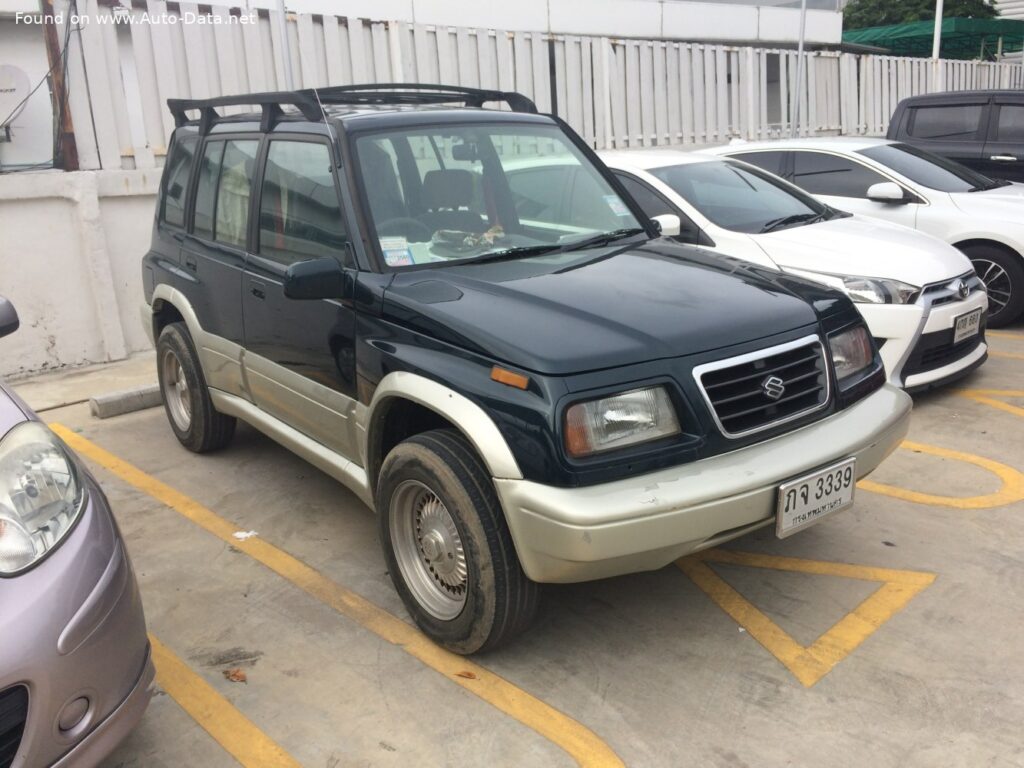
The Suzuki Vitara (ET, TA) 2.0 TDI, produced between 1994 and 1998, represents a significant iteration of Suzuki’s popular compact SUV. While not initially a major player in the North American market, the Vitara held a prominent position in Europe and other international markets as an affordable and capable four-wheel-drive vehicle. This generation bridged the gap between the earlier, more utilitarian Samurai/SJ series and the later, more refined Grand Vitara. The 2.0 TDI model, equipped with a turbocharged diesel engine, offered a balance of fuel efficiency and torque, making it suitable for both on-road driving and light off-road adventures.
Suzuki Vitara (ET, TA): A Detailed Overview
The Vitara (ET, TA) was part of the second generation of the Vitara line, building upon the success of its predecessor. It was offered in both short-wheelbase (ET) and long-wheelbase (TA) configurations, with the latter providing increased passenger and cargo space. The 2.0 TDI variant was particularly popular in European markets where diesel engines were favored for their fuel economy and lower running costs. The vehicle’s design reflected the evolving SUV aesthetic of the mid-1990s, moving away from purely utilitarian designs towards more rounded and car-like forms.
Engine & Performance
The heart of the Vitara 2.0 TDI is a 1.998-liter inline-four cylinder diesel engine, designated the RF engine code. This engine produces 83 horsepower at 4000 rpm and 168 Nm (123.91 lb.-ft.) of torque at 2000 rpm. While the horsepower figure may seem modest by modern standards, the engine’s torque output provides ample pulling power, especially useful for off-road driving or towing light loads. The engine utilizes a precombustion chamber injection system and is equipped with a turbocharger to enhance performance. The engine’s power-to-weight ratio is 59.1 HP per tonne, and the torque-to-weight ratio is 119.6 Nm per tonne. The 5-speed manual transmission delivers power to all four wheels via a selectable four-wheel-drive system. Fuel economy figures are rated at 11.5 l/100 km (20.5 US mpg) in urban conditions, 7.3 l/100 km (32.2 US mpg) on the extra-urban cycle, and 9.3 l/100 km (25.3 US mpg) combined. The vehicle has a maximum speed of 130 km/h (80.78 mph).
Design & Features
The Suzuki Vitara (ET, TA) is a five-door, five-seater SUV characterized by its boxy, yet relatively modern for its time, design. The body-on-frame construction provided robustness and durability, making it suitable for tackling rough terrain. Key features included a relatively spacious interior for its class, a practical cargo area with a minimum capacity of 580 liters (20.48 cu. ft.) expandable to 1300 liters (45.91 cu. ft.) with the rear seats folded down, and a selectable four-wheel-drive system. Safety features, while limited by the standards of the 1990s, typically included basic seatbelts and a robust chassis. The vehicle’s aesthetics were functional rather than flamboyant, with a focus on practicality and durability. The exterior design featured a relatively high ground clearance, contributing to its off-road capability. The vehicle’s dimensions are 4125 mm (162.4 in) in length, 1695 mm (66.73 in) in width, and 1695 mm (66.73 in) in height, with a wheelbase of 2480 mm (97.64 in).
Technical Specifications
| Brand | Suzuki |
| Model | Vitara |
| Generation | Vitara (ET, TA) |
| Type (Engine) | 2.0 TDI (83 Hp) |
| Start of production | 1994 |
| End of production | 1998 |
| Powertrain Architecture | Internal Combustion engine |
| Body type | SUV |
| Seats | 5 |
| Doors | 5 |
| Fuel consumption (urban) | 11.5 l/100 km (20.5 US mpg) |
| Fuel consumption (extra urban) | 7.3 l/100 km (32.2 US mpg) |
| Fuel consumption (combined) | 9.3 l/100 km (25.3 US mpg) |
| Fuel Type | Diesel |
| Maximum speed | 130 km/h (80.78 mph) |
| Weight-to-power ratio | 16.9 kg/Hp |
| Weight-to-torque ratio | 8.4 kg/Nm |
| Power | 83 Hp @ 4000 rpm |
| Torque | 168 Nm @ 2000 rpm (123.91 lb.-ft. @ 2000 rpm) |
| Engine layout | Front, Longitudinal |
| Engine Model/Code | RF |
| Engine displacement | 1998 cm3 (121.93 cu. in.) |
| Number of cylinders | 4 |
| Engine configuration | Inline |
| Cylinder Bore | 86 mm (3.39 in.) |
| Piston Stroke | 86 mm (3.39 in.) |
| Compression ratio | 20.9:1 |
| Number of valves per cylinder | 2 |
| Fuel injection system | Precombustion chamber injection |
| Engine aspiration | Turbocharger |
| Valvetrain | OHC |
| Engine oil capacity | 5.5 l (5.81 US qt | 4.84 UK qt) |
| Coolant capacity | 6.6 l (6.97 US qt | 5.81 UK qt) |
| Kerb Weight | 1405 kg (3097.49 lbs.) |
| Max. weight | 1945 kg (4287.99 lbs.) |
| Max load | 540 kg (1190.5 lbs.) |
| Trunk (boot) space – minimum | 580 l (20.48 cu. ft.) |
| Trunk (boot) space – maximum | 1300 l (45.91 cu. ft.) |
| Fuel tank capacity | 70 l (18.49 US gal | 15.4 UK gal) |
| Length | 4125 mm (162.4 in.) |
| Width | 1695 mm (66.73 in.) |
| Height | 1695 mm (66.73 in.) |
| Wheelbase | 2480 mm (97.64 in.) |
| Front track | 1455 mm (57.28 in.) |
| Rear track | 1450 mm (57.09 in.) |
| Drive wheel | All wheel drive (4×4) |
| Number of gears | 5 |
| Gearbox type | Manual transmission |
| Front suspension | Wishbone |
| Rear suspension | Coil spring |
| Front brakes | Ventilated discs |
| Rear brakes | Drum |
| Steering type | Steering rack and pinion |
| Power steering | Hydraulic Steering |
| Tires size | 215/65 R16 S |
| Wheel rims size | 16 |
The Suzuki Vitara (ET, TA) 2.0 TDI, while not a high-performance vehicle, offered a compelling package of affordability, practicality, and off-road capability. Its robust construction, fuel-efficient diesel engine, and selectable four-wheel-drive system made it a popular choice for those seeking a versatile and reliable SUV in the mid-1990s. It laid the groundwork for the more sophisticated Grand Vitara models that followed, solidifying Suzuki’s reputation as a manufacturer of capable and value-oriented SUVs.