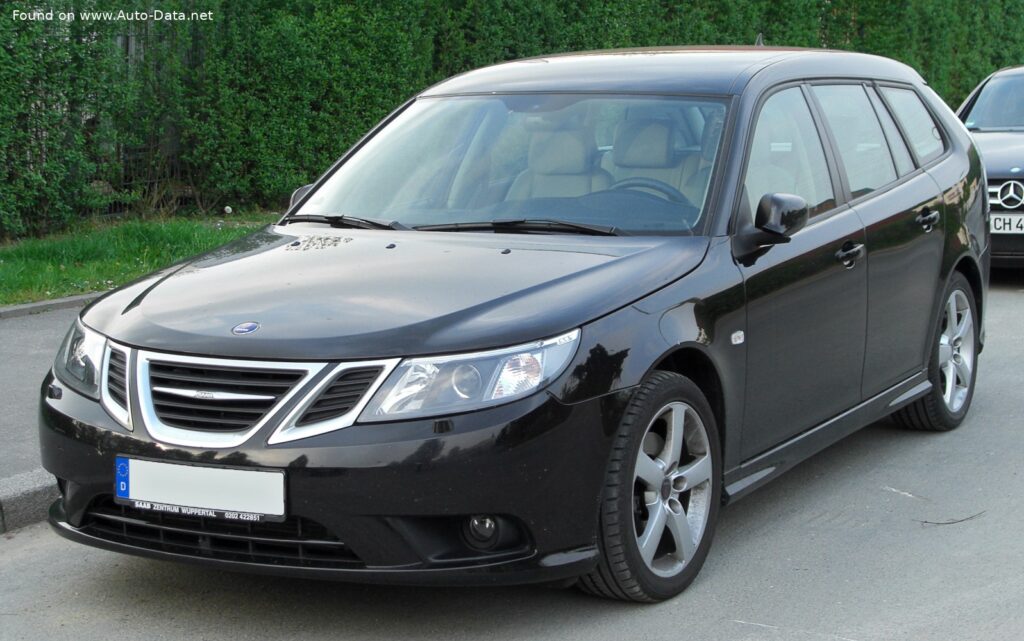
The Saab 9-3 Sport Combi II, specifically the facelifted version introduced in September 2007 and produced through December 2010, represents a significant iteration of Saab’s compact executive car. Positioned as a five-door, five-seat station wagon (estate), the 9-3 Sport Combi II aimed to blend practicality with Saab’s characteristic Scandinavian design and engineering. This version, powered by the 1.9 TTiD engine producing 180 horsepower, was primarily sold in the European market, offering a diesel-powered alternative within the competitive D-segment. The Sport Combi body style was crucial to Saab’s lineup, providing a more versatile option compared to the sedan, and appealing to buyers prioritizing cargo space and family functionality.
Saab 9-3 Sport Combi II (2007-2010) 1.9 TTiD
The 2007 facelift brought cosmetic and mechanical updates to the second-generation 9-3, enhancing its appeal and addressing some earlier criticisms. The 1.9 TTiD variant, equipped with a twin-turbocharged diesel engine, was a key offering, balancing performance with fuel efficiency. This model aimed to provide a refined driving experience, coupled with the practicality expected of a station wagon. While Saab faced financial difficulties during this period, the 9-3 Sport Combi II remained a popular choice for those seeking a distinctive and well-engineered vehicle.
Engine & Performance
The heart of the 9-3 Sport Combi II 1.9 TTiD is a 1.9-liter inline-four cylinder diesel engine, designated Z19DTR. This engine is notable for its twin-turbocharger configuration, which contributes to both strong low-end torque and respectable peak power. Producing 180 horsepower at 4000 rpm and 400 Nm (295.02 lb.-ft.) of torque between 1850 and 2750 rpm, the engine delivers a responsive driving experience. The power-to-liter ratio is a respectable 94.2 hp/l. The engine features a diesel commonrail fuel injection system and a double overhead camshaft (DOHC) valvetrain with four valves per cylinder. A particulate filter was included to meet Euro 4 emission standards. Power is delivered to the front wheels via a six-speed manual transmission. Performance figures include a 0-100 km/h (0-62 mph) acceleration time of 8.7 seconds, and a 0-60 mph time of approximately 8.3 seconds. The vehicle achieves a maximum speed of 220 km/h (136.7 mph). Fuel economy is a strong point, with combined cycle consumption rated at 5.8 l/100 km (40.6 US mpg, 48.7 UK mpg), and CO2 emissions of 154 g/km.
Design & Features
The Saab 9-3 Sport Combi II boasts a classic station wagon body style, characterized by its elongated roofline and generous cargo area. The 2007 facelift brought subtle styling revisions, including a redesigned front grille, headlights, and bumper. Inside, the cabin features a driver-focused layout, typical of Saab designs, with ergonomic seating and a clean dashboard. The interior prioritizes functionality and comfort. Key features include a spacious trunk offering 419 liters (14.8 cu. ft.) of space with the rear seats up, expanding to 1273 liters (44.96 cu. ft.) when folded down. Safety features, crucial for a family-oriented vehicle, include ABS (Anti-lock Braking System) and ventilated disc brakes on all four wheels (302mm front, 292mm rear). The vehicle’s suspension consists of an independent McPherson strut setup at the front and an independent multi-link setup at the rear, providing a balance between ride comfort and handling. Available wheel sizes range from 16 to 19 inches, with tire sizes varying accordingly.
Technical Specifications
| Brand | Saab |
| Model | 9-3 |
| Generation | 9-3 Sport Combi II (facelift 2007) |
| Type (Engine) | 1.9 TTiD (180 Hp) |
| Start of production | September, 2007 |
| End of production | December, 2010 |
| Powertrain Architecture | Internal Combustion engine |
| Body type | Station wagon (estate) |
| Seats | 5 |
| Doors | 5 |
| Fuel consumption (economy) – urban (NEDC) | 7.7 l/100 km (30.5 US mpg, 36.7 UK mpg, 13 km/l) |
| Fuel consumption (economy) – extra urban (NEDC) | 4.7 l/100 km (50 US mpg, 60.1 UK mpg, 21.3 km/l) |
| Fuel consumption (economy) – combined (NEDC) | 5.8 l/100 km (40.6 US mpg, 48.7 UK mpg, 17.2 km/l) |
| CO2 emissions (NEDC) | 154 g/km |
| Fuel Type | Diesel |
| Acceleration 0 – 100 km/h | 8.7 sec |
| Acceleration 0 – 62 mph | 8.7 sec |
| Acceleration 0 – 60 mph | 8.3 sec |
| Maximum speed | 220 km/h (136.7 mph) |
| Emission standard | Euro 4 |
| Weight-to-power ratio | 9.3 kg/Hp, 108.1 Hp/tonne |
| Weight-to-torque ratio | 4.2 kg/Nm, 240.2 Nm/tonne |
| Power | 180 Hp @ 4000 rpm |
| Torque | 400 Nm @ 1850-2750 rpm (295.02 lb.-ft. @ 1850-2750 rpm) |
| Engine layout | Front, Transverse |
| Engine Model/Code | Z19DTR |
| Engine displacement | 1910 cm3 (116.56 cu. in.) |
| Number of cylinders | 4 |
| Engine configuration | Inline |
| Cylinder Bore | 82 mm (3.23 in.) |
| Piston Stroke | 90.4 mm (3.56 in.) |
| Compression ratio | 16.5:1 |
| Number of valves per cylinder | 4 |
| Fuel injection system | Diesel Commonrail |
| Engine aspiration | Twin-Turbo, Intercooler |
| Valvetrain | DOHC |
| Engine oil capacity | 4.5 l (4.76 US qt | 3.96 UK qt) |
| Coolant | 7.4 l (7.82 US qt | 6.51 UK qt) |
| Kerb Weight | 1665 kg (3670.7 lbs.) |
| Max. weight | 2120 kg (4673.8 lbs.) |
| Max load | 455 kg (1003.1 lbs.) |
| Trunk (boot) space – minimum | 419 l (14.8 cu. ft.) |
| Trunk (boot) space – maximum | 1273 l (44.96 cu. ft.) |
| Fuel tank capacity | 62 l (16.38 US gal | 13.64 UK gal) |
| Length | 4670 mm (183.86 in.) |
| Width | 1762 mm (69.37 in.) |
| Height | 1496 mm (58.9 in.) |
| Wheelbase | 2675 mm (105.31 in.) |
| Number of gears and type of gearbox | 6 gears, manual transmission |