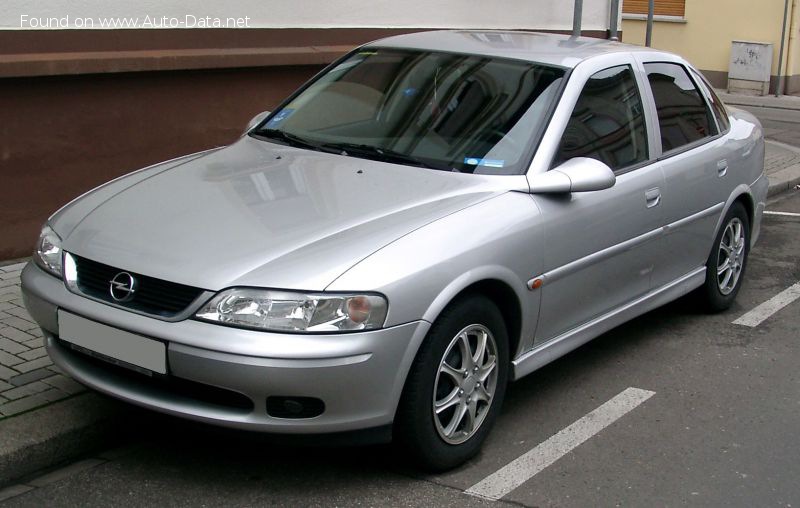
The Opel Vectra B (facelift 1999) 2.2 16V Automatic is a mid-size family car produced by the German manufacturer Opel from 2000 to 2002. As a facelift of the broader Vectra B range (1995-2003), this iteration featured styling updates and refinements. While not officially sold in the United States, the Vectra was a significant model in the European market, competing with vehicles like the Ford Mondeo, Volkswagen Passat, and Peugeot 406. The Vectra B aimed to provide a comfortable and practical driving experience, blending affordability with a reasonable level of performance and features.
Opel Vectra B: A European Family Sedan
The Vectra B represented Opel’s attempt to modernize its mid-size offering and appeal to a broader customer base. The facelifted version, introduced in 1999, brought revised front and rear styling, interior improvements, and updated engine options. The 2.2 16V variant, equipped with an automatic transmission, was positioned as a comfortable and capable choice for drivers prioritizing ease of use and a balance between performance and fuel economy. The Vectra B was available as a sedan, hatchback (often marketed as a ‘fastback’), and station wagon, catering to diverse needs.
Engine & Performance
The 2000-2002 Opel Vectra B 2.2 16V Automatic is powered by the Z22SE engine, a 2.2-liter inline-four cylinder gasoline engine. This naturally aspirated engine produces 147 horsepower at 5800 rpm and 203 Newton-meters (149.73 lb.-ft.) of torque at 4000 rpm. The engine utilizes multi-port fuel injection and a double overhead camshaft (DOHC) valvetrain with four valves per cylinder. This configuration contributes to a relatively smooth power delivery and respectable performance for its class. Paired with a four-speed automatic transmission, the Vectra B 2.2 16V achieves a 0-100 km/h (0-62 mph) acceleration time of 9.5 seconds and a top speed of 218 km/h (135.46 mph). The weight-to-power ratio of 9.7 kg/Hp and a weight-to-torque ratio of 7 kg/Nm indicate a reasonably efficient powertrain for the time. The engine has a displacement of 2198 cm3 (134.13 cu. in.) with a bore of 86 mm (3.39 in.) and a stroke of 94.6 mm (3.72 in.).
Design & Features
The Opel Vectra B facelift retained the overall silhouette of the original B-series, but received a more modern and refined appearance. The sedan body style offered a traditional three-box design, prioritizing practicality and passenger space. The interior was designed with comfort in mind, offering seating for five passengers. Key features included hydraulic power steering, ventilated front disc brakes, and disc brakes on the rear axle. An Anti-lock Braking System (ABS) was standard, enhancing safety. The trunk offered a generous 500 liters (17.66 cu. ft.) of space, expandable to 1240 liters (43.79 cu. ft.) with the rear seats folded down. The vehicle’s dimensions are 4495 mm (176.97 in.) in length, 1707 mm (67.2 in.) in width, and 1425 mm (56.1 in.) in height. The drag coefficient of 0.30 contributed to reasonable aerodynamic efficiency. The Vectra B aimed to provide a comfortable and practical driving experience, typical of European family sedans of the era.
Technical Specifications
| Brand | Opel |
| Model | Vectra |
| Generation | Vectra B (facelift 1999) |
| Type (Engine) | 2.2 16 V (147 Hp) Automatic |
| Start of production | July, 2000 |
| End of production | January, 2002 |
| Powertrain Architecture | Internal Combustion engine |
| Body type | Sedan |
| Seats | 5 |
| Doors | 4 |
| Fuel Type | Petrol (Gasoline) |
| Acceleration 0 – 100 km/h | 9.5 sec |
| Acceleration 0 – 62 mph | 9.5 sec |
| Acceleration 0 – 60 mph | 9 sec |
| Maximum speed | 218 km/h / 135.46 mph |
| Weight-to-power ratio | 9.7 kg/Hp, 103.5 Hp/tonne |
| Weight-to-torque ratio | 7 kg/Nm, 143 Nm/tonne |
| Power | 147 Hp @ 5800 rpm |
| Power per litre | 66.9 Hp/l |
| Torque | 203 Nm @ 4000 rpm / 149.73 lb.-ft. @ 4000 rpm |
| Engine layout | Front, Transverse |
| Engine Model/Code | Z22SE |
| Engine displacement | 2198 cm3 / 134.13 cu. in. |
| Number of cylinders | 4 |
| Engine configuration | Inline |
| Cylinder Bore | 86 mm / 3.39 in. |
| Piston Stroke | 94.6 mm / 3.72 in. |
| Compression ratio | 10:1 |
| Number of valves per cylinder | 4 |
| Fuel injection system | Multi-port manifold injection |
| Engine aspiration | Naturally aspirated engine |
| Valvetrain | DOHC |
| Engine oil capacity | 5 l / 5.28 US qt | 4.4 UK qt |
| Coolant | 6.9 l / 7.29 US qt | 6.07 UK qt |
| Kerb Weight | 1420 kg / 3130.56 lbs |
| Max. weight | 1875 kg / 4133.67 lbs |
| Max load | 455 kg / 1003.1 lbs |
| Trunk (boot) space – minimum | 500 l / 17.66 cu. ft. |
| Trunk (boot) space – maximum | 1240 l / 43.79 cu. ft. |
| Fuel tank capacity | 60 l / 15.85 US gal | 13.2 UK gal |
| Length | 4495 mm / 176.97 in. |
| Width | 1707 mm / 67.2 in. |
| Width including mirrors | 1841 mm / 72.48 in. |
| Height | 1425 mm / 56.1 in. |
| Wheelbase | 2637 mm / 103.82 in. |
| Front track | 1484 mm / 58.43 in. |
| Rear (Back) track | 1487 mm / 58.54 in. |
| Drag coefficient (Cd) | 0.30 |
| Drivetrain Architecture | The Internal combustion engine (ICE) drives the front wheels of the vehicle. |
| Drive wheel | Front wheel drive |
| Number of gears and type of gearbox | 4 gears, automatic transmission |
| Front suspension | Coil spring |
| Rear suspension | Coil spring |
| Front brakes | Ventilated discs |
| Rear brakes | Disc |
| Assisting systems | ABS (Anti-lock braking system) |
| Steering type | Steering rack and pinion |
| Power steering | Hydraulic Steering |
| Tires size | 195/65 R15 |
| Wheel rims size | 5.5J x 15 |