
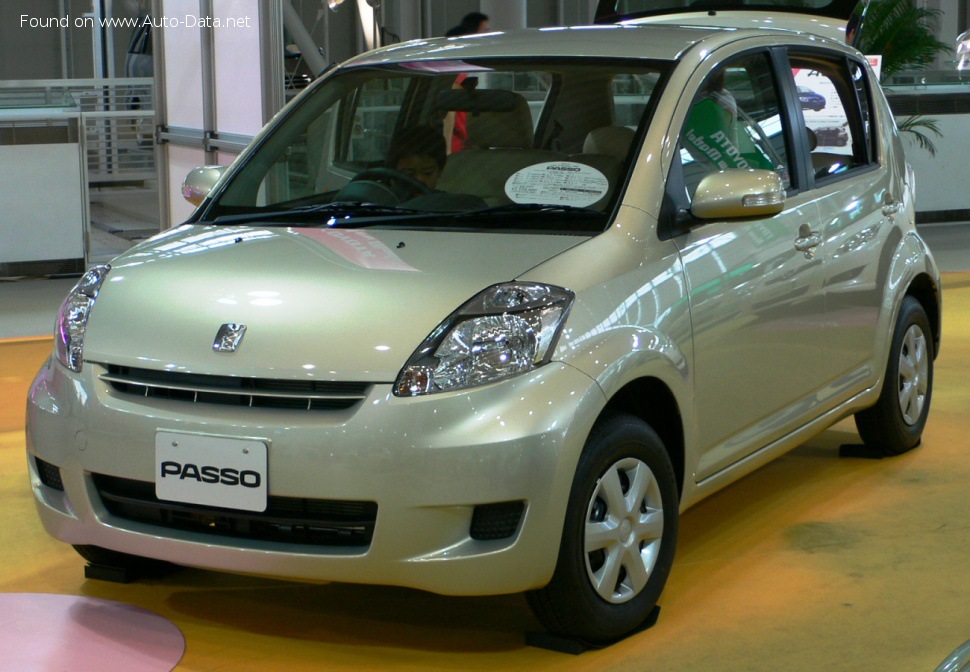
The Toyota Passo, known as the Daihatsu Boon in Japan, is a light hatchback produced by Toyota from 2004 to 2010. Designed as an affordable and practical city car, the Passo primarily targeted the Japanese domestic market (JDM). It was offered with various engine and trim levels, aiming to provide economical transportation for urban commuters. While not officially sold in the United States, the Passo represents Toyota’s strategy of offering compact, fuel-efficient vehicles in densely populated markets. This article details the 1.3i variant, equipped with an 88 horsepower engine and an automatic transmission, focusing on its technical specifications and characteristics.
Toyota Passo 1.3i: An Overview
The Passo, along with its Daihatsu Boon counterpart, filled a niche in the Japanese “kei car” and subcompact segments. These vehicles are known for their small size, ease of maneuverability, and low running costs. The Passo 1.3i, while not a kei car due to its engine displacement, offered a slightly larger and more powerful option within the subcompact category. It competed with vehicles like the Honda Fit and Nissan March, offering a practical and economical alternative for buyers seeking a small, five-door hatchback.
Engine & Performance
The heart of the Toyota Passo 1.3i is the K3-VE 1.3-liter inline-four cylinder gasoline engine. This naturally aspirated engine produces 88 horsepower at 6000 rpm and 123 Nm (90.72 lb-ft) of torque at 4400 rpm. While not a performance-oriented vehicle, the engine provides adequate power for city driving and light highway use. The power-to-weight ratio of 10.6 kg/Hp (94.6 Hp/tonne) and torque-to-weight ratio of 7.6 kg/Nm (132.3 Nm/tonne) reflect its focus on efficiency rather than outright speed. The engine utilizes a multi-port fuel injection system and a double overhead camshaft (DOHC) valvetrain, contributing to its relatively smooth operation and fuel economy. Power is delivered to the front wheels via a four-speed automatic transmission. The Passo’s engine oil capacity is 3.1 liters (3.28 US qt / 2.73 UK qt), and it requires coolant totaling 4.1 liters (4.33 US qt / 3.61 UK qt).
Design & Features
The Toyota Passo 1.3i is a five-door hatchback designed with practicality in mind. Its compact dimensions – 3595 mm (141.54 in) in length, 1665 mm (65.55 in) in width, and 1535 mm (60.43 in) in height – make it easy to maneuver in tight urban environments. The interior comfortably accommodates five passengers, although rear legroom is limited. The Passo’s design prioritizes functionality over aesthetics, with a focus on maximizing interior space within its small footprint. Safety features for the time included an Anti-lock Braking System (ABS), a standard feature aimed at improving braking performance and stability. The Passo’s relatively light curb weight of 930 kg (2050.3 lbs) contributes to its fuel efficiency and nimble handling. The fuel tank capacity is 40 liters (10.57 US gal / 8.8 UK gal), providing a reasonable driving range.
Technical Specifications
| Brand | Toyota |
| Model | Passo |
| Generation | Passo |
| Type (Engine) | 1.3i (88 Hp) Automatic |
| Start of production | 2004 |
| End of production | 2010 |
| Powertrain Architecture | Internal Combustion engine |
| Body type | Hatchback |
| Seats | 5 |
| Doors | 5 |
| Fuel Type | Petrol (Gasoline) |
| Emission standard | Euro 4 |
| Weight-to-power ratio | 10.6 kg/Hp |
| Weight-to-torque ratio | 7.6 kg/Nm |
| Power | 88 Hp @ 6000 rpm |
| Power per litre | 67.7 Hp/l |
| Torque | 123 Nm @ 4400 rpm |
| Torque (lb-ft) | 90.72 lb.-ft. @ 4400 rpm |
| Engine layout | Front, Transverse |
| Engine Model/Code | K3-VE |
| Engine displacement | 1299 cm3 |
| Engine displacement (cu. in.) | 79.27 cu. in. |
| Number of cylinders | 4 |
| Engine configuration | Inline |
| Cylinder Bore | 75 mm |
| Cylinder Bore (in.) | 2.95 in. |
| Piston Stroke | 73.5 mm |
| Piston Stroke (in.) | 2.89 in. |
| Compression ratio | 10.5:1 |
| Number of valves per cylinder | 4 |
| Fuel injection system | Multi-port manifold injection |
| Engine aspiration | Naturally aspirated engine |
| Valvetrain | DOHC |
| Engine oil capacity | 3.1 l |
| Engine oil capacity (US qt) | 3.28 US qt |
| Engine oil capacity (UK qt) | 2.73 UK qt |
| Coolant | 4.1 l |
| Coolant (US qt) | 4.33 US qt |
| Coolant (UK qt) | 3.61 UK qt |
| Kerb Weight | 930 kg |
| Kerb Weight (lbs) | 2050.3 lbs |
| Fuel tank capacity | 40 l |
| Fuel tank capacity (US gal) | 10.57 US gal |
| Fuel tank capacity (UK gal) | 8.8 UK gal |
| Length | 3595 mm |
| Length (in.) | 141.54 in. |
| Width | 1665 mm |
| Width (in.) | 65.55 in. |
| Height | 1535 mm |
| Height (in.) | 60.43 in. |
| Wheelbase | 2440 mm |
| Wheelbase (in.) | 96.06 in. |
| Front track | 1465 mm |
| Front track (in.) | 57.68 in. |
| Rear track | 1475 mm |
| Rear track (in.) | 58.07 in. |
| Minimum turning circle | 8.6 m |
| Minimum turning circle (ft) | 28.22 ft |
| Drivetrain Architecture | Front wheel drive |
| Number of gears | 4 |
| Gearbox type | automatic transmission |
| Front brakes | Ventilated discs |
| Rear brakes | Drum |
| Assisting systems | ABS (Anti-lock braking system) |
In conclusion, the Toyota Passo 1.3i was a practical and economical hatchback designed for urban environments. While not a high-performance vehicle, it offered a comfortable and reliable transportation solution for buyers in its target market. Its compact size, fuel efficiency, and affordability made it a popular choice in Japan and other regions where it was offered.
