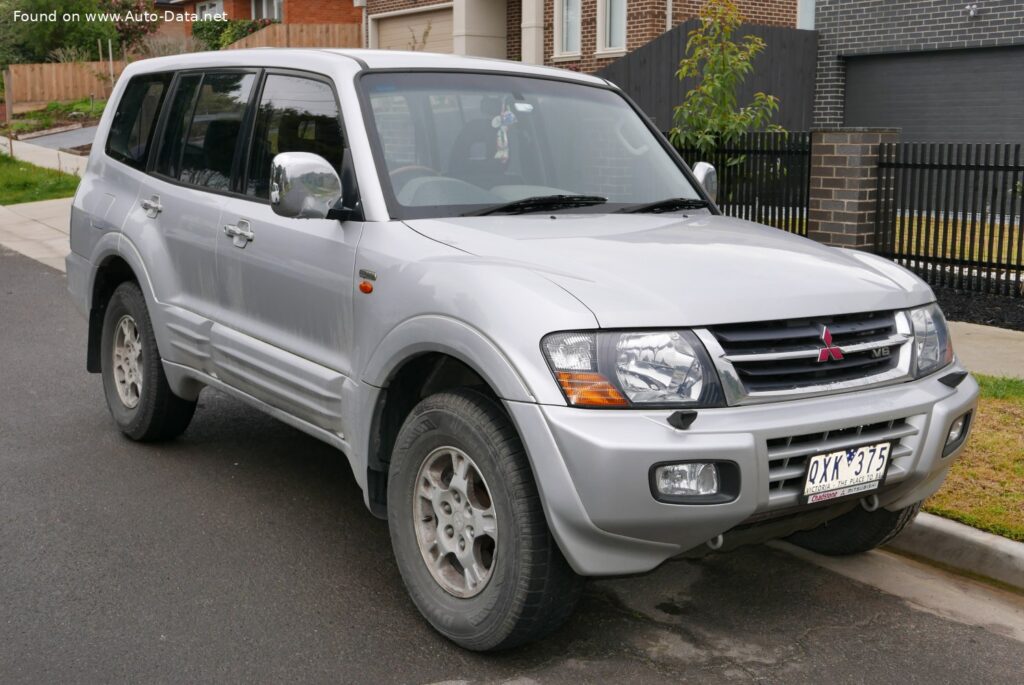
The Mitsubishi Pajero III, produced from 2000 to 2006, represents the third generation of Mitsubishi’s renowned Pajero SUV. While not widely sold in the United States, the Pajero held a significant position in the European, Asian, and Australian markets as a capable and comfortable off-road vehicle. This generation marked a substantial evolution in refinement and technology compared to its predecessors, offering a blend of robust four-wheel-drive capability with increased on-road comfort and features. The 3.5 V6 GDI model, equipped with a 3.5-liter gasoline engine producing 202 horsepower, was a popular configuration, offering a balance of power and efficiency for a full-size SUV. It was primarily marketed towards families and individuals seeking a versatile vehicle for both daily driving and adventurous excursions.
Mitsubishi Pajero III 3.5 V6 GDI: An Overview
The Pajero III, internally designated as the NM series, was a significant departure from the boxy styling of the previous generation. It adopted a more aerodynamic and modern design, reflecting the evolving tastes of the early 2000s. The 3.5 V6 GDI variant specifically catered to markets desiring a more powerful gasoline engine option. The “GDI” designation stands for Gasoline Direct Injection, a technology that improved fuel efficiency and power output. This model typically featured seven seats, making it a practical choice for larger families. The Pajero III aimed to compete with other established SUVs like the Toyota Land Cruiser and Nissan Patrol, offering a compelling package of off-road prowess, on-road comfort, and a relatively luxurious interior.
Engine & Performance
The heart of the Pajero III 3.5 V6 GDI is its 6G74 engine, a 3.5-liter V6 powerplant. This engine delivers 202 horsepower at 5000 rpm and 318 Nm (234.54 lb.-ft.) of torque at 4000 rpm. The direct fuel injection system contributes to improved combustion efficiency and a higher power-to-weight ratio. The engine is longitudinally mounted, driving all four wheels through a five-speed manual transmission. Acceleration from 0 to 100 km/h (0-62 mph) takes approximately 10.7 seconds, while 0 to 60 mph is achieved in around 10.2 seconds. The vehicle boasts a maximum speed of 190 km/h (118.06 mph). The weight-to-power ratio of 10.6 kg/Hp and a weight-to-torque ratio of 6.7 kg/Nm demonstrate a reasonable balance between power and mass for a vehicle of its size and capability. While fuel economy isn’t a strong point, typical combined consumption is around 12.8 l/100 km (18.4 US mpg, 22.1 UK mpg).
Design & Features
The Pajero III features a classic SUV body style with five doors and seven seats. Its design incorporates a more rounded aesthetic compared to earlier Pajero models, with a focus on improved aerodynamics. The interior prioritizes comfort and practicality, offering ample space for passengers and cargo. The seven-seat configuration provides flexibility for families, with the rear seats folding flat to maximize cargo capacity, ranging from a minimum of 215 liters (7.59 cu. ft.) to a maximum of 1700 liters (60.03 cu. ft.) with the seats folded. Safety features for the era included ABS (Anti-lock Braking System) and ventilated disc brakes on all four wheels. The suspension system utilizes a double wishbone setup at the front and coil springs at the rear, providing a comfortable ride both on and off-road. The Pajero III’s dimensions are substantial, measuring 4795 mm (188.78 in.) in length, 1875 mm (73.82 in.) in width, and 1855 mm (73.03 in.) in height, with a wheelbase of 2780 mm (109.45 in.).
Technical Specifications
| Brand | Mitsubishi |
| Model | Pajero |
| Generation | Pajero III |
| Type (Engine) | 3.5 V6 GDI (202 Hp) 7 Seat |
| Start of production | 2000 year |
| End of production | 2006 year |
| Powertrain Architecture | Internal Combustion engine |
| Body type | SUV |
| Seats | 7 |
| Doors | 5 |
| Fuel consumption (urban) | 16.9 l/100 km (13.9 US mpg, 16.7 UK mpg, 5.9 km/l) |
| Fuel consumption (extra urban) | 10.5 l/100 km (22.4 US mpg, 26.9 UK mpg, 9.5 km/l) |
| Fuel consumption (combined) | 12.8 l/100 km (18.4 US mpg, 22.1 UK mpg, 7.8 km/l) |
| Fuel Type | Petrol (Gasoline) |
| Acceleration 0 – 100 km/h | 10.7 sec |
| Acceleration 0 – 62 mph | 10.7 sec |
| Acceleration 0 – 60 mph | 10.2 sec |
| Maximum speed | 190 km/h (118.06 mph) |
| Weight-to-power ratio | 10.6 kg/Hp |
| Weight-to-torque ratio | 6.7 kg/Nm |
| Power | 202 Hp @ 5000 rpm |
| Torque | 318 Nm @ 4000 rpm (234.54 lb.-ft. @ 4000 rpm) |
| Engine layout | Front, Longitudinal |
| Engine Model/Code | 6G74 |
| Engine displacement | 3497 cm3 (213.4 cu. in.) |
| Number of cylinders | 6 |
| Engine configuration | V-engine |
| Cylinder Bore | 93 mm (3.66 in.) |
| Piston Stroke | 85.8 mm (3.38 in.) |
| Compression ratio | 10.4:1 |
| Number of valves per cylinder | 4 |
| Fuel injection system | Direct injection |
| Engine aspiration | Naturally aspirated engine |
| Valvetrain | DOHC |
| Engine oil capacity | 4.6 l (4.86 US qt | 4.05 UK qt) |
| Coolant | 9 l (9.51 US qt | 7.92 UK qt) |
| Kerb Weight | 2135 kg (4706.87 lbs.) |
| Max. weight | 2760 kg (6084.76 lbs.) |
| Max load | 625 kg (1377.89 lbs.) |
| Trunk (boot) space – minimum | 215 l (7.59 cu. ft.) |
| Trunk (boot) space – maximum | 1700 l (60.03 cu. ft.) |
| Fuel tank capacity | 90 l (23.78 US gal | 19.8 UK gal) |
| Length | 4795 mm (188.78 in.) |
| Width | 1875 mm (73.82 in.) |
| Height | 1855 mm (73.03 in.) |
| Wheelbase | 2780 mm (109.45 in.) |
| Front track | 1560 mm (61.42 in.) |
| Rear (Back) track | 1560 mm (61.42 in.) |
| Drive wheel | All wheel drive (4×4) |
| Number of gears and type of gearbox | 5 gears, manual transmission |
| Front suspension | Double wishbone |
| Rear suspension | Coil spring |
| Front brakes | Ventilated discs |
| Rear brakes | Ventilated discs |
| Assisting systems | ABS (Anti-lock braking system) |
| Steering type | Steering rack and pinion |
| Power steering | Hydraulic Steering |
| Tires size | 265/70 R16 H |