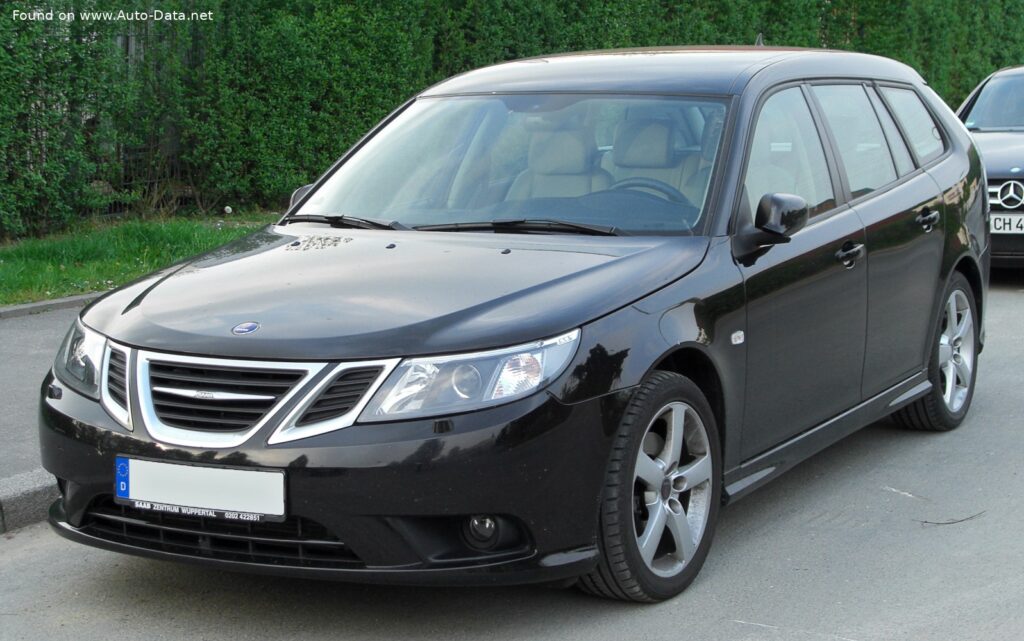
The Saab 9-3 Sport Combi II, specifically the facelifted version introduced in 2007, represents a refined iteration of Saab’s compact executive car. Positioned as a five-door station wagon (estate) in the European market, the 9-3 Sport Combi aimed to blend practicality with Saab’s signature Scandinavian design and engineering. This particular variant, produced from 2008 to 2009, featured a potent 2.8-liter turbocharged V6 engine paired with Saab’s XWD all-wheel-drive system, offering a compelling combination of performance and all-weather capability. While Saab never achieved significant market penetration in the United States, the 9-3 series, including the Sport Combi, was appreciated by enthusiasts for its unique character and driver-focused experience.
Saab 9-3 Sport Combi II (2007-2009) 2.8T V6 XWD
The 9-3 Sport Combi II facelift brought subtle but important changes to the original 9-3 design, enhancing its aesthetic appeal and refining its interior. The focus was on modernizing the vehicle while retaining the core Saab values of safety, functionality, and a distinctive driving experience. The 2.8T V6 XWD model occupied the top end of the 9-3 Sport Combi range, offering a premium experience for buyers seeking both performance and practicality.
Engine & Performance
The heart of the 9-3 Sport Combi II 2.8T V6 XWD is its 2.8-liter V6 engine, designated the B284R. This engine produces 280 horsepower at 5300 rpm and 400 Newton-meters (295 lb-ft) of torque available from a low 1900 rpm, sustaining through 4500 rpm. The engine utilizes a twin-scroll turbocharger and an intercooler to maximize power output and responsiveness. The power-to-liter ratio is an impressive 100.3 hp/l. This engine is transversely mounted in the front of the vehicle. Paired with a six-speed manual transmission, the 9-3 Sport Combi 2.8T V6 XWD delivers brisk acceleration, achieving 0-100 km/h (0-62 mph) in 6.5 seconds and 0-60 mph in approximately 6.2 seconds. Its top speed is electronically limited to 250 km/h (155.34 mph). Despite its performance capabilities, fuel economy is rated at 11 liters per 100 kilometers combined (21.4 US mpg, 25.7 UK mpg), with CO2 emissions of 263 g/km, reflecting the engine’s size and output, and adhering to Euro 4 emission standards.
Design & Features
The Saab 9-3 Sport Combi II is a five-door, five-seat station wagon. Its design emphasizes practicality and load-carrying capacity. The Sport Combi body style offers a generous 419 liters (14.8 cu ft) of trunk space with the rear seats up, expanding to a substantial 1273 liters (44.96 cu ft) when the rear seats are folded down. The vehicle’s dimensions are 4670 mm (183.86 in) in length, 1762 mm (69.37 in) in width, and 1496 mm (58.9 in) in height. The wheelbase measures 2675 mm (105.31 in).
The 2.8T V6 XWD model typically included a higher level of standard equipment, focusing on comfort and safety. Key features included Saab’s XWD all-wheel-drive system, which intelligently distributes torque between the front and rear axles for enhanced traction and stability. The XWD system utilizes an electronically controlled clutch to engage the rear wheels when needed, providing a dynamic and secure driving experience. Safety features included ABS (Anti-lock Braking System), ventilated disc brakes on all four wheels (314mm front, 292mm rear), and a robust chassis designed to protect occupants in the event of a collision. The vehicle’s kerb weight is 1800 kg (3968.32 lbs), with a maximum permissible weight of 2260 kg (4982.45 lbs).
Technical Specifications
| Brand | Saab |
| Model | 9-3 |
| Generation | 9-3 Sport Combi II (facelift 2007) |
| Type (Engine) | 2.8T V6 (280 Hp) XWD |
| Start of production | 2008 |
| End of production | 2009 |
| Powertrain Architecture | Internal Combustion engine |
| Body type | Station wagon (estate) |
| Seats | 5 |
| Doors | 5 |
| Fuel consumption (urban) | 16.5 l/100 km (14.3 US mpg, 17.1 UK mpg) |
| Fuel consumption (extra urban) | 7.8 l/100 km (30.2 US mpg, 36.2 UK mpg) |
| Fuel consumption (combined) | 11 l/100 km (21.4 US mpg, 25.7 UK mpg) |
| CO2 emissions | 263 g/km |
| Fuel Type | Petrol (Gasoline) |
| Acceleration 0 – 100 km/h | 6.5 sec |
| Acceleration 0 – 62 mph | 6.5 sec |
| Acceleration 0 – 60 mph | 6.2 sec |
| Maximum speed | 250 km/h (155.34 mph) |
| Emission standard | Euro 4 |
| Weight-to-power ratio | 6.4 kg/Hp |
| Weight-to-torque ratio | 4.5 kg/Nm |
| Power | 280 Hp @ 5300 rpm |
| Torque | 400 Nm @ 1900-4500 rpm (295.02 lb.-ft.) |
| Engine layout | Front, Transverse |
| Engine Model/Code | B284R |
| Engine displacement | 2792 cm3 (170.38 cu. in.) |
| Number of cylinders | 6 |
| Engine configuration | V-engine |
| Cylinder Bore | 89 mm (3.5 in.) |
| Piston Stroke | 74.8 mm (2.94 in.) |
| Compression ratio | 9.5:1 |
| Number of valves per cylinder | 4 |
| Fuel injection system | Multi-port manifold injection |
| Engine aspiration | Twin-scroll turbo, Intercooler |
| Valvetrain | DOHC |
| Engine oil capacity | 6 l (6.34 US qt | 5.28 UK qt) |
| Coolant capacity | 9.6 l (10.14 US qt | 8.45 UK qt) |
| Kerb Weight | 1800 kg (3968.32 lbs.) |
| Max. weight | 2260 kg (4982.45 lbs.) |
| Max load | 460 kg (1014.13 lbs.) |
| Trunk (boot) space – minimum | 419 l (14.8 cu. ft.) |
| Trunk (boot) space – maximum | 1273 l (44.96 cu. ft.) |
| Fuel tank capacity | 61 l (16.11 US gal | 13.42 UK gal) |
| Max. roof load | 100 kg (220.46 lbs.) |
| Permitted trailer load with brakes (12%) | 1600 kg (3527.4 lbs.) |
| Permitted trailer load without brakes | 750 kg (1653.47 lbs.) |
| Length | 4670 mm (183.86 in.) |
| Width | 1762 mm (69.37 in.) |
| Width including mirrors | 2038 mm (80.24 in.) |
| Height | 1496 mm (58.9 in.) |
| Wheelbase | 2675 mm (105.31 in.) |
| Front track | 1524 mm (60 in.) |
| Rear track | 1506 mm (59.29 in.) |
| Front overhang | 981 mm (38.62 in.) |
| Rear overhang | 1014 mm (39.92 in.) |
| Ride height (ground clearance) | 150 mm (5.91 in.) |
| Minimum turning circle | 11.7 m (38.39 ft.) |
| Drivetrain | All wheel drive (4×4) |
| Number of gears | 6 |
| Gearbox type | Manual transmission |
| Front suspension | Independent, McPherson with coil spring and anti-roll bar |
| Rear suspension | Independent multi-link spring suspension with stabilizer |
| Front brakes | Ventilated discs, 314 mm |
| Rear brakes | Ventilated discs, 292 mm |
| Steering type | Steering rack and pinion |
| Power steering | Hydraulic |
| Tires size | 235/45 R17; 225/45 R18; 235/45 R18; 235/40 R19 |
| Wheel rims size | 7.5J x 17; 7.5J x 18; 8J x 19 |