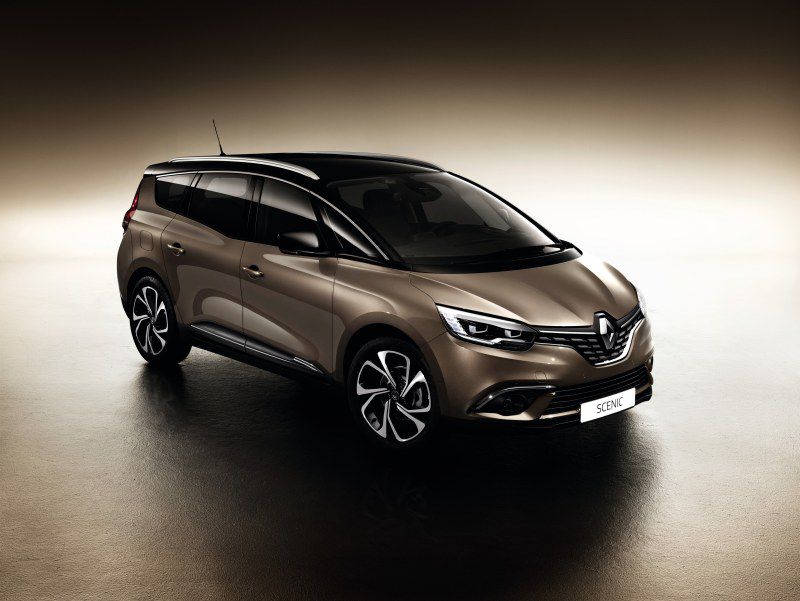
The Renault Grand Scenic IV (Phase I) 1.5 Energy dCi (110 Hp) Hybrid Assist 7 Seat is a compact minivan produced by the French automaker Renault from 2017 to 2018. Representing the fourth generation of the Scenic line, the Grand Scenic IV aimed to blend practicality, fuel efficiency, and modern technology within the family vehicle segment. This particular variant, equipped with a 1.5-liter diesel engine and a mild hybrid system, was primarily marketed in Europe, where demand for fuel-efficient multi-passenger vehicles remained strong. It offered a seven-seat configuration, making it a versatile option for larger families.
Renault Grand Scenic IV: A Detailed Overview
The Grand Scenic IV marked a significant evolution in the Scenic lineup, moving towards a more crossover-inspired design language. It distinguished itself from the standard Scenic by offering an extended wheelbase and a third row of seats, increasing passenger capacity and cargo space. The Phase I models, produced between 2017 and 2018, represent the initial iteration of this generation, featuring a specific set of equipment and engine options. The introduction of the mild hybrid system, known as Hybrid Assist, was a key feature, designed to improve fuel economy and reduce emissions.
Engine & Performance
The Renault Grand Scenic IV 1.5 Energy dCi (110 Hp) Hybrid Assist is powered by a 1.5-liter inline-four cylinder diesel engine, designated K9K. This engine produces 110 horsepower at 4,000 rpm and 260 Nm (191.77 lb.-ft.) of torque at 1,750 rpm. The engine features a turbocharger and intercooler to enhance performance and efficiency. The “Energy dCi” designation signifies Renault’s efforts to optimize diesel engine technology for reduced fuel consumption and emissions. The mild hybrid system, a 48-volt system, provides a small boost to the engine during acceleration and allows for regenerative braking, capturing energy that would otherwise be lost during deceleration. This system doesn’t enable fully electric driving, but it contributes to improved fuel economy. Acceleration from 0 to 100 km/h (0-62 mph) takes 12.6 seconds, with a top speed of 181 km/h (112.47 mph). The engine’s power-to-weight ratio is 14 kg/Hp, and the torque-to-weight ratio is 5.9 kg/Nm.
Design & Features
The Grand Scenic IV adopts a modern and dynamic exterior design, characterized by sculpted lines and a prominent front grille. Its minivan body style prioritizes interior space and practicality. The vehicle offers five doors and seating for up to seven passengers. Key features include a spacious and modular interior, allowing for flexible seating arrangements to accommodate varying passenger and cargo needs. The dashboard incorporates a large touchscreen display for infotainment and vehicle control functions. Safety features, typical for vehicles of this era, include ABS (Anti-lock Braking System), electronic stability control, and multiple airbags. The vehicle’s dimensions are 4,635 mm (182.48 in) in length, 1,866 mm (73.46 in) in width, and 1,655 mm (65.16 in) in height. Trunk space ranges from a minimum of 186 liters (6.57 cu. ft.) with all seats in use to a maximum of 1,737 liters (61.34 cu. ft.) with the rear seats folded down. The vehicle has a kerb weight of 1,540 kg (3,395.12 lbs) and a maximum authorized weight of 2,300 kg (5,070.63 lbs).
Technical Specifications
| Brand | Renault |
| Model | Scenic |
| Generation | Grand Scenic IV (Phase I) |
| Type | 1.5 Energy dCi (110 Hp) Hybrid Assist 7 Seat |
| Start of production | 2017 |
| End of production | 2018 |
| Powertrain Architecture | MHEV (Mild Hybrid Electric Vehicle) |
| Body type | Minivan |
| Seats | 7 |
| Doors | 5 |
| Fuel consumption (urban) | 4 l/100 km (58.8 US mpg) |
| Fuel consumption (extra urban) | 3.2 l/100 km (73.5 US mpg) |
| Fuel consumption (combined) | 3.6 l/100 km (65.3 US mpg) |
| CO2 emissions | 94 g/km |
| Fuel Type | Diesel |
| Acceleration 0 – 100 km/h | 12.6 sec |
| Acceleration 0 – 62 mph | 12.6 sec |
| Acceleration 0 – 60 mph | 12 sec |
| Maximum speed | 181 km/h (112.47 mph) |
| Emission standard | Euro 6 |
| Weight-to-power ratio | 14 kg/Hp |
| Weight-to-torque ratio | 5.9 kg/Nm |
| Power | 110 Hp @ 4000 rpm |
| Torque | 260 Nm @ 1750 rpm (191.77 lb.-ft. @ 1750 rpm) |
| Engine layout | Front, Transverse |
| Engine Model/Code | K9K |
| Engine displacement | 1461 cm3 (89.16 cu. in.) |
| Number of cylinders | 4 |
| Engine configuration | Inline |
| Cylinder Bore | 76 mm (2.99 in.) |
| Piston Stroke | 80.5 mm (3.17 in.) |
| Number of valves per cylinder | 2 |
| Fuel injection system | Diesel Commonrail |
| Engine aspiration | Turbocharger, Intercooler |
| Engine oil capacity | 4.8 l (5.07 US qt | 4.22 UK qt) |
| Coolant | 6 l (6.34 US qt | 5.28 UK qt) |
| Kerb Weight | 1540 kg (3395.12 lbs.) |
| Max. weight | 2300 kg (5070.63 lbs.) |
| Max load | 760 kg (1675.51 lbs.) |
| Trunk (boot) space – minimum | 186 l (6.57 cu. ft.) |
| Trunk (boot) space – maximum | 1737 l (61.34 cu. ft.) |
| Fuel tank capacity | 53 l (14 US gal | 11.66 UK gal) |
| Max. roof load | 80 kg (176.37 lbs.) |
| Permitted trailer load with brakes (12%) | 1850 kg (4078.55 lbs.) |
| Permitted trailer load without brakes | 750 kg (1653.47 lbs.) |
| Permitted towbar download | 75 kg (165.35 lbs.) |
| Length | 4635 mm (182.48 in.) |
| Width | 1866 mm (73.46 in.) |
| Width including mirrors | 2128 mm (83.78 in.) |
| Height | 1655 mm (65.16 in.) |
| Wheelbase | 2804 mm (110.39 in.) |
| Front track | 1602 mm (63.07 in.) |
| Rear (Back) track | 1596 mm (62.83 in.) |
| Front overhang | 931 mm (36.65 in.) |
| Rear overhang | 899 mm (35.39 in.) |
| Ride height (ground clearance) | 159 mm (6.26 in.) |
| Minimum turning circle (turning diameter) | 11.39 m (37.37 ft.) |
| Drive wheel | Front wheel drive |
| Number of gears and type of gearbox | 6 gears, manual transmission |
| Front suspension | Independent type McPherson |
| Rear suspension | Semi-independent, coil spring |
| Front brakes | Ventilated discs, 320 mm |
| Rear brakes | Disc, 290 mm |
| Tires size | 195/55 R20 95H |
| Wheel rims size | 20 |