
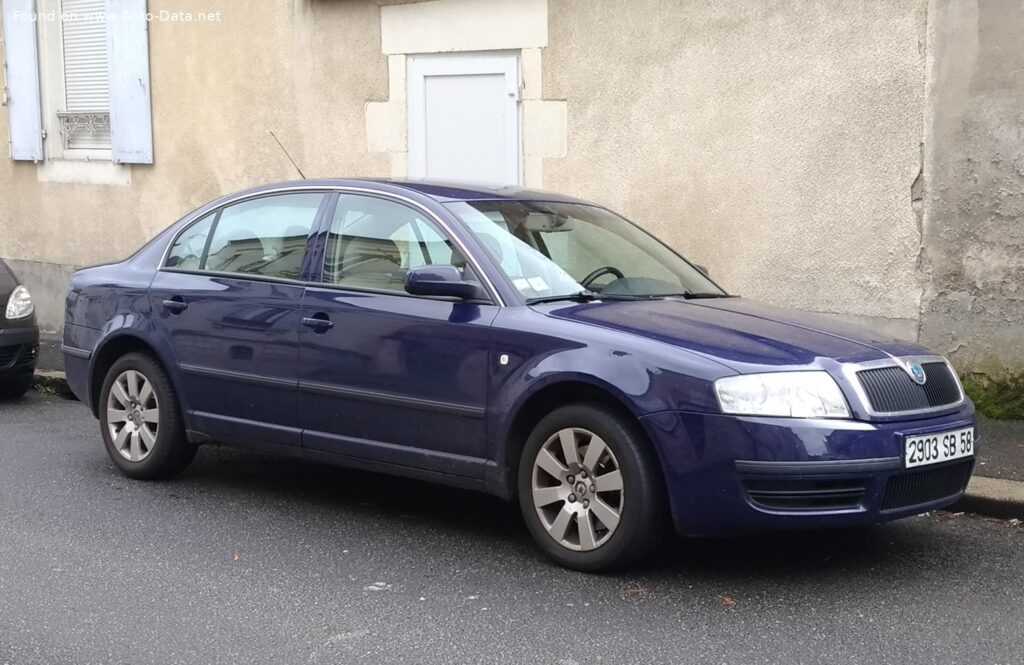
The Skoda Superb I 2.8 V6, produced between 2001 and 2006, represents a significant effort by the Czech automaker to enter the upper-midsize executive car segment. While Skoda was, and largely remains, a brand strongly associated with value and practicality, the Superb I aimed to offer a more premium experience, competing with established players like the Ford Mondeo, Volkswagen Passat, and Opel/Vauxhall Vectra. This first generation Superb was particularly important for establishing Skoda’s ambition to move beyond its budget-friendly image, offering a spacious and well-equipped sedan primarily targeted at the European market. It was based on the Volkswagen Passat B5 platform, benefiting from German engineering while offering a distinct design and often a more competitive price point.
Skoda Superb I 2.8 V6: Overview and Market Position
The Superb I was Skoda’s flagship model, designed to provide a comfortable and spacious alternative to more expensive executive cars. It distinguished itself with a generous interior, particularly in rear passenger space, and a large trunk capacity. The 2.8 V6 engine variant was positioned as the top-of-the-line offering, providing a substantial performance upgrade over the lower-powered engine options. Unlike many of its competitors, the Superb I was exclusively offered as a sedan, foregoing the availability of a station wagon (estate) body style. This focus on the sedan form factor catered to preferences in certain European markets where this body style remained popular.
Engine & Performance
The heart of the Superb I 2.8 V6 is a 2.8-liter naturally aspirated VR6 engine, designated the EA390 / AMX. This engine produces 193 horsepower at 6000 rpm and 280 Nm (206.52 lb-ft) of torque at 3200 rpm. The VR6 configuration, a unique Volkswagen Group design, combines the smoothness of a V6 with the compactness of an inline engine. This engine is longitudinally mounted at the front of the vehicle and drives the front wheels through a five-speed manual transmission. Acceleration from 0 to 100 km/h (0-62 mph) takes 8 seconds, while the 0-60 mph sprint is achieved in a calculated 7.6 seconds. The Superb I 2.8 V6 boasts a maximum speed of 237 km/h (147.26 mph). The engine’s power-to-weight ratio is 6.5 kg/Hp, and its torque-to-weight ratio is 4.5 kg/Nm, contributing to a responsive driving experience. Fuel economy is rated at 9.9 l/100 km (23.8 US mpg) combined, with 14.3 l/100 km (16.4 US mpg) in urban conditions and 7.3 l/100 km (32.2 US mpg) on the extra-urban cycle.
Design & Features
The Skoda Superb I is a four-door sedan with a classic three-box design. Its styling, while conservative, aimed for a sophisticated and understated appearance. The interior prioritizes space and comfort, offering ample legroom and headroom for both front and rear passengers. Key features include a spacious 577-liter (20.38 cu ft) trunk, expandable to 1228 liters (43.37 cu ft) with the rear seats folded down. Standard safety equipment included ABS (Anti-lock Braking System). The Superb I also featured hydraulic power steering and a transverse stabilizer for improved handling. The suspension utilizes coil springs at the rear and ventilated discs on the front brakes, with standard discs at the rear. The vehicle rides on 205/55 R16 tires mounted on 7.0J x 16 alloy wheels.
Technical Specifications
| Brand | Skoda |
| Model | Superb |
| Generation | Superb I |
| Type (Engine) | 2.8 V6 (193 Hp) |
| Start of production | December, 2001 |
| End of production | 2006 |
| Powertrain Architecture | Internal Combustion engine |
| Body type | Sedan |
| Seats | 5 |
| Doors | 4 |
| Fuel consumption (urban) | 14.3 l/100 km (16.4 US mpg) |
| Fuel consumption (extra urban) | 7.3 l/100 km (32.2 US mpg) |
| Fuel consumption (combined) | 9.9 l/100 km (23.8 US mpg) |
| Fuel Type | Petrol (Gasoline) |
| Acceleration 0 – 100 km/h | 8 sec |
| Acceleration 0 – 62 mph | 8 sec |
| Acceleration 0 – 60 mph | 7.6 sec |
| Maximum speed | 237 km/h (147.26 mph) |
| Weight-to-power ratio | 6.5 kg/Hp |
| Weight-to-torque ratio | 4.5 kg/Nm |
| Power | 193 Hp @ 6000 rpm |
| Torque | 280 Nm @ 3200 rpm (206.52 lb.-ft. @ 3200 rpm) |
| Engine layout | Front, Longitudinal |
| Engine Model/Code | EA390 / AMX |
| Engine displacement | 2771 cm3 (169.1 cu. in.) |
| Number of cylinders | 6 |
| Engine configuration | VR-engine |
| Cylinder Bore | 82.5 mm (3.25 in.) |
| Piston Stroke | 86.4 mm (3.4 in.) |
| Compression ratio | 10.6:1 |
| Number of valves per cylinder | 5 |
| Fuel injection system | Multi-port manifold injection |
| Engine aspiration | Naturally aspirated engine |
| Valvetrain | DOHC |
| Engine oil capacity | 5.7 l (6.02 US qt | 5.02 UK qt) |
| Coolant | 10.5 l (11.1 US qt | 9.24 UK qt) |
| Kerb Weight | 1250 kg (2755.78 lbs.) |
| Max. weight | 1840 kg (4056.51 lbs.) |
| Max load | 590 kg (1300.73 lbs.) |
| Trunk (boot) space – minimum | 577 l (20.38 cu. ft.) |
| Trunk (boot) space – maximum | 1228 l (43.37 cu. ft.) |
| Fuel tank capacity | 62 l (16.38 US gal | 13.64 UK gal) |
| Length | 4803 mm (189.09 in.) |
| Width | 1765 mm (69.49 in.) |
| Height | 1469 mm (57.83 in.) |
| Wheelbase | 2803 mm (110.35 in.) |
| Front track | 1515 mm (59.65 in.) |
| Rear (Back) track | 1515 mm (59.65 in.) |
| Drivetrain Architecture | ICE drives front wheels |
| Drive wheel | Front wheel drive |
| Number of gears and type of gearbox | 5 gears, manual transmission |
| Front suspension | Transverse stabilizer |
| Rear suspension | Coil spring |
| Front brakes | Ventilated discs |
| Rear brakes | Disc |
| Assisting systems | ABS (Anti-lock braking system) |
| Steering type | Steering rack and pinion |
| Power steering | Hydraulic Steering |
| Tires size | 205/55 R16 |
| Wheel rims size | 7.0J x 16 |
The Skoda Superb I 2.8 V6, while not a massive sales success, played a crucial role in reshaping Skoda’s brand image. It demonstrated the company’s ability to produce a genuinely competitive executive car, paving the way for the more successful second and third-generation Superb models that followed. Its spaciousness, comfortable ride, and powerful engine made it a compelling option for those seeking a value-oriented alternative in the premium sedan segment.
