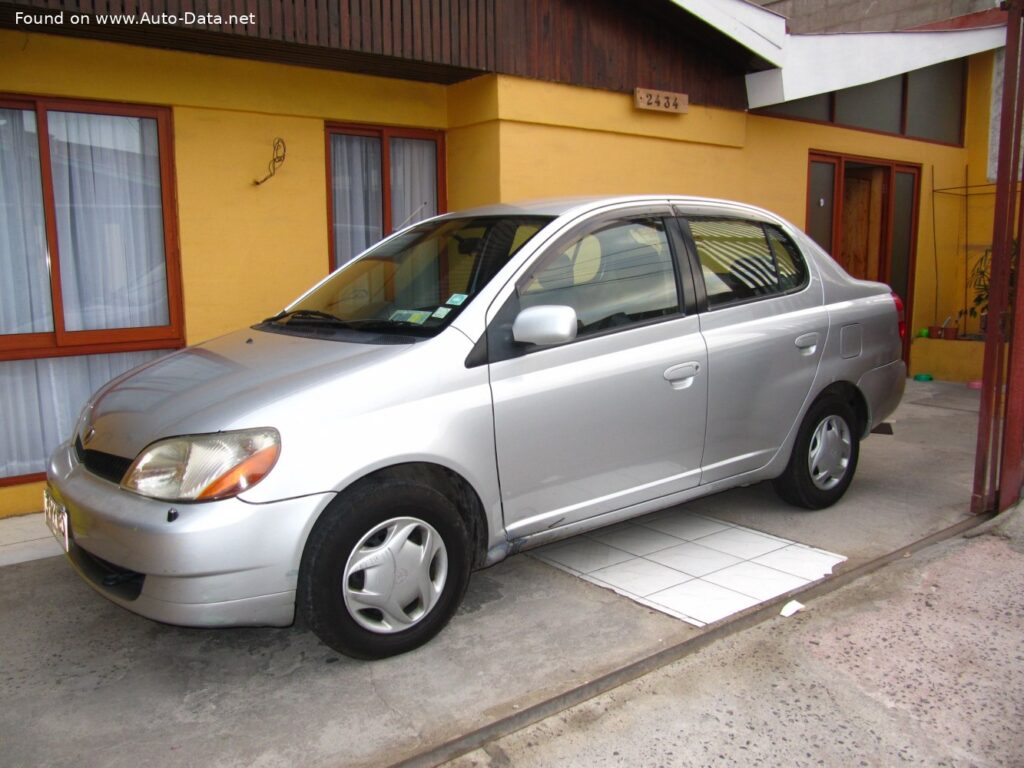
The Toyota Platz, known as the Toyota Echo in North America and Australia, is a subcompact car produced by Toyota from 1999 to 2005. Designed as an affordable and practical vehicle, the Platz (and Echo) occupied a crucial segment in Toyota’s global lineup, particularly in markets where smaller, fuel-efficient cars were highly sought after. While not initially sold in the United States as the “Platz,” the Echo version offered a similar value proposition to American consumers. This article details the technical specifications and characteristics of the 1.5i 16V Automatic variant, a common configuration of the vehicle.
Toyota Platz 1.5i 16V: An Overview
The Toyota Platz 1.5i 16V represents a significant entry in the subcompact car market. Introduced as a replacement for the Toyota Starlet in many regions, the Platz aimed to provide reliable transportation with a focus on fuel economy and ease of use. Its simple, yet functional design, coupled with Toyota’s reputation for durability, made it a popular choice for first-time car buyers, urban commuters, and those seeking a cost-effective vehicle. The 1.5i 16V designation refers to the engine’s displacement (1.5 liters) and valve configuration (16 valves), indicating a relatively modern engine design for its time. The availability of an automatic transmission further broadened its appeal to a wider range of drivers.
Engine & Performance
The heart of the Toyota Platz 1.5i 16V is a 1.5-liter inline four-cylinder engine. This naturally aspirated powerplant produces 110 horsepower at 6000 rpm and 105.47 lb.-ft. of torque at 4200 rpm. The engine utilizes a multi-port fuel injection system and a double overhead camshaft (DOHC) valvetrain, contributing to its relatively efficient operation. The engine’s power output, while not exceptionally high, is sufficient for everyday driving and provides a reasonable weight-to-power ratio of 8.3 kg/Hp. The Platz achieves a maximum speed of 111.85 mph (180 km/h). The engine’s 73.5 horsepower per liter demonstrates a focus on extracting reasonable power from a small displacement. The engine is transversely mounted at the front of the vehicle, driving the front wheels via a four-speed automatic transmission.
Design & Features
The Toyota Platz is a four-door sedan with a relatively compact footprint. Its design prioritizes practicality and interior space over stylistic flourishes. The vehicle comfortably seats five passengers and offers 15.36 cubic feet of trunk space, making it suitable for small families or individuals with moderate cargo needs. Safety features, while basic by modern standards, included an Anti-lock Braking System (ABS) which was a notable inclusion for a vehicle in this segment during the late 1990s and early 2000s. The steering system employs a hydraulic power steering rack and pinion setup, providing responsive and relatively effortless steering. The suspension utilizes a wishbone configuration at the front and a coil spring setup at the rear, offering a comfortable, if not particularly sporty, ride. The vehicle rides on 14-inch wheels fitted with 175/65 R14 tires.
Technical Specifications
| Brand | Toyota |
| Model | Platz |
| Generation | Platz |
| Type (Engine) | 1.5i 16V (110 Hp) Automatic |
| Start of production | 1999 year |
| End of production | 2005 year |
| Powertrain Architecture | Internal Combustion engine |
| Body type | Sedan |
| Seats | 5 |
| Doors | 4 |
| Fuel Type | Petrol (Gasoline) |
| Maximum speed | 180 km/h (111.85 mph) |
| Weight-to-power ratio | 8.3 kg/Hp, 120.9 Hp/tonne |
| Weight-to-torque ratio | 6.4 kg/Nm, 157.1 Nm/tonne |
| Power | 110 Hp @ 6000 rpm |
| Power per litre | 73.5 Hp/l |
| Torque | 143 Nm @ 4200 rpm (105.47 lb.-ft. @ 4200 rpm) |
| Engine layout | Front, Transverse |
| Engine displacement | 1496 cm3 (91.29 cu. in.) |
| Number of cylinders | 4 |
| Engine configuration | Inline |
| Cylinder Bore | 75 mm (2.95 in.) |
| Piston Stroke | 84.7 mm (3.33 in.) |
| Compression ratio | 10.5:1 |
| Number of valves per cylinder | 4 |
| Fuel injection system | Multi-port manifold injection |
| Engine aspiration | Naturally aspirated engine |
| Valvetrain | DOHC |
| Kerb Weight | 910 kg (2006.21 lbs) |
| Max. weight | 1185 kg (2612.48 lbs) |
| Max load | 275 kg (606.27 lbs) |
| Trunk (boot) space – minimum | 435 l (15.36 cu. ft.) |
| Fuel tank capacity | 45 l (11.89 US gal | 9.9 UK gal) |
| Length | 4145 mm (163.19 in.) |
| Width | 1660 mm (65.35 in.) |
| Height | 1500 mm (59.06 in.) |
| Wheelbase | 2370 mm (93.31 in.) |
| Front track | 1440 mm (56.69 in.) |
| Rear (Back) track | 1420 mm (55.91 in.) |
| Drivetrain Architecture | The Internal combustion engine (ICE) drives the front wheels of the vehicle. |
| Drive wheel | Front wheel drive |
| Number of gears and type of gearbox | 4 gears, automatic transmission |
| Front suspension | Wishbone |
| Rear suspension | Coil spring |
| Front brakes | Ventilated discs |
| Rear brakes | Disc |
| Assisting systems | ABS (Anti-lock braking system) |
| Steering type | Steering rack and pinion |
| Power steering | Hydraulic Steering |
| Tires size | 175/65 R14 |
| Wheel rims size | 14 |
In conclusion, the Toyota Platz 1.5i 16V Automatic was a practical and reliable subcompact car that served a valuable role in Toyota’s global product strategy. Its focus on fuel efficiency, affordability, and ease of maintenance made it a popular choice for a wide range of drivers, particularly in markets where smaller cars are preferred. While not a performance vehicle, the Platz offered a comfortable and dependable driving experience, cementing its place as a sensible and economical transportation option.