
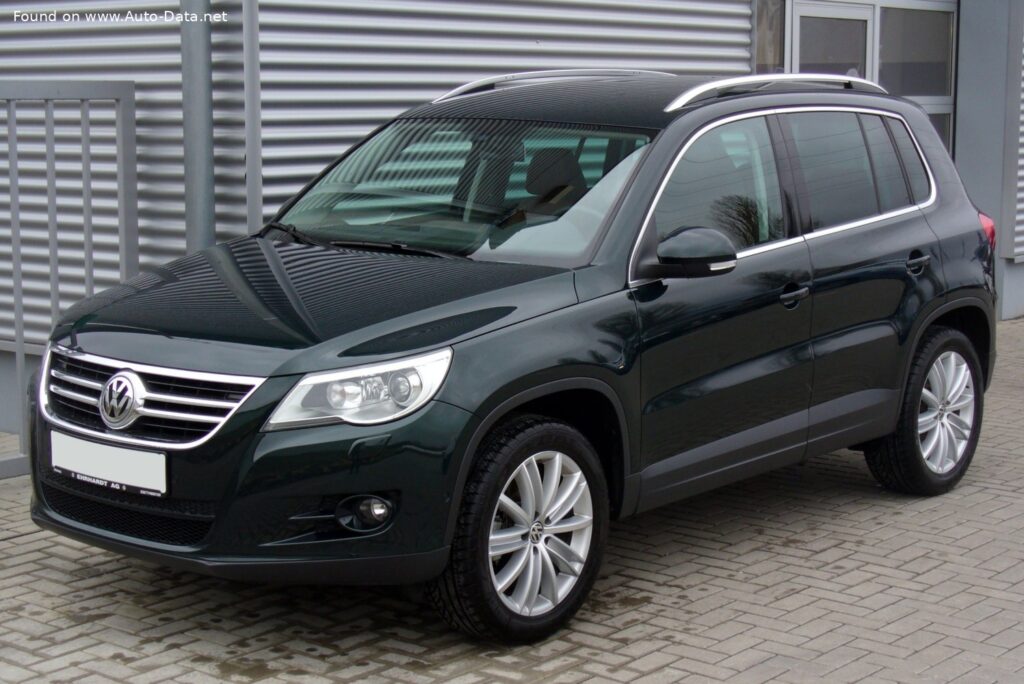
The Volkswagen Tiguan I 2.0 TDI (140 Hp) 4MOTION Automatic DPF, produced between 2007 and 2009, represents Volkswagen’s initial foray into the burgeoning compact SUV market. Positioned as a more practical and versatile alternative to traditional hatchbacks, the Tiguan aimed to blend the driving dynamics of a passenger car with the increased space and capability of a sport utility vehicle. While not initially sold in the United States, the Tiguan quickly gained popularity in Europe, becoming a significant competitor to models like the Nissan Qashqai and the Renault Kadjar. This first-generation Tiguan offered a compelling package of fuel efficiency, practicality, and available all-wheel drive, making it a popular choice for families and individuals seeking a versatile vehicle.
Volkswagen Tiguan I: An Overview
The Tiguan I, built on the Volkswagen Group’s PQ35 platform (shared with the Golf Mk5 and Touran), was a five-door SUV offering seating for five passengers. It distinguished itself with a relatively sophisticated suspension setup and the availability of Volkswagen’s 4MOTION all-wheel-drive system. The 2.0 TDI variant, equipped with a 140 horsepower diesel engine and an automatic transmission, was a common configuration, particularly in European markets where diesel fuel was prevalent and tax incentives favored lower-emission vehicles. The inclusion of a Diesel Particulate Filter (DPF) underscored Volkswagen’s commitment to meeting increasingly stringent emissions standards.
Engine & Performance
The heart of the Tiguan I 2.0 TDI is a 1,968 cc (120.09 cu. in.) inline-four cylinder diesel engine. This engine, designated CBAB or CFFB, produces 140 horsepower at 4,000 rpm and a substantial 320 Nm (236.02 lb.-ft.) of torque at 1750 rpm. The torque output, readily available at low engine speeds, provides strong acceleration and effortless cruising. The engine utilizes a turbocharger with an intercooler to enhance performance and efficiency. Fuel is delivered via a Diesel Commonrail injection system, contributing to refined operation and reduced emissions. Paired with a six-speed automatic transmission and the 4MOTION all-wheel-drive system, the Tiguan I 2.0 TDI achieves a 0-100 km/h (0-62 mph) time of 10.9 seconds and a maximum speed of 182 km/h (113.09 mph). Fuel economy figures are respectable for a vehicle of its type, with combined cycle consumption rated at 7.5 l/100 km (31.4 US mpg, 37.7 UK mpg).
Design & Features
The Tiguan I features a contemporary SUV design, characterized by clean lines and a relatively upright stance. Its five-door body style provides easy access to the cabin, and the interior is designed with practicality in mind. The rear seats can be folded down to increase cargo capacity, ranging from a minimum of 470 liters (16.6 cu. ft.) to a maximum of 1,510 liters (53.33 cu. ft.) with the seats folded. Standard safety features for the era included ABS (Anti-lock Braking System) and electric power steering. The 4MOTION all-wheel-drive system provides enhanced traction and stability in various driving conditions, making the Tiguan a capable vehicle for both on-road and light off-road use. Available wheel sizes ranged from 6.5J x 16 to 7J x 17, typically fitted with tires sized 215/65 R16 or 235/55 R17. The vehicle’s dimensions – 4,427 mm (174.29 in.) in length, 1,809 mm (71.22 in.) in width, and 1,683 mm (66.26 in.) in height – position it squarely within the compact SUV segment.
Technical Specifications
| Brand | Volkswagen |
| Model | Tiguan |
| Generation | Tiguan I |
| Type (Engine) | 2.0 TDI (140 Hp) 4MOTION Automatic DPF |
| Start of production | 2007 |
| End of production | 2009 |
| Powertrain Architecture | Internal Combustion engine |
| Body type | SUV |
| Seats | 5 |
| Doors | 5 |
| Fuel consumption (urban) | 9.7 l/100 km (24.2 US mpg, 29.1 UK mpg, 10.3 km/l) |
| Fuel consumption (extra urban) | 6.3 l/100 km (37.3 US mpg, 44.8 UK mpg, 15.9 km/l) |
| Fuel consumption (combined) | 7.5 l/100 km (31.4 US mpg, 37.7 UK mpg, 13.3 km/l) |
| Fuel Type | Diesel |
| Acceleration 0 – 100 km/h | 10.9 sec |
| Acceleration 0 – 62 mph | 10.9 sec |
| Acceleration 0 – 60 mph | 10.4 sec |
| Maximum speed | 182 km/h (113.09 mph) |
| Emission standard | Euro 4 |
| Weight-to-power ratio | 11.5 kg/Hp, 87.3 Hp/tonne |
| Weight-to-torque ratio | 5 kg/Nm, 199.5 Nm/tonne |
| Power | 140 Hp @ 4000 rpm |
| Power per litre | 71.1 Hp/l |
| Torque | 320 Nm @ 1750 rpm (236.02 lb.-ft. @ 1750 rpm) |
| Engine layout | Front, Transverse |
| Engine Model/Code | CBAB, CFFB |
| Engine displacement | 1968 cm3 (120.09 cu. in.) |
| Number of cylinders | 4 |
| Engine configuration | Inline |
| Cylinder Bore | 81 mm (3.19 in.) |
| Piston Stroke | 95.5 mm (3.76 in.) |
| Compression ratio | 18.5:1 |
| Number of valves per cylinder | 4 |
| Fuel injection system | Diesel Commonrail |
| Engine aspiration | Turbocharger, Intercooler |
| Engine oil capacity | 4 l (4.23 US qt | 3.52 UK qt) |
| Kerb Weight | 1604 kg (3536.21 lbs.) |
| Max. weight | 2260 kg (4982.45 lbs.) |
| Max load | 656 kg (1446.23 lbs.) |
| Trunk (boot) space – minimum | 470 l (16.6 cu. ft.) |
| Trunk (boot) space – maximum | 1510 l (53.33 cu. ft.) |
| Fuel tank capacity | 64 l (16.91 US gal | 14.08 UK gal) |
| Length | 4427 mm (174.29 in.) |
| Width | 1809 mm (71.22 in.) |
| Height | 1683 mm (66.26 in.) |
| Wheelbase | 2604 mm (102.52 in.) |
| Front track | 1570 mm (61.81 in.) |
| Rear (Back) track | 1570 mm (61.81 in.) |
| Minimum turning circle | 12 m (39.37 ft.) |
| Drive wheel | All wheel drive (4×4) |
| Number of gears | 6 |
| Type of gearbox | automatic transmission |
| Front brakes | Disc |
| Rear brakes | Disc |
| Assisting systems | ABS (Anti-lock braking system) |
| Power steering | Electric Steering |
| Tires size | 215/65 R16; 235/55 R17 |
| Wheel rims size | 6.5J x 16; 7J x 17 |
