
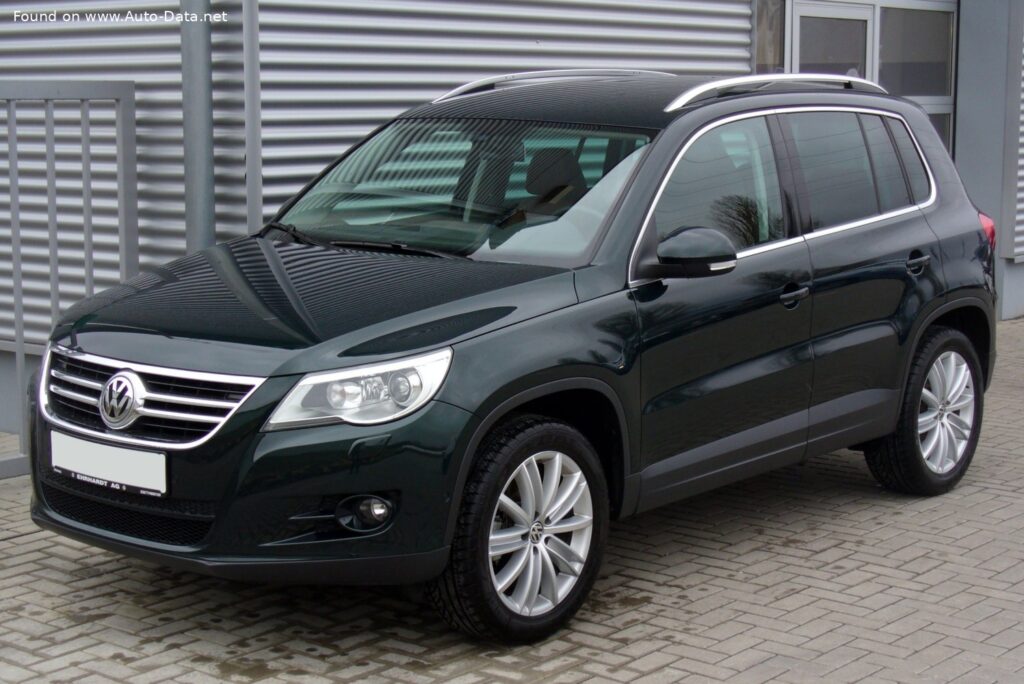
The Volkswagen Tiguan I 2.0 TDI (170 Hp) 4MOTION is a compact SUV produced by the German manufacturer Volkswagen from 2008 to 2009. Representing Volkswagen’s entry into the burgeoning compact SUV segment, the Tiguan aimed to blend the practicality of a small family vehicle with the capability of an all-wheel-drive system. While not initially sold in the United States during its first generation, the Tiguan was a significant model in the European market, competing with vehicles like the Nissan Qashqai, Renault Kadjar, and Hyundai ix35. The “Tiguan” name itself is a portmanteau of “tiger” and “Iguana,” reflecting the vehicle’s intended blend of ruggedness and agility.
Volkswagen Tiguan I: Overview and Market Position
The Tiguan I was based on the Volkswagen Group’s PQ35 platform, shared with models like the Volkswagen Golf Mk5 and Audi TT. This platform allowed for a relatively lightweight and agile chassis, contributing to the Tiguan’s balanced driving characteristics. The 4MOTION all-wheel-drive system, a staple of Volkswagen’s offerings, provided enhanced traction in various conditions, making it a popular choice in regions with inclement weather. The 2.0 TDI engine variant, producing 170 horsepower, was a common engine choice in Europe, offering a balance of performance and fuel efficiency. The Tiguan I was positioned as a more premium offering within the compact SUV segment, with a focus on build quality, interior refinement, and technological features.
Engine & Performance
The Tiguan I 2.0 TDI (170 Hp) 4MOTION is powered by a 1.968-liter inline-four cylinder diesel engine, designated the CBBB engine code. This engine utilizes a turbocharger with an intercooler to boost power output to 170 horsepower at 4,400 rpm, and delivers a substantial 350 Nm (258.15 lb.-ft.) of torque between 1,750 and 2,500 rpm. This torque band provides strong acceleration and effortless cruising. Power is delivered to all four wheels via a six-speed manual transmission and Volkswagen’s 4MOTION all-wheel-drive system. The 4MOTION system is primarily front-wheel drive, engaging the rear wheels as needed via a multi-plate clutch to maintain optimal traction. Acceleration from 0 to 100 km/h (0-62 mph) takes 8.9 seconds, while 0 to 60 mph is achieved in approximately 8.5 seconds. The vehicle boasts a maximum speed of 201 km/h (124.9 mph). Fuel economy, according to the NEDC standard, is rated at 6.6 l/100 km (35.6 US mpg) combined, with 8.4 l/100 km (28 US mpg) in urban driving and 5.5 l/100 km (42.8 US mpg) on the extra-urban cycle. CO2 emissions are rated at 172 g/km.
Design & Features
The Tiguan I features a contemporary SUV design, characterized by its relatively compact dimensions and upright stance. The body style is a five-door SUV with seating for five passengers. Key design elements include a prominent front grille, sculpted headlights, and a relatively short rear overhang. The interior is designed with practicality and comfort in mind, offering a spacious cabin for its class. Standard features typically included air conditioning, power windows, central locking, and an audio system. Safety features, important for the era, included ABS (Anti-lock Braking System), and driver and passenger airbags. The Tiguan I offers a trunk (boot) space of 470 liters (16.6 cu. ft.) with the rear seats up, expanding to 1510 liters (53.33 cu. ft.) when the rear seats are folded down. The vehicle has a kerb weight of 1534 kg (3381.89 lbs) and a maximum permissible weight of 2243 kg (4944.97 lbs). The Tiguan I’s design prioritized a blend of functionality, modern aesthetics, and a comfortable driving experience.
Technical Specifications
| Brand | Volkswagen |
| Model | Tiguan |
| Generation | Tiguan I |
| Type (Engine) | 2.0 TDI (170 Hp) 4MOTION |
| Start of production | 2008 |
| End of production | 2009 |
| Powertrain Architecture | Internal Combustion engine |
| Body type | SUV |
| Seats | 5 |
| Doors | 5 |
| Fuel consumption (economy) – urban (NEDC) | 8.4 l/100 km (28 US mpg) |
| Fuel consumption (economy) – extra urban (NEDC) | 5.5 l/100 km (42.8 US mpg) |
| Fuel consumption (economy) – combined (NEDC) | 6.6 l/100 km (35.6 US mpg) |
| CO2 emissions (NEDC) | 172 g/km |
| Fuel Type | Diesel |
| Acceleration 0 – 100 km/h | 8.9 sec |
| Acceleration 0 – 62 mph | 8.9 sec |
| Acceleration 0 – 60 mph | 8.5 sec |
| Maximum speed | 201 km/h (124.9 mph) |
| Emission standard | Euro 4 |
| Weight-to-power ratio | 9 kg/Hp |
| Weight-to-torque ratio | 4.4 kg/Nm |
| Power | 170 Hp @ 4400 rpm |
| Torque | 350 Nm @ 1750-2500 rpm (258.15 lb.-ft.) |
| Engine layout | Front, Transverse |
| Engine Model/Code | CBBB |
| Engine displacement | 1968 cm3 (120.09 cu. in.) |
| Number of cylinders | 4 |
| Engine configuration | Inline |
| Cylinder Bore | 81 mm (3.19 in.) |
| Piston Stroke | 95.5 mm (3.76 in.) |
| Compression ratio | 16.5:1 |
| Number of valves per cylinder | 4 |
| Fuel injection system | Diesel Commonrail |
| Engine aspiration | Turbocharger, Intercooler |
| Valvetrain | DOHC |
| Engine oil capacity | 4 l (4.23 US qt | 3.52 UK qt) |
| Kerb Weight | 1534 kg (3381.89 lbs.) |
| Max. weight | 2243 kg (4944.97 lbs.) |
| Max load | 709 kg (1563.08 lbs.) |
| Trunk (boot) space – minimum | 470 l (16.6 cu. ft.) |
| Trunk (boot) space – maximum | 1510 l (53.33 cu. ft.) |
| Fuel tank capacity | 64 l (16.91 US gal | 14.08 UK gal) |
| Length | 4457 mm (175.47 in.) |
| Width | 1809 mm (71.22 in.) |
| Height | 1686 mm (66.38 in.) |
| Wheelbase | 2604 mm (102.52 in.) |
The Volkswagen Tiguan I 2.0 TDI (170 Hp) 4MOTION represented a significant step for Volkswagen in the compact SUV market, offering a blend of practicality, performance, and all-weather capability. While not initially available in the US market, it established the Tiguan nameplate as a contender in the global SUV landscape.
