
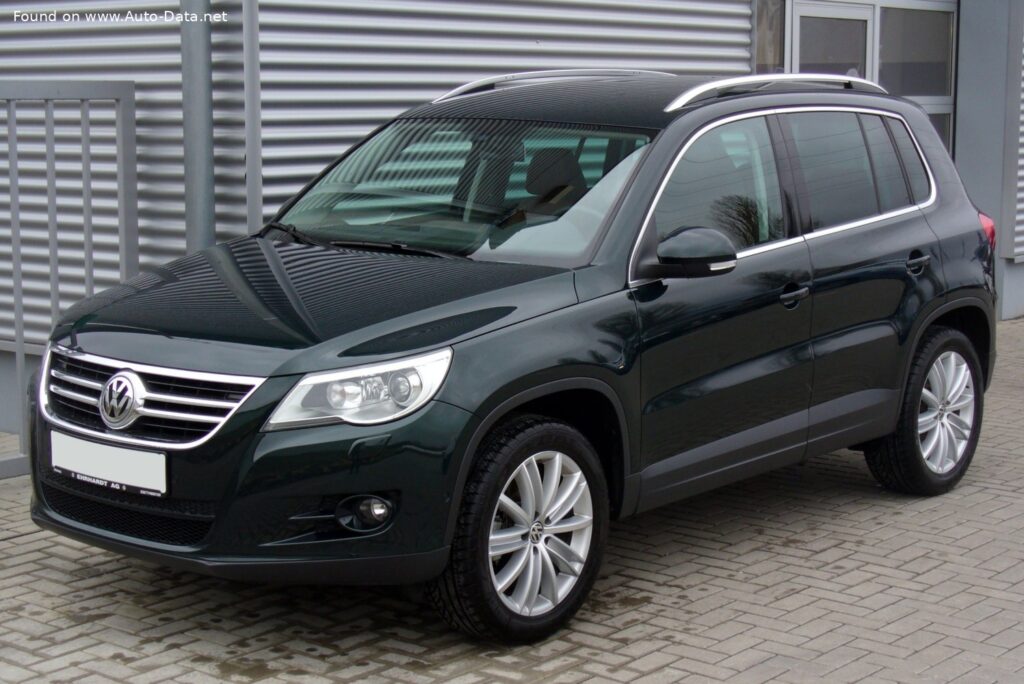
The Volkswagen Tiguan I 2.0 TDI BMT (140 Hp) represents Volkswagen’s entry into the burgeoning compact SUV market in the late 2000s. Introduced in 2009 and continuing through 2011, this iteration of the Tiguan was primarily aimed at the European market, offering a blend of practicality, fuel efficiency, and Volkswagen’s typically understated styling. While not initially a major seller in the United States (the Tiguan was introduced to the US market in 2009 as a 2010 model, but with different engine options), the Tiguan I established the nameplate and laid the groundwork for its future success as a globally recognized SUV. This model distinguished itself with its focus on diesel power, offering a compelling alternative to gasoline-powered competitors, particularly in regions with higher diesel fuel acceptance and favorable tax incentives.
Volkswagen Tiguan I 2.0 TDI BMT (140 Hp): Overview
The Tiguan I, built on the PQ35 platform shared with the Volkswagen Golf Mk5 and Audi TT, was designed to be a versatile vehicle capable of both on-road comfort and light off-road capability. The 2.0 TDI BMT variant, specifically, was a popular choice in Europe due to its balance of performance and economy. “BMT” stands for “BlueMotion Technology,” indicating the inclusion of fuel-saving features. The Tiguan I offered a five-seat configuration and a practical cargo area, making it suitable for small families or individuals needing flexible space. It was positioned as a more premium offering within the compact SUV segment, competing with vehicles like the Nissan Qashqai and Renault Kadjar.
Engine & Performance
The heart of the Tiguan I 2.0 TDI BMT is a 1,968 cc (120.09 cu. in.) inline-four cylinder diesel engine. This engine produces 140 horsepower (Hp) at 4,200 rpm and 320 Newton-meters (236.02 lb.-ft.) of torque between 1,750 and 2,500 rpm. The engine utilizes a turbocharger with an intercooler to enhance performance and efficiency. Fuel is delivered via a Diesel Commonrail injection system, ensuring precise fuel metering and optimized combustion. Power is sent to the front wheels through a six-speed manual transmission. Acceleration from 0 to 100 km/h (0-62 mph) takes 10.2 seconds, while 0 to 60 mph is achieved in approximately 9.7 seconds. The vehicle boasts a maximum speed of 192 km/h (119.3 mph). The engine’s power-to-weight ratio is 10.4 kg/Hp, and its torque-to-weight ratio is 4.6 kg/Nm. The engine’s 18:1 compression ratio is typical for a diesel engine, contributing to its efficiency.
Design & Features
The Tiguan I features a classic SUV body style with a five-door configuration. Its design is characterized by clean lines and a relatively understated aesthetic, typical of Volkswagen’s design philosophy at the time. The vehicle’s dimensions are 4,427 mm (174.29 in.) in length, 1,809 mm (71.22 in.) in width, and 1,686 mm (66.38 in.) in height. The wheelbase measures 2,604 mm (102.52 in.). The interior of the Tiguan I is functional and well-built, with a focus on practicality. Standard features included air conditioning, power windows, and a basic audio system. Safety features, while not as comprehensive as modern vehicles, included ABS (Anti-lock Braking System) and front airbags. The Tiguan I offered a trunk (boot) space of 470 liters (16.6 cu. ft.) with the rear seats up, expanding to 1,510 liters (53.33 cu. ft.) with the rear seats folded down. The vehicle’s ride height (ground clearance) is 200 mm (7.87 in.), providing adequate ground clearance for light off-road use. The inclusion of a particulate filter and a Start & Stop system in the BMT version demonstrates Volkswagen’s early efforts to reduce emissions and improve fuel economy.
Technical Specifications
| Brand | Volkswagen |
| Model | Tiguan |
| Generation | Tiguan I |
| Type (Engine) | 2.0 TDI BMT (140 Hp) |
| Start of production | 2009 year |
| End of production | 2011 year |
| Powertrain Architecture | Internal Combustion engine |
| Body type | SUV |
| Seats | 5 |
| Doors | 5 |
| Fuel consumption (economy) – urban (NEDC) | 6.3 l/100 km (37.3 US mpg, 44.8 UK mpg, 15.9 km/l) |
| Fuel consumption (economy) – extra urban (NEDC) | 4.8 l/100 km (49 US mpg, 58.9 UK mpg, 20.8 km/l) |
| Fuel consumption (economy) – combined (NEDC) | 5.3 l/100 km (44.4 US mpg, 53.3 UK mpg, 18.9 km/l) |
| CO2 emissions (NEDC) | 139 g/km |
| Fuel Type | Diesel |
| Acceleration 0 – 100 km/h | 10.2 sec |
| Acceleration 0 – 62 mph | 10.2 sec |
| Acceleration 0 – 60 mph | 9.7 sec |
| Maximum speed | 192 km/h (119.3 mph) |
| Emission standard | Euro 5 |
| Weight-to-power ratio | 10.4 kg/Hp |
| Weight-to-torque ratio | 4.6 kg/Nm |
| Power | 140 Hp @ 4200 rpm |
| Torque | 320 Nm @ 1750-2500 rpm (236.02 lb.-ft. @ 1750-2500 rpm) |
| Engine layout | Front, Transverse |
| Engine Model/Code | CBAB, CFFB |
| Engine displacement | 1968 cm3 (120.09 cu. in.) |
| Number of cylinders | 4 |
| Engine configuration | Inline |
| Cylinder Bore | 81 mm (3.19 in.) |
| Piston Stroke | 95.5 mm (3.76 in.) |
| Compression ratio | 18:1 |
| Number of valves per cylinder | 4 |
| Fuel injection system | Diesel Commonrail |
| Engine aspiration | Turbocharger, Intercooler |
| Valvetrain | DOHC |
| Engine oil capacity | 4 l (4.23 US qt | 3.52 UK qt) |
| Kerb Weight | 1460 kg (3218.75 lbs.) |
| Max. weight | 2080 kg (4585.62 lbs.) |
| Max load | 620 kg (1366.87 lbs.) |
| Trunk (boot) space – minimum | 470 l (16.6 cu. ft.) |
| Trunk (boot) space – maximum | 1510 l (53.33 cu. ft.) |
| Fuel tank capacity | 64 l (16.91 US gal | 14.08 UK gal) |
| Length | 4427 mm (174.29 in.) |
| Width | 1809 mm (71.22 in.) |
| Height | 1686 mm (66.38 in.) |
| Wheelbase | 2604 mm (102.52 in.) |
The Volkswagen Tiguan I 2.0 TDI BMT (140 Hp) remains a significant vehicle in Volkswagen’s history, demonstrating the company’s commitment to fuel efficiency and practicality within the compact SUV segment. Its success in Europe paved the way for the Tiguan’s global expansion and its continued popularity today.
