
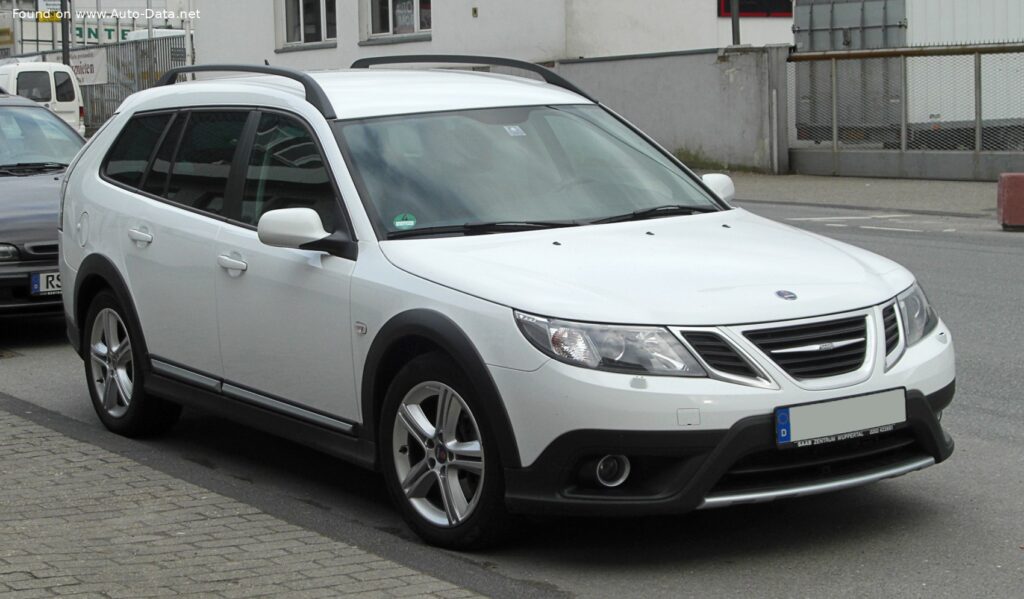
The Saab 9-3X II 2.0T XWD, produced between 2009 and 2010, represents a unique offering from the Swedish automaker, particularly as it was not widely sold in the United States. Positioned as a crossover station wagon (estate), it aimed to blend the practicality of a family vehicle with a slightly more rugged aesthetic. This second generation of the 9-3X was primarily marketed in Europe, offering an alternative to more conventional estate cars and early crossovers. The “XWD” designation signifies Saab’s all-wheel-drive system, a key feature intended to enhance stability and traction in varying road conditions. The 2.0T variant, equipped with a turbocharged 2.0-liter engine producing 210 horsepower, was a popular choice within the 9-3X lineup.
Saab 9-3X II 2.0T XWD: An Overview
The 9-3X II was a relatively short-lived model, reflecting the financial difficulties Saab faced in the late 2000s. It built upon the foundation of the standard Saab 9-3, but with increased ground clearance, robust body cladding, and standard all-wheel drive. This gave it a more adventurous appearance and improved capability on unpaved roads. While not a dedicated off-roader, the 9-3X II offered a compelling package for buyers seeking a versatile and stylish vehicle. The model’s design incorporated Saab’s signature Scandinavian aesthetic, emphasizing functionality and understated elegance.
Engine & Performance
The heart of the 9-3X II 2.0T XWD is a 1.998-liter inline-four cylinder engine, designated the B207R. This engine utilizes a turbocharger and intercooler to boost power output to 210 horsepower at 5300 rpm, and 300 Nm (221.27 lb.-ft.) of torque between 2500 and 4000 rpm. This provides a good balance of performance and fuel efficiency. The engine features multi-port fuel injection and a double overhead camshaft (DOHC) valvetrain. Power is delivered to all four wheels via a six-speed manual transmission, contributing to a 0-100 km/h (0-62 mph) acceleration time of 8.5 seconds. The 0-60 mph time is calculated at 8.1 seconds. Maximum speed is electronically limited to 230 km/h (142.92 mph). The engine’s power-to-weight ratio is 7.9 kg/Hp, and the torque-to-weight ratio is 5.5 kg/Nm, indicating a reasonably responsive driving experience. Fuel economy, as measured by the NEDC standard, is rated at 8.1 l/100 km (29 US mpg) combined, with 11.4 l/100 km (20.6 US mpg) in urban driving and 6.2 l/100 km (37.9 US mpg) on the open road. CO2 emissions are rated at 194 g/km.
Design & Features
The Saab 9-3X II is a five-door station wagon (estate) with crossover styling cues. It features a raised ride height, protective lower body cladding, and distinctive roof rails. The interior offers seating for five passengers and provides a practical cargo area. Trunk space ranges from 477 liters (16.85 cu. ft.) with the rear seats up to 1331 liters (47 cu. ft.) with the seats folded down. The vehicle’s design prioritizes functionality and practicality, with a focus on providing a comfortable and versatile space for passengers and cargo. Safety features included ABS (Anti-lock braking system) as standard. The steering is rack and pinion with hydraulic power assistance. The vehicle rides on either 225/50 R17 or 235/45 R18 tires, mounted on 7J x 17 or 7.5J x 18 inch wheel rims respectively. The 9-3X II’s design, while rooted in the traditional Saab aesthetic, incorporated elements intended to appeal to a broader audience seeking a more contemporary and versatile vehicle.
Technical Specifications
| Brand | Saab |
| Model | 9-3 |
| Generation | 9-3X II |
| Type (Engine) | 2.0T (210 Hp) XWD |
| Start of production | June, 2009 |
| End of production | December, 2010 |
| Powertrain Architecture | Internal Combustion engine |
| Body type | Station wagon (estate), Crossover |
| Seats | 5 |
| Doors | 5 |
| Fuel consumption (economy) – urban (NEDC) | 11.4 l/100 km (20.6 US mpg, 24.8 UK mpg, 8.8 km/l) |
| Fuel consumption (economy) – extra urban (NEDC) | 6.2 l/100 km (37.9 US mpg, 45.6 UK mpg, 16.1 km/l) |
| Fuel consumption (economy) – combined (NEDC) | 8.1 l/100 km (29 US mpg, 34.9 UK mpg, 12.3 km/l) |
| CO2 emissions (NEDC) | 194 g/km |
| Fuel Type | Petrol (Gasoline) |
| Acceleration 0 – 100 km/h | 8.5 sec |
| Acceleration 0 – 62 mph | 8.5 sec |
| Acceleration 0 – 60 mph | 8.1 sec |
| Maximum speed | 230 km/h (142.92 mph) |
| Emission standard | Euro 4 |
| Weight-to-power ratio | 7.9 kg/Hp, 127 Hp/tonne |
| Weight-to-torque ratio | 5.5 kg/Nm, 181.5 Nm/tonne |
| Power | 210 Hp @ 5300 rpm |
| Power per litre | 105.1 Hp/l |
| Torque | 300 Nm @ 2500-4000 rpm (221.27 lb.-ft. @ 2500-4000 rpm) |
| Engine layout | Front, Transverse |
| Engine Model/Code | B207R |
| Engine displacement | 1998 cm3 (121.93 cu. in.) |
| Number of cylinders | 4 |
| Engine configuration | Inline |
| Cylinder Bore | 86 mm (3.39 in.) |
| Piston Stroke | 86 mm (3.39 in.) |
| Number of valves per cylinder | 4 |
| Fuel injection system | Multi-port manifold injection |
| Engine aspiration | Turbocharger, Intercooler |
| Valvetrain | DOHC |
| Engine oil capacity | 6 l (6.34 US qt | 5.28 UK qt) |
| Coolant | 7.5 l (7.93 US qt | 6.6 UK qt) |
| Kerb Weight | 1653-1761 kg (3644.24 – 3882.34 lbs.) |
| Max. weight | 2118-2226 kg (4669.39 – 4907.49 lbs.) |
| Max load | 465 kg (1025.15 lbs.) |
| Trunk (boot) space – minimum | 477 l (16.85 cu. ft.) |
| Trunk (boot) space – maximum | 1331 l (47 cu. ft.) |
| Fuel tank capacity | 61 l (16.11 US gal | 13.42 UK gal) |
| Max. roof load | 100 kg (220.46 lbs.) |
| Permitted trailer load with brakes (12%) | 1600 kg (3527.4 lbs.) |
| Permitted trailer load without brakes | 750 kg (1653.47 lbs.) |
| Length | 4690 mm (184.65 in.) |
| Width | 1802 mm (70.94 in.) |
| Width including mirrors | 2038 mm (80.24 in.) |
| Height | 1574 mm (61.97 in.) |
| Wheelbase | 2675 mm (105.31 in.) |
| Front track | 1524 mm (60 in.) |
| Rear (Back) track | 1504 mm (59.21 in.) |
| Front overhang | 985 mm (38.78 in.) |
| Rear overhang | 1030 mm (40.55 in.) |
| Minimum turning circle (turning diameter) | 11.7 m (38.39 ft.) |
| Drivetrain Architecture | All wheel drive (4×4). ICE drives front wheels, rear wheels driven by clutch. |
| Number of gears and type of gearbox | 6 gears, manual transmission |
| Front suspension | Independent, McPherson with coil spring and anti-roll bar |
| Rear suspension | Independent multi-link spring suspension with stabilizer |
| Front brakes | Ventilated discs, 314 mm |
| Rear brakes | Ventilated discs, 292 mm |
| Steering type | Steering rack and pinion |
| Power steering | Hydraulic Steering |
| Tires size | 225/50 R17; 235/45 R18 |
| Wheel rims size | 7J x 17; 7.5J x 18 |
The Saab 9-3X II 2.0T XWD, despite its short production run, remains a distinctive and appealing vehicle for those seeking a blend of practicality, style, and all-weather capability. It represents a final chapter in Saab’s independent history, showcasing the brand’s commitment to innovation and Scandinavian design.
