
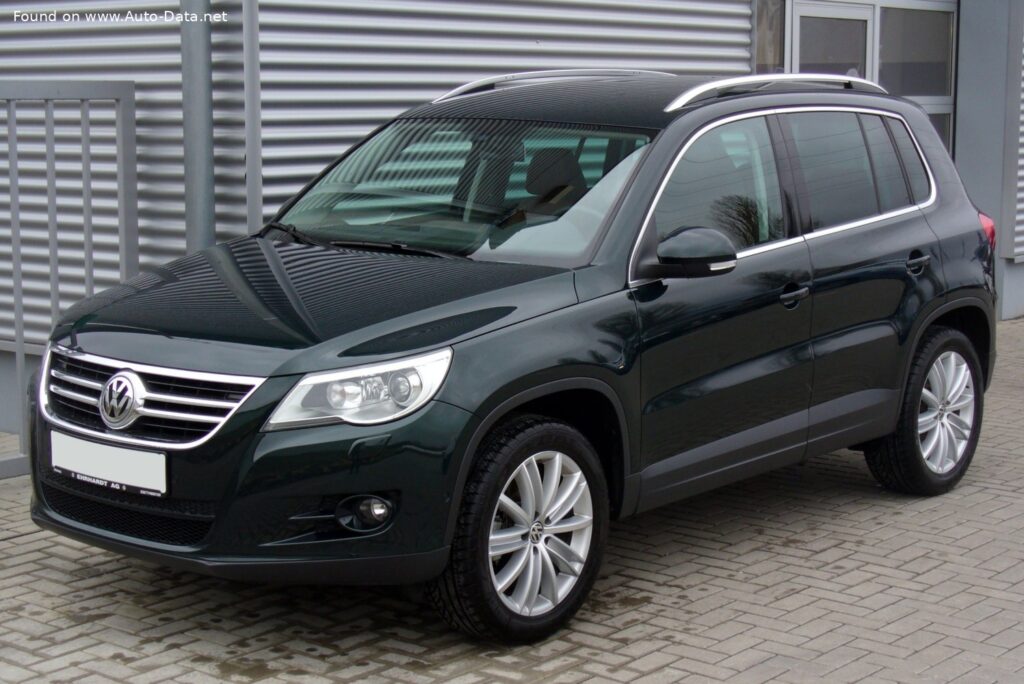
The Volkswagen Tiguan I 2.0 TSI (170 Hp) 4MOTION DSG is a compact SUV produced by the German manufacturer Volkswagen between 2010 and 2011. Representing the first generation of the Tiguan model, it was designed to bridge the gap between Volkswagen’s smaller SUVs and larger crossover vehicles. While not initially offered in the North American market during this specific iteration, the Tiguan has since become a significant player in the US SUV segment. The Tiguan I, particularly the 2.0 TSI 4MOTION variant, was primarily aimed at the European market, offering a blend of practicality, performance, and all-wheel-drive capability.
Volkswagen Tiguan I: An Overview
The Tiguan I was Volkswagen’s entry into the burgeoning compact SUV market. Launched in 2007, it was positioned as a more stylish and dynamic alternative to traditional SUVs. The 2.0 TSI 4MOTION model, equipped with a turbocharged gasoline engine and Volkswagen’s 4MOTION all-wheel-drive system, was a popular choice for drivers seeking enhanced performance and all-weather traction. The “TSI” designation signifies Volkswagen’s direct-injection turbocharged stratified injection engine technology. The DSG (Direct-Shift Gearbox) is a dual-clutch transmission known for its quick and smooth gear changes.
Engine & Performance
The heart of the Tiguan I 2.0 TSI 4MOTION is a 1.984-liter (121.07 cubic inches) inline-four cylinder engine. This engine produces 170 horsepower at 4,300-6,000 rpm and 280 Nm (206.52 lb-ft) of torque between 1,700 and 5,000 rpm. The direct injection and turbocharging contribute to a responsive driving experience. Power is delivered to all four wheels via Volkswagen’s 4MOTION system, an on-demand all-wheel-drive system that normally operates in front-wheel drive to maximize fuel efficiency, engaging the rear wheels when traction is needed. The 7-speed DSG automatic transmission provides quick and efficient gear changes, contributing to a 0-100 km/h (0-62 mph) acceleration time of 8.1 seconds. The 0-60 mph time is calculated at 7.7 seconds. The vehicle achieves a maximum speed of 199 km/h (123.65 mph). The engine’s power-to-weight ratio is 9.3 kg/Hp, and the torque-to-weight ratio is 5.6 kg/Nm.
Design & Features
The Tiguan I features a contemporary SUV design, characterized by its relatively compact dimensions and upright stance. It’s a five-door SUV with seating for five passengers. The interior is designed with practicality and comfort in mind, offering a spacious cabin for its class. Key features include a versatile cargo area with a minimum capacity of 470 liters (16.6 cubic feet) expanding to 1510 liters (53.33 cubic feet) with the rear seats folded down. Standard safety features for the era included ABS (Anti-lock Braking System) and a robust chassis designed for stability. The suspension utilizes an independent McPherson strut setup at the front and an independent multi-link suspension at the rear, providing a comfortable ride and responsive handling. The vehicle’s dimensions are 4427 mm (174.29 in) in length, 1809 mm (71.22 in) in width, and 1686 mm (66.38 in) in height. Ground clearance is 200 mm (7.87 in).
Technical Specifications
| Brand | Volkswagen |
| Model | Tiguan |
| Generation | Tiguan I |
| Type (Engine) | 2.0 TSI (170 Hp) 4MOTION DSG |
| Start of production | 2010 |
| End of production | 2011 |
| Powertrain Architecture | Internal Combustion engine |
| Body type | SUV |
| Seats | 5 |
| Doors | 5 |
| Fuel consumption (economy) – urban (NEDC) | 11.8 l/100 km (19.9 US mpg, 23.9 UK mpg, 8.5 km/l) |
| Fuel consumption (economy) – extra urban (NEDC) | 6.7 l/100 km (35.1 US mpg, 42.2 UK mpg, 14.9 km/l) |
| Fuel consumption (economy) – combined (NEDC) | 8.6 l/100 km (27.4 US mpg, 32.8 UK mpg, 11.6 km/l) |
| CO2 emissions (NEDC) | 199 g/km |
| Fuel Type | Petrol (Gasoline) |
| Acceleration 0 – 100 km/h | 8.1 sec |
| Acceleration 0 – 62 mph | 8.1 sec |
| Acceleration 0 – 60 mph | 7.7 sec |
| Maximum speed | 199 km/h (123.65 mph) |
| Emission standard | Euro 5 |
| Weight-to-power ratio | 9.3 kg/Hp, 108.1 Hp/tonne |
| Weight-to-torque ratio | 5.6 kg/Nm, 178 Nm/tonne |
| Power | 170 Hp @ 4300-6000 rpm |
| Power per litre | 85.7 Hp/l |
| Torque | 280 Nm @ 1700-5000 rpm (206.52 lb.-ft. @ 1700-5000 rpm) |
| Engine layout | Front, Transverse |
| Engine Model/Code | CAWA, CCZC |
| Engine displacement | 1984 cm3 (121.07 cu. in.) |
| Number of cylinders | 4 |
| Engine configuration | Inline |
| Cylinder Bore | 82.5 mm (3.25 in.) |
| Piston Stroke | 92.8 mm (3.65 in.) |
| Compression ratio | 9.6:1 |
| Number of valves per cylinder | 4 |
| Fuel injection system | Direct injection |
| Engine aspiration | Turbocharger, Intercooler |
| Valvetrain | DOHC |
| Engine oil capacity | 4.7 l (4.97 US qt | 4.14 UK qt) |
| Kerb Weight | 1573 kg (3467.87 lbs.) |
| Max. weight | 2220 kg (4894.26 lbs.) |
| Max load | 647 kg (1426.39 lbs.) |
| Trunk (boot) space – minimum | 470 l (16.6 cu. ft.) |
| Trunk (boot) space – maximum | 1510 l (53.33 cu. ft.) |
| Fuel tank capacity | 64 l (16.91 US gal | 14.08 UK gal) |
| Max. roof load | 75 kg (165.35 lbs.) |
| Permitted trailer load with brakes (8%) | 2200 kg (4850.17 lbs.) |
| Permitted trailer load with brakes (12%) | 2200 kg (4850.17 lbs.) |
| Permitted trailer load without brakes | 750 kg (1653.47 lbs.) |
| Permitted towbar download | 100 kg (220.46 lbs.) |
| Length | 4427 mm (174.29 in.) |
| Width | 1809 mm (71.22 in.) |
| Width including mirrors | 2041 mm (80.35 in.) |
| Height | 1686 mm (66.38 in.) |
| Wheelbase | 2604 mm (102.52 in.) |
| Front track | 1570 mm (61.81 in.) |
| Rear (Back) track | 1570 mm (61.81 in.) |
| Front overhang | 925 mm (36.42 in.) |
| Rear overhang | 898 mm (35.35 in.) |
| Ride height (ground clearance) | 200 mm (7.87 in.) |
| Minimum turning circle (turning diameter) | 12 m (39.37 ft.) |
| Drivetrain Architecture | The Internal combustion engine (ICE) drives the front wheels permanently, and the rear wheels are driven through an electrically or mechanically operated clutch if necessary. |
| Drive wheel | All wheel drive (4×4) |
| Number of gears and type of gearbox | 7 gears, automatic transmission DSG |
The Volkswagen Tiguan I 2.0 TSI 4MOTION DSG, while not a long-lived model, established the Tiguan as a competitive force in the compact SUV segment. Its blend of performance, practicality, and all-wheel-drive capability made it a popular choice for European drivers, and paved the way for the Tiguan’s subsequent success in global markets.
