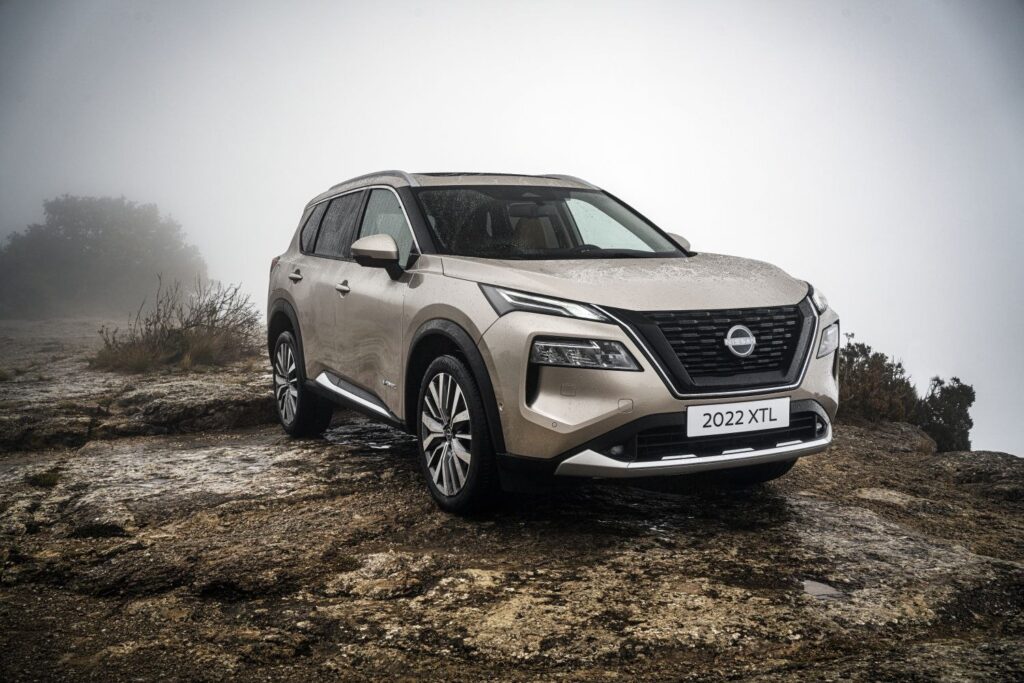
The Nissan X-Trail IV (T33), launched in September 2022, represents the fourth generation of Nissan’s popular compact SUV. Sold globally, the X-Trail holds a significant position in the European and Asian markets, competing with vehicles like the Hyundai Tucson, Kia Sportage, and Toyota RAV4. The T33 generation marks a substantial shift towards electrification and advanced technology, offering a compelling blend of practicality, efficiency, and family-focused features. This particular variant, the 1.5 VC-T e-4ORCE, is a full hybrid electric vehicle (FHEV) equipped with a 1.5-liter turbocharged engine and Nissan’s innovative e-4ORCE all-wheel-drive system, offering seven-seat capability.
Nissan X-Trail IV (T33) 1.5 VC-T e-4ORCE: An Overview
The fourth-generation X-Trail builds upon the strengths of its predecessors, focusing on enhanced comfort, safety, and fuel efficiency. The introduction of the e-4ORCE system and the VC-T engine demonstrates Nissan’s commitment to powertrain innovation. The T33 is characterized by a more modern and refined design, both inside and out, and a greater emphasis on connectivity and driver assistance technologies. The availability of a seven-seat configuration further enhances its appeal to families.
Engine & Performance
The heart of the X-Trail 1.5 VC-T e-4ORCE is a 1.5-liter three-cylinder turbocharged gasoline engine (KR15DDT) producing 158 horsepower at 4600 rpm and 250 Nm (184.39 lb.-ft.) of torque between 2400-4400 rpm. This engine features direct fuel injection and an intercooler to optimize performance and efficiency. However, the system’s total output is significantly higher due to the integration of two electric motors. A front electric motor delivers 204 horsepower and 330 Nm (243.4 lb.-ft.) of torque, while a rear electric motor contributes 136 horsepower and 195 Nm (143.82 lb.-ft.) of torque. Combined, the system generates a total of 213 horsepower and 525 Nm (387.22 lb.-ft.) of torque.
The e-4ORCE system allows for fully electric driving in certain situations, as well as a blended hybrid mode. The powertrain is coupled with a single-speed automatic transmission and Nissan’s intelligent all-wheel-drive system, providing confident traction and handling in various conditions. Acceleration from 0 to 100 km/h (0-62 mph) takes 7.2 seconds, and 0-60 mph is achieved in approximately 6.8 seconds. The vehicle has a maximum speed of 180 km/h (111.85 mph). Fuel consumption is rated at 6.3-6.7 liters per 100 kilometers (37.3-35.1 US mpg), with CO2 emissions ranging from 143-152 g/km, meeting Euro 6d-Full emission standards.
Design & Features
The Nissan X-Trail IV (T33) is a five-door SUV offering seating for up to seven passengers. Its exterior design is characterized by a bold front grille, sharp LED headlights, and a muscular silhouette. The vehicle’s dimensions are 4680 mm (184.25 in) in length, 1840 mm (72.44 in) in width, and 1720 mm (67.72 in) in height, with a wheelbase of 2705 mm (106.5 in).
Inside, the X-Trail T33 boasts a modern and spacious cabin with high-quality materials and a focus on practicality. Key features include a digital instrument cluster, a large touchscreen infotainment system with smartphone integration (Apple CarPlay and Android Auto), and a comprehensive suite of driver assistance systems. The seven-seat configuration provides flexibility for families, while the trunk offers a minimum of 485 liters (17.13 cu. ft.) of cargo space, expanding to 1298 liters (45.84 cu. ft.) with the rear seats folded down. Safety features include ABS, multiple airbags, and advanced driver-assistance systems like lane departure warning, automatic emergency braking, and adaptive cruise control. The battery, with a gross capacity of 2.1 kWh and a usable capacity of 1.73 kWh, is located under the front seats.
Technical Specifications
| General Information | Specifications |
| Brand | Nissan |
| Model | X-Trail |
| Generation | X-Trail IV (T33) |
| Type | 1.5 VC-T (213 Hp) e-4ORCE 4WD Automatic 7 Seat |
| Start of production | September, 2022 |
| Powertrain Architecture | FHEV (Full Hybrid Electric Vehicle) |
| Body type | SUV |
| Seats | 7 |
| Doors | 5 |
| Performance Specs | Specifications |
| Combined fuel consumption (WLTP) | 6.3-6.7 l/100 km (37.3 – 35.1 US mpg) |
| CO2 emissions (WLTP) | 143-152 g/km |
| Fuel Type | Petrol (Gasoline) |
| Acceleration 0 – 100 km/h | 7.2 sec |
| Acceleration 0 – 62 mph | 7.2 sec |
| Acceleration 0 – 60 mph | 6.8 sec |
| Maximum speed | 180 km/h (111.85 mph) |
| Emission standard | Euro 6d-Full |
| Weight-to-power ratio | 8.8 kg/Hp |
| Weight-to-torque ratio | 3.6 kg/Nm |
| Electric & Hybrid Specs | Specifications |
| Gross battery capacity | 2.1 kWh |
| Net (usable) battery capacity | 1.73 kWh |
| Battery voltage | 200 V |
| Battery technology | Lithium-ion (Li-Ion) |
| Battery location | Under the front seats |
| Electric motor power (Front) | 204 Hp |
| Electric motor torque (Front) | 330 Nm (243.4 lb.-ft.) |
| Electric motor location (Front) | Front axle, Transverse |
| Electric motor power (Rear) | 136 Hp |
| Electric motor torque (Rear) | 195 Nm (143.82 lb.-ft.) |
| Electric motor location (Rear) | Rear axle, Transverse |
| System power | 213 Hp |
| System torque | 525 Nm (387.22 lb.-ft.) |
| Internal Combustion Engine Specs | Specifications |
| Power | 158 Hp @ 4600 rpm |
| Torque | 250 Nm @ 2400-4400 rpm (184.39 lb.-ft. @ 2400-4400 rpm) |
| Engine layout | Front, Transverse |
| Engine Model/Code | KR15DDT |
| Engine displacement | 1497 cm3 (91.35 cu. in.) |
| Number of cylinders | 3 |
| Engine configuration | Inline |
| Cylinder Bore | 84 mm (3.31 in.) |
| Piston Stroke | 90.1 mm (3.55 in.) |
| Compression ratio | 14:1 |
| Fuel injection system | Direct injection |
| Engine aspiration | Turbocharger, Intercooler |
| Space, Volume & Weights | Specifications |
| Kerb Weight | 1883-1965 kg (4151.3 – 4332.08 lbs.) |
| Max. weight | 2535 kg (5588.72 lbs.) |
| Max load | 570-652 kg (1256.63 – 1437.41 lbs.) |
| Trunk (boot) space – minimum | 485 l (17.13 cu. ft.) |
| Trunk (boot) space – maximum | 1298 l (45.84 cu. ft.) |
| Fuel tank capacity | 55 l (14.53 US gal) |
| Permitted trailer load with brakes (12%) | 1650 kg (3637.63 lbs.) |
| Permitted trailer load without brakes | 750 kg (1653.47 lbs.) |