
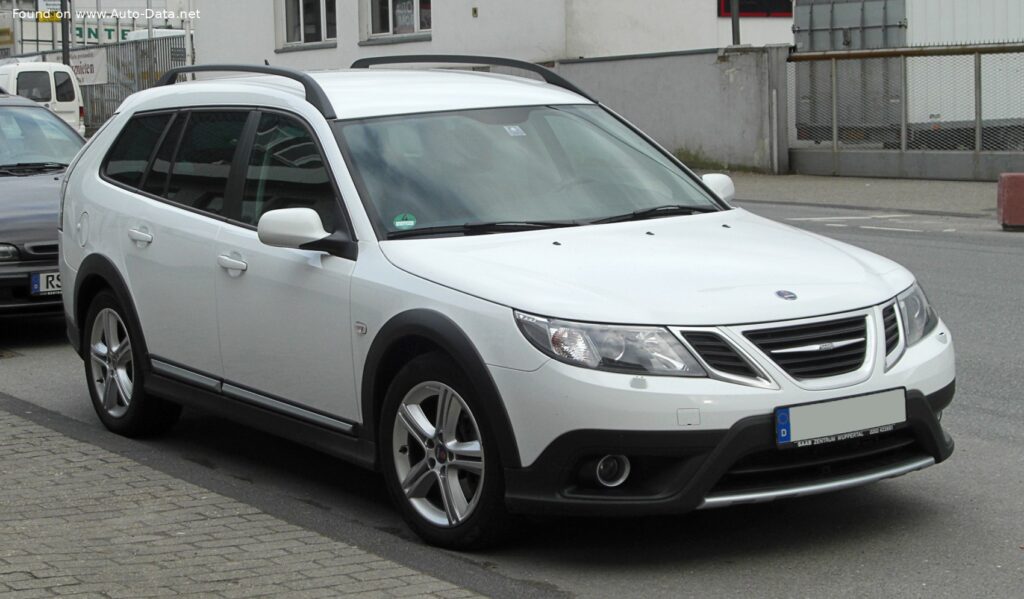
The Saab 9-3X II 2.0T XWD Sentronic represents a unique offering from the Swedish automaker, produced between 2009 and 2010. Positioned as a crossover station wagon (estate), it aimed to blend the practicality of a family vehicle with a slightly more rugged aesthetic. While not officially sold in the United States during its production run, the 9-3X was primarily marketed in Europe as a competitor to vehicles like the Audi A4 Allroad and Volvo XC70, offering all-wheel drive and increased ground clearance compared to the standard Saab 9-3 sedan and wagon. This model is significant as one of the final iterations of the 9-3 platform before Saab’s eventual bankruptcy in 2011.
Saab 9-3X II: A Detailed Overview
The 9-3X II falls within the compact executive car segment, attempting to carve out a niche for itself by offering a more versatile alternative to traditional saloons and estates. The “II” designation indicates a mid-cycle refresh of the original 9-3X, introducing subtle styling changes and updated technology. The XWD (Cross Wheel Drive) system was a key selling point, providing enhanced traction and stability in various driving conditions. The Sentronic automatic transmission further enhanced the vehicle’s appeal to drivers seeking convenience and ease of use.
Engine & Performance
The Saab 9-3X II 2.0T XWD is powered by a 2.0-liter inline-four cylinder turbocharged gasoline engine, designated the B207R. This engine produces 210 horsepower at 5300 rpm and 300 Nm (221.27 lb.-ft.) of torque between 2500 and 4000 rpm. The turbocharger and intercooler work in conjunction to deliver responsive performance and a relatively high power-to-litre ratio of 105.1 hp/l. Power is delivered to all four wheels via Saab’s XWD system, a sophisticated all-wheel-drive setup that utilizes an electronically controlled multi-plate clutch to distribute torque between the front and rear axles. This system proactively adjusts torque distribution based on driving conditions, enhancing grip and stability. The vehicle is equipped with a six-speed Sentronic automatic transmission, offering smooth and efficient gear changes. Acceleration from 0 to 100 km/h (0-62 mph) takes 9.6 seconds, while 0 to 60 mph is achieved in approximately 9.1 seconds. The top speed is electronically limited to 220 km/h (136.7 mph).
Design & Features
The Saab 9-3X II features a station wagon (estate) body style with crossover-inspired design elements. These include robust plastic cladding around the lower body, increased ride height, and roof rails, giving it a more adventurous appearance. The vehicle offers seating for five passengers and provides a generous 477 liters (16.85 cu. ft.) of trunk space with the rear seats up, expanding to 1331 liters (47 cu. ft.) when the rear seats are folded down. Inside, the 9-3X II offers a typically Scandinavian interior design, emphasizing functionality and simplicity. Standard features include air conditioning, power windows, and a basic audio system. Safety features, crucial for a vehicle of this era, include ABS (Anti-lock Braking System) and a robust chassis designed for impact protection. The vehicle’s design reflects Saab’s commitment to aerodynamic efficiency and driver-focused ergonomics.
Technical Specifications
| Brand | Saab |
| Model | 9-3 |
| Generation | 9-3X II |
| Type (Engine) | 2.0T (210 Hp) XWD Sentronic |
| Start of production | June, 2009 |
| End of production | December, 2010 |
| Powertrain Architecture | Internal Combustion engine |
| Body type | Station wagon (estate), Crossover |
| Seats | 5 |
| Doors | 5 |
| Fuel consumption (economy) – urban (NEDC) | 15.1 l/100 km (15.6 US mpg, 18.7 UK mpg, 6.6 km/l) |
| Fuel consumption (economy) – extra urban (NEDC) | 7.2 l/100 km (32.7 US mpg, 39.2 UK mpg, 13.9 km/l) |
| Fuel consumption (economy) – combined (NEDC) | 10.1 l/100 km (23.3 US mpg, 28 UK mpg, 9.9 km/l) |
| CO2 emissions (NEDC) | 242 g/km |
| Fuel Type | Petrol (Gasoline) |
| Acceleration 0 – 100 km/h | 9.6 sec |
| Acceleration 0 – 62 mph | 9.6 sec |
| Acceleration 0 – 60 mph | 9.1 sec |
| Maximum speed | 220 km/h (136.7 mph) |
| Emission standard | Euro 4 |
| Weight-to-power ratio | 7.9 kg/Hp, 127 Hp/tonne |
| Weight-to-torque ratio | 5.5 kg/Nm, 181.5 Nm/tonne |
| Power | 210 Hp @ 5300 rpm |
| Power per litre | 105.1 Hp/l |
| Torque | 300 Nm @ 2500-4000 rpm (221.27 lb.-ft. @ 2500-4000 rpm) |
| Engine layout | Front, Transverse |
| Engine Model/Code | B207R |
| Engine displacement | 1998 cm3 (121.93 cu. in.) |
| Number of cylinders | 4 |
| Engine configuration | Inline |
| Cylinder Bore | 86 mm (3.39 in.) |
| Piston Stroke | 86 mm (3.39 in.) |
| Compression ratio | 9.5:1 |
| Number of valves per cylinder | 4 |
| Fuel injection system | Multi-port manifold injection |
| Engine aspiration | Turbocharger, Intercooler |
| Valvetrain | DOHC |
| Engine oil capacity | 6 l (6.34 US qt | 5.28 UK qt) |
| Coolant | 7.5 l (7.93 US qt | 6.6 UK qt) |
| Kerb Weight | 1653-1761 kg (3644.24 – 3882.34 lbs.) |
| Max. weight | 2118-2226 kg (4669.39 – 4907.49 lbs.) |
| Max load | 465 kg (1025.15 lbs.) |
| Trunk (boot) space – minimum | 477 l (16.85 cu. ft.) |
| Trunk (boot) space – maximum | 1331 l (47 cu. ft.) |
| Fuel tank capacity | 61 l (16.11 US gal | 13.42 UK gal) |
| Max. roof load | 100 kg (220.46 lbs.) |
| Permitted trailer load with brakes (12%) | 1600 kg (3527.4 lbs.) |
| Permitted trailer load without brakes | 750 kg (1653.47 lbs.) |
| Length | 4690 mm (184.65 in.) |
| Width | 1802 mm (70.94 in.) |
| Width including mirrors | 2038 mm (80.24 in.) |
| Height | 1574 mm (61.97 in.) |
| Wheelbase | 2675 mm (105.31 in.) |
| Front track | 1524 mm (60 in.) |
| Rear (Back) track | 1504 mm (59.21 in.) |
| Front overhang | 985 mm (38.78 in.) |
| Rear overhang | 1030 mm (40.55 in.) |
| Minimum turning circle (turning diameter) | 11.7 m (38.39 ft.) |
| Drivetrain Architecture | The Internal combustion engine (ICE) drives the front wheels permanently, and the rear wheels are driven through an electrically or mechanically operated clutch if necessary. |
| Drive wheel | All wheel drive (4×4) |
| Number of gears and type of gearbox | 6 gears, automatic transmission Sentronic |
| Front suspension | Independent, type McPherson with coil spring and anti-roll bar |
| Rear suspension | Independent multi-link spring suspension with stabilizer |
| Front brakes | Ventilated discs, 314 mm |
| Rear brakes | Ventilated discs, 292 mm |
| Assisting systems | ABS (Anti-lock braking system) |
| Steering type | Steering rack and pinion |
| Power steering | Hydraulic Steering |
| Tires size | 225/50 R17; 235/45 R18 |
| Wheel rims size | 7J x 17; 7.5J x 18 |
