
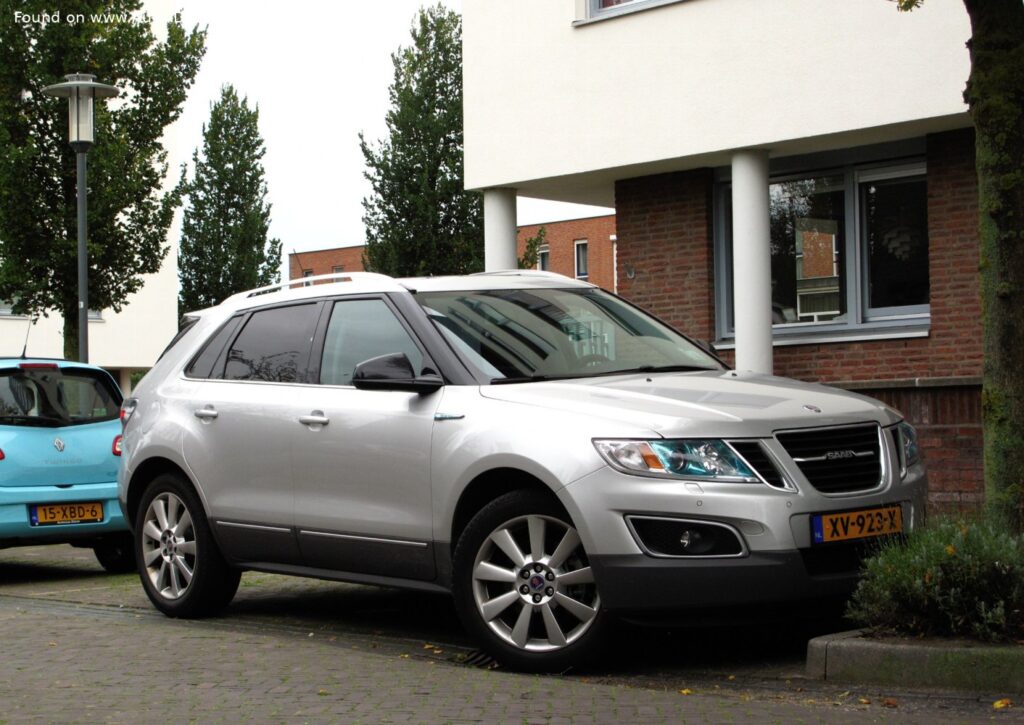
The Saab 9-4X is a compact luxury crossover SUV that was produced by the Swedish manufacturer Saab Automobile for the 2011 model year. Positioned above the Saab 9-3 in the company’s lineup, the 9-4X represented Saab’s attempt to enter the growing luxury SUV market. It was a relatively short-lived model, with production ceasing in 2011 due to Saab’s financial difficulties and eventual bankruptcy. While not widely sold in the United States, the 9-4X was intended to broaden Saab’s appeal and compete with established European and Japanese rivals.
The Saab 9-4X: A Late Entry into the Luxury Crossover Segment
The 9-4X was Saab’s first venture into the crossover SUV segment. Developed in collaboration with General Motors, who held a significant stake in Saab at the time, the 9-4X shared its platform with the Cadillac SRX. However, Saab engineers focused on imbuing the vehicle with the brand’s signature Scandinavian design principles and a focus on driver engagement. The vehicle aimed to offer a blend of practicality, comfort, and a unique driving experience, characteristics traditionally associated with the Saab brand.
Engine & Performance
The Saab 9-4X 3.0i V6 was powered by a 3.0-liter, naturally aspirated V6 engine, designated the LF1. This engine produced 265 horsepower at 6,950 rpm and 302 Nm (222.74 lb.-ft.) of torque at 5,100 rpm. The engine featured direct fuel injection and a double overhead camshaft (DOHC) valvetrain with four valves per cylinder. Power was delivered to the front wheels via a six-speed automatic transmission. The engine’s power-to-weight ratio was 7.3 kg/Hp, or 137.4 Hp/tonne, and the torque-to-weight ratio was 6.4 kg/Nm, or 156.6 Nm/tonne. The 9-4X offered a respectable level of performance for its class, with acceleration figures being competitive with other luxury crossovers of the time. Fuel economy was rated at 13.1 l/100 km (18 US mpg) in urban driving and 9.4 l/100 km (25 US mpg) in extra-urban conditions.
Design & Features
The Saab 9-4X featured a distinctive exterior design that incorporated Saab’s characteristic styling cues. The vehicle’s profile was characterized by a sleek roofline, sculpted body panels, and a prominent grille. The interior was designed with a focus on Scandinavian minimalism and functionality. The cabin offered seating for five passengers and provided a comfortable and spacious environment. Standard features included leather upholstery, power-adjustable front seats, a premium audio system, and a navigation system. Safety was also a priority, with the 9-4X equipped with an anti-lock braking system (ABS) and a comprehensive airbag system. The vehicle’s trunk offered 827 liters (29.21 cu. ft.) of cargo space, providing ample room for luggage and other items. The 9-4X’s ride height of 200 mm (7.87 in) provided adequate ground clearance for navigating various road conditions.
Technical Specifications
| Brand | Saab |
| Model | 9-4X |
| Generation | 9-4X |
| Type (Engine) | 3.0i V6 (265 Hp) Automatic |
| Start of production | 2010 |
| End of production | 2011 |
| Powertrain Architecture | Internal Combustion engine |
| Body type | SUV |
| Seats | 5 |
| Doors | 5 |
| Fuel consumption (urban) | 13.1 l/100 km (18 US mpg, 21.6 UK mpg, 7.6 km/l) |
| Fuel consumption (extra urban) | 9.4 l/100 km (25 US mpg, 30.1 UK mpg, 10.6 km/l) |
| Fuel Type | Petrol (Gasoline) |
| Weight-to-power ratio | 7.3 kg/Hp |
| Weight-to-torque ratio | 6.4 kg/Nm |
| Power | 265 Hp @ 6950 rpm |
| Power per litre | 88.4 Hp/l |
| Torque | 302 Nm @ 5100 rpm (222.74 lb.-ft. @ 5100 rpm) |
| Engine layout | Front, Transverse |
| Engine Model/Code | LF1 |
| Engine displacement | 2997 cm3 (182.89 cu. in.) |
| Number of cylinders | 6 |
| Engine configuration | V-engine |
| Cylinder Bore | 88.9 mm (3.5 in.) |
| Piston Stroke | 80.26 mm (3.16 in.) |
| Compression ratio | 11.7:1 |
| Number of valves per cylinder | 4 |
| Fuel injection system | Direct injection |
| Engine aspiration | Naturally aspirated |
| Valvetrain | DOHC |
| Engine oil capacity | 5.7 l (6.02 US qt | 5.02 UK qt) |
| Coolant capacity | 11.7 l (12.36 US qt | 10.29 UK qt) |
| Kerb Weight | 1928-1975 kg (4250.51 – 4354.13 lbs.) |
| Trunk (boot) space (minimum) | 827 l (29.21 cu. ft.) |
| Fuel tank capacity | 80 l (21.13 US gal | 17.6 UK gal) |
| Permitted trailer load with brakes (12%) | 1588 kg (3500.94 lbs.) |
| Length | 4829 mm (190.12 in.) |
| Width | 1905 mm (75 in.) |
| Height | 1679 mm (66.1 in.) |
| Wheelbase | 2807 mm (110.51 in.) |
| Front track | 1622 mm (63.86 in.) |
| Rear track | 1623 mm (63.9 in.) |
| Front overhang | 1006 mm (39.61 in.) |
| Rear overhang | 1016 mm (40 in.) |
| Ride height (ground clearance) | 200 mm (7.87 in.) |
| Drag coefficient (Cd) | 0.38 |
| Minimum turning circle | 11.9 m (39.04 ft.) |
| Drivetrain Architecture | ICE, Front wheel drive |
| Number of gears | 6 |
| Gearbox type | Automatic transmission |
| Front suspension | Independent, McPherson with coil spring and anti-roll bar |
| Rear suspension | Spring Strut, Wishbone, Transverse stabilizer |
| Front brakes | Ventilated discs, 345 mm |
| Rear brakes | Ventilated discs, 315 mm |
| Assisting systems | ABS (Anti-lock braking system) |
| Steering type | Steering rack and pinion |
| Power steering | Hydraulic |
Despite its merits, the Saab 9-4X was ultimately a commercial failure. The limited production run and Saab’s subsequent bankruptcy meant that the vehicle remains a relatively rare sight on the road today. However, for enthusiasts of the Saab brand, the 9-4X represents a final chapter in the company’s history and a testament to its commitment to innovation and distinctive design.
