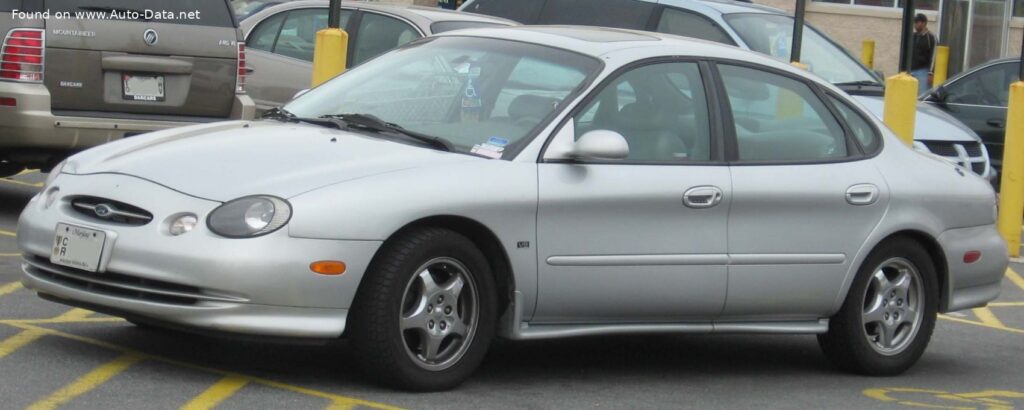
The Ford Taurus III, produced between 1995 and 1999, represented a significant evolution of Ford’s full-size sedan. Positioned as a family vehicle in the North American market, the Taurus III aimed to blend comfort, practicality, and a degree of performance. This generation saw refinements in styling, interior appointments, and powertrain options, building upon the success of its predecessors. The 3.0 V6 24V variant, equipped with an automatic transmission, was a popular choice, offering a balance of power and fuel efficiency for everyday driving.
Ford Taurus III 3.0 V6: An Overview
The Taurus III continued Ford’s commitment to the large sedan segment, competing with vehicles like the Chevrolet Lumina and the Toyota Camry. While not a performance-focused vehicle, the 3.0L V6 engine provided adequate power for comfortable highway cruising and city driving. The third-generation Taurus benefited from ongoing engineering improvements, focusing on ride quality and interior space. It served as a mainstay in Ford’s lineup during a period of increasing competition from import brands.
Engine & Performance
The heart of the Ford Taurus III 3.0 V6 is the Duratec 30 engine, a 2.967-liter (181.06 cubic inch) V6 producing 200 horsepower at 5750 rpm and 271 Nm (199.88 lb.-ft.) of torque at 4500 rpm. This naturally aspirated engine utilizes multi-port fuel injection and a double overhead camshaft (DOHC) valvetrain with four valves per cylinder. The engine’s power-to-weight ratio is 7.6 kg/Hp, and the torque-to-weight ratio is 5.6 kg/Nm. Paired with a 4-speed automatic transmission, the Taurus III 3.0 V6 achieves a 0-60 mph time of approximately 9.6 seconds and a 0-100 km/h time of 10.1 seconds. Its top speed is electronically limited to 210 km/h (130.49 mph). Fuel economy is rated at 11.8 l/100 km (19.9 US mpg) in urban conditions and 8.1 l/100 km (29 US mpg) on the open road.
Design & Features
The Ford Taurus III is a four-door sedan with a traditional body-on-frame construction. It offers seating for five passengers and a trunk capacity of 447 liters (15.79 cubic feet). The exterior styling of the Taurus III was evolutionary, featuring rounded lines and a more aerodynamic profile compared to earlier generations. Inside, the Taurus III prioritized comfort and practicality. Standard features typically included air conditioning, power windows and locks, and an AM/FM stereo. Safety features, while not as comprehensive as modern vehicles, included ABS (Anti-lock Braking System) as a standard offering. The suspension utilizes a wishbone configuration for both the front and rear axles, providing a comfortable ride. The steering system is a hydraulic rack and pinion setup. The vehicle rides on 205/65 R15 tires mounted on 15-inch wheels.
Technical Specifications
| Brand | Ford |
| Model | Taurus |
| Generation | Taurus III |
| Type (Engine) | 3.0 V6 24V (200 Hp) Automatic |
| Start of production | 1995 |
| End of production | 1999 |
| Powertrain Architecture | Internal Combustion engine |
| Body type | Sedan |
| Seats | 5 |
| Doors | 4 |
| Fuel consumption (urban) | 11.8 l/100 km (19.9 US mpg) |
| Fuel consumption (extra urban) | 8.1 l/100 km (29 US mpg) |
| Fuel Type | Petrol (Gasoline) |
| Acceleration 0 – 100 km/h | 10.1 sec |
| Acceleration 0 – 62 mph | 10.1 sec |
| Acceleration 0 – 60 mph | 9.6 sec |
| Maximum speed | 210 km/h (130.49 mph) |
| Weight-to-power ratio | 7.6 kg/Hp |
| Weight-to-torque ratio | 5.6 kg/Nm |
| Power | 200 Hp @ 5750 rpm |
| Power per litre | 67.4 Hp/l |
| Torque | 271 Nm @ 4500 rpm (199.88 lb.-ft. @ 4500 rpm) |
| Engine layout | Front, Transverse |
| Engine Model/Code | Duratec 30 |
| Engine displacement | 2967 cm3 (181.06 cu. in.) |
| Number of cylinders | 6 |
| Engine configuration | V-engine |
| Cylinder Bore | 89 mm (3.5 in.) |
| Piston Stroke | 79.5 mm (3.13 in.) |
| Compression ratio | 10:1 |
| Number of valves per cylinder | 4 |
| Fuel injection system | Multi-port manifold injection |
| Engine aspiration | Naturally aspirated engine |
| Valvetrain | DOHC |
| Engine oil capacity | 5.2 l (5.49 US qt | 4.58 UK qt) |
| Coolant capacity | 10 l (10.57 US qt | 8.8 UK qt) |
| Kerb Weight | 1522 kg (3355.44 lbs.) |
| Trunk (boot) space – minimum | 447 l (15.79 cu. ft.) |
| Fuel tank capacity | 61 l (16.11 US gal | 13.42 UK gal) |
| Length | 5016 mm (197.48 in.) |
| Width | 1854 mm (72.99 in.) |
| Height | 1400 mm (55.12 in.) |
| Wheelbase | 2756 mm (108.5 in.) |
| Front track | 1565 mm (61.61 in.) |
| Rear (Back) track | 1560 mm (61.42 in.) |
| Drag coefficient (Cd) | 0.31 |
| Minimum turning circle | 11.8 m (38.71 ft.) |
| Drivetrain Architecture | ICE, Front Wheel Drive |
| Drive wheel | Front wheel drive |
| Number of gears and type of gearbox | 4 gears, automatic transmission |
| Front suspension | Wishbone |
| Rear suspension | Wishbone |
| Front brakes | Ventilated discs |
| Rear brakes | Drum |
| Assisting systems | ABS |
| Steering type | Steering rack and pinion |
| Power steering | Hydraulic |
| Tires size | 205/65 R15 |
| Wheel rims size | 15 |
The Ford Taurus III 3.0 V6, while not a groundbreaking vehicle, represented a solid and reliable option for families seeking a comfortable and spacious sedan. Its blend of practicality, reasonable performance, and available features made it a popular choice in the North American market during its production run.