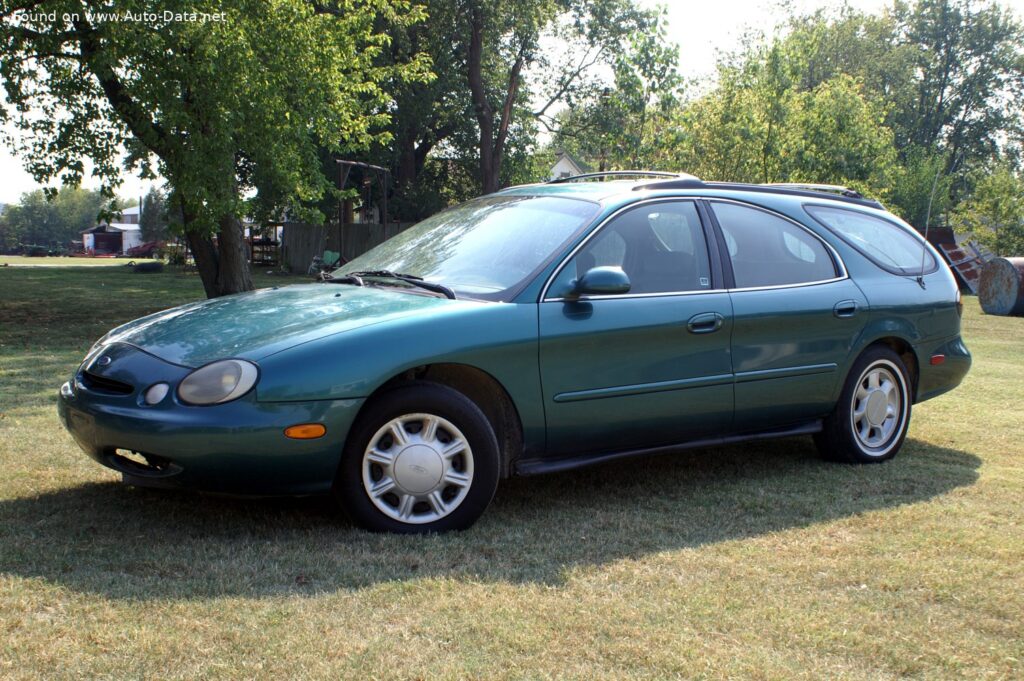
The Ford Taurus III Station Wagon, produced between 1995 and 1999, represented the third generation of Ford’s full-size family car. This iteration of the Taurus, while not achieving the same sales success as its predecessor, offered a practical and spacious option for American families seeking a comfortable and reliable vehicle. The station wagon body style, in particular, provided ample cargo capacity, making it a popular choice for those with active lifestyles. While the Taurus nameplate was primarily a North American offering, the third generation saw continued refinement of a platform designed to compete with imports and maintain Ford’s position in the competitive family sedan and wagon market.
Ford Taurus III Station Wagon: An Overview
The Taurus III, including the station wagon variant, was a significant update to the Taurus line. It featured revised styling, both inside and out, and incorporated improvements to ride quality and handling. The 3.0 V6 engine, paired with an automatic transmission, was a common configuration, offering a balance of performance and fuel efficiency for the time. The station wagon’s appeal lay in its versatility, providing a larger cargo area than the sedan without sacrificing passenger comfort. It was positioned as a practical alternative to minivans and SUVs, catering to families who didn’t require the extra height or all-wheel-drive capabilities of those vehicles.
Engine & Performance
The 1995-1999 Ford Taurus III Station Wagon equipped with the 3.0 V6 engine delivered 147 horsepower at 5250 rpm and 230 Nm (169.64 lb.-ft.) of torque at 3250 rpm. This naturally aspirated, 2986 cm³ (182.22 cu. in.) V6, known as the Vulcan engine, featured a 9.2:1 compression ratio and utilized multi-port fuel injection. The engine’s transverse front-wheel-drive layout was standard for the Taurus. Power was delivered through a 4-speed automatic transmission. Performance figures included a maximum speed of 180 km/h (111.85 mph). The weight-to-power ratio was 10.7 kg/Hp, and the weight-to-torque ratio was 6.9 kg/Nm, indicating a reasonable level of performance for a family-oriented station wagon of its era. The engine’s 49.2 Hp/l specific output was typical for naturally aspirated V6 engines of the mid-1990s.
Design & Features
The Taurus III Station Wagon maintained the aerodynamic styling cues of the second generation, with a focus on a rounded, contemporary appearance. The station wagon body style extended the roofline to the rear, maximizing cargo space. The interior offered seating for five passengers and prioritized comfort and practicality. Key features included a spacious cabin, comfortable seating, and a large trunk with a maximum capacity of 2302 liters (81.29 cu. ft.). Safety features, while not as advanced as modern standards, included ABS (Anti-lock Braking System) as standard equipment. The suspension utilized a wishbone configuration for both the front and rear axles, providing a comfortable ride. Hydraulic power steering was also standard. The vehicle’s dimensions were substantial, measuring 5070 mm (199.61 in.) in length, 1854 mm (72.99 in.) in width, and 1463 mm (57.6 in.) in height. The wheelbase was 2756 mm (108.5 in.).
Technical Specifications
| Brand | Ford |
| Model | Taurus |
| Generation | Taurus III Station Wagon |
| Type (Engine) | 3.0 V6 (147 Hp) Automatic |
| Start of production | 1995 |
| End of production | 1999 |
| Powertrain Architecture | Internal Combustion engine |
| Body type | Station wagon (estate) |
| Seats | 5 |
| Doors | 5 |
| Fuel consumption (urban) | 11.8 l/100 km (19.9 US mpg / 23.9 UK mpg) |
| Fuel consumption (extra urban) | 8.1 l/100 km (29 US mpg / 34.9 UK mpg) |
| Fuel Type | Petrol (Gasoline) |
| Maximum speed | 180 km/h (111.85 mph) |
| Weight-to-power ratio | 10.7 kg/Hp |
| Weight-to-torque ratio | 6.9 kg/Nm |
| Power | 147 Hp @ 5250 rpm |
| Power per litre | 49.2 Hp/l |
| Torque | 230 Nm @ 3250 rpm (169.64 lb.-ft. @ 3250 rpm) |
| Engine layout | Front, Transverse |
| Engine Model/Code | Vulcan |
| Engine displacement | 2986 cm³ (182.22 cu. in.) |
| Number of cylinders | 6 |
| Engine configuration | V-engine |
| Cylinder Bore | 89 mm (3.5 in.) |
| Piston Stroke | 80 mm (3.15 in.) |
| Compression ratio | 9.2:1 |
| Number of valves per cylinder | 2 |
| Fuel injection system | Multi-port manifold injection |
| Engine aspiration | Naturally aspirated engine |
| Valvetrain | OHV |
| Engine oil capacity | 4.25 l (4.49 US qt | 3.74 UK qt) |
| Coolant | 11 l (11.62 US qt | 9.68 UK qt) |
| Kerb Weight | 1579 kg (3481.1 lbs.) |
| Trunk (boot) space – maximum | 2302 l (81.29 cu. ft.) |
| Fuel tank capacity | 61 l (16.11 US gal | 13.42 UK gal) |
| Length | 5070 mm (199.61 in.) |
| Width | 1854 mm (72.99 in.) |
| Height | 1463 mm (57.6 in.) |
| Wheelbase | 2756 mm (108.5 in.) |
| Front track | 1564 mm (61.57 in.) |
| Rear (Back) track | 1570 mm (61.81 in.) |
| Minimum turning circle | 11.8 m (38.71 ft.) |
| Drivetrain Architecture | Front wheel drive |
| Number of gears and type of gearbox | 4 gears, automatic transmission |
| Front suspension | Wishbone |
| Rear suspension | Wishbone |
| Front brakes | Ventilated discs |
| Rear brakes | Drum |
| Assisting systems | ABS (Anti-lock braking system) |
| Steering type | Steering rack and pinion |
| Power steering | Hydraulic Steering |
| Tires size | 205/65 R15 |
| Wheel rims size | 15 |
The Ford Taurus III Station Wagon, while perhaps not a standout in terms of performance or innovation, provided a solid and practical transportation solution for families during its production run. Its spacious interior, comfortable ride, and reasonable fuel economy made it a competitive offering in the full-size family car segment.