
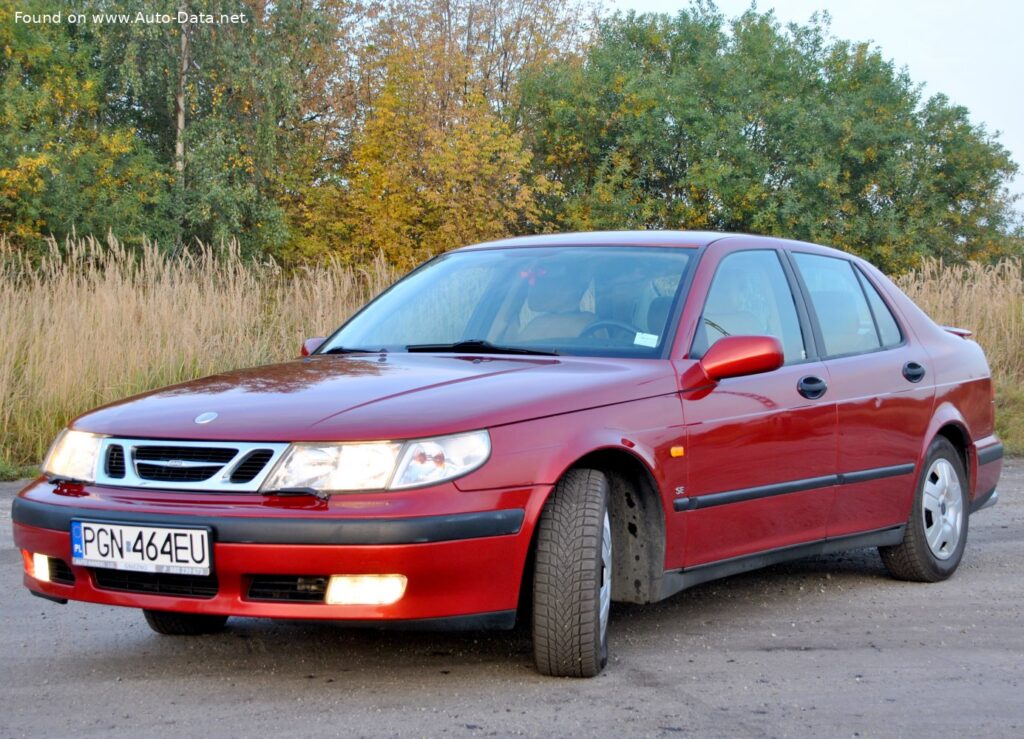
The Saab 9-5, specifically the 2.0i T SE (150 Hp) Automatic variant produced between 1998 and 2001, represents a pivotal model in the Swedish automaker’s history. As the successor to the venerable Saab 9000, the first-generation Saab 9-5 carried the torch for the brand in the competitive executive and premium mid-size sedan segment. Launched with a strong emphasis on safety, ergonomic design, and turbocharged performance, it aimed to blend Scandinavian practicality with a distinctive driving experience. While Saab had a relatively niche market presence globally, its vehicles, including the 9-5, were known for their unique character and advanced engineering, appealing to a discerning clientele who valued innovation and robust construction over mainstream luxury badges. This particular iteration, with its 2.0-liter light-pressure turbo engine and automatic transmission, offered a balanced proposition of accessible power and comfortable cruising, embodying Saab’s commitment to intelligent automotive design.
The Saab 9-5: A Scandinavian Executive Sedan
The Saab 9-5, launched in 1997 and produced through 2010, spanned two distinct generations. The first generation, encompassing models from 1997 to 2005, was a significant departure from the Saab 9000, offering a more refined and contemporary package. The 2.0i T SE model, produced between 1998 and 2001, occupied a key position within this first generation, providing a compelling entry point into the Saab 9-5 range. It targeted buyers seeking a comfortable, safe, and subtly sporty sedan with the hallmark Saab characteristics of innovation and driver focus. The 9-5 competed with established players in the mid-size executive segment, such as the Audi A6, BMW 5 Series, and Mercedes-Benz E-Class, but distinguished itself through its unique design philosophy and engineering approach.
Engine & Performance
At the heart of the 1998-2001 Saab 9-5 2.0i T SE lies a sophisticated 2.0-liter (1985 cm3) inline four-cylinder engine, designated B205E. This powerplant exemplifies Saab’s long-standing expertise in turbocharging technology, even in its “light-pressure” guise. The engine features a DOHC (Dual Overhead Camshaft) valvetrain with four valves per cylinder, ensuring efficient breathing and combustion. Fuel is delivered via a multi-port manifold injection system, precisely controlled to optimize performance and fuel economy.
The turbocharger is a key component, enabling the 2.0-liter engine to produce 150 horsepower at 5500 rpm. It also delivers 158.58 lb.-ft. of torque at a low 2500 rpm. This broad torque band is characteristic of Saab’s turbo philosophy, providing strong acceleration from low engine speeds, making the car responsive and effortless in everyday driving. The engine is mounted front and transverse, driving the front wheels. The compression ratio is 9.2:1, optimized for turbocharged operation.
A 4-speed automatic transmission is paired with this engine, chosen for its smooth shifts and ease of use, aligning with the car’s role as a comfortable executive sedan. While not exceptionally quick by modern standards, the 9-5 2.0i T SE achieves a 0-60 mph acceleration time of approximately 11 seconds (0-100 km/h in 11.6 seconds), with a maximum speed of 130.49 mph (210 km/h). These figures were competitive for its class at the turn of the millennium, particularly considering its focus on comfort and safety. Fuel efficiency is rated at 15.6 US mpg (urban) and 30.2 US mpg (extra-urban). The engine’s oil capacity is 4.23 US quarts, and the cooling system holds 7.82 US quarts of coolant, indicating robust engineering for thermal management.
Design & Features
The design of the Saab 9-5 2.0i T SE is distinctly Saab, characterized by a blend of aerodynamic efficiency, understated elegance, and functional Scandinavian aesthetics. As a 4-door sedan with seating for five, it offered a spacious and comfortable cabin. The exterior, penned by Björn Envall, featured smooth lines, a characteristic “clamshell” hood, and Saab’s signature three-port grille, hinting at its aviation heritage. Its dimensions – a length of 189.17 inches, a width of 70.55 inches, and a height of 57.05 inches – contributed to a substantial road presence and a stable platform. The wheelbase of 106.42 inches provided ample interior space for both front and rear passengers.
Inside, the 9-5 prioritized ergonomics and safety. The cockpit was designed around the driver, with logically placed controls and clear instrumentation. Saab was renowned for its commitment to safety, and the 9-5 was no exception. It featured advanced safety systems for its time, including ABS (Anti-lock Braking System) as standard, along with robust crash structures. Saab’s innovative active head restraints were a pioneering feature, designed to reduce the risk of whiplash injuries in rear-end collisions. The car’s substantial kerb weight of 3384.1 lbs. (1535 kg) further underscored its solid construction and passive safety credentials.
Comfort and practicality were also paramount. The trunk offered a generous 17.66 cu. ft. (500 liters) of cargo space. The fuel tank capacity of 19.81 US gallons (75 liters) provided a commendable cruising range. The suspension system, featuring Spring Struts at both the front and rear, was tuned for a comfortable ride while maintaining predictable handling. Steering was managed by a hydraulic rack and pinion system, offering direct feedback to the driver. Braking performance was assured by ventilated discs at the front and solid discs at the rear. The 9-5 2.0i T SE came equipped with standard tire sizes of 205/65 R15 or optional 215/55 R16, mounted on 15 or 16-inch wheel rims, respectively.
Technical Specifications
| Brand | Saab |
| Model | 9-5 |
| Generation | 9-5 |
| Type (Engine) | 2.0i T SE (150 Hp) Automatic |
| Start of production | 1998 year |
| End of production | 2001 year |
| Powertrain Architecture | Internal Combustion engine |
| Body type | Sedan |
| Seats | 5 |
| Doors | 4 |
| Fuel consumption (economy) – urban | 15.6 US mpg (15.1 l/100 km) |
| Fuel consumption (economy) – extra urban | 30.2 US mpg (7.8 l/100 km) |
| Fuel Type | Petrol (Gasoline) |
| Acceleration 0 – 60 mph | 11 sec |
| Acceleration 0 – 100 km/h | 11.6 sec |
| Maximum speed | 130.49 mph (210 km/h) |
| Weight-to-power ratio | 10.2 kg/Hp, 97.7 Hp/tonne |
| Weight-to-torque ratio | 7.1 kg/Nm, 140.1 Nm/tonne |
| Power | 150 Hp @ 5500 rpm |
| Power per liter | 75.6 Hp/l |
| Torque | 158.58 lb.-ft. @ 2500 rpm (215 Nm @ 2500 rpm) |
| Engine layout | Front, Transverse |
| Engine Model/Code | B205E |
| Engine displacement | 121.13 cu. in. (1985 cm3) |
| Number of cylinders | 4 |
| Engine configuration | Inline |
| Cylinder Bore | 3.54 in. (90 mm) |
| Piston Stroke | 3.07 in. (78 mm) |
| Compression ratio | 9.2:1 |
| Number of valves per cylinder | 4 |
| Fuel injection system | Multi-port manifold injection |
| Engine aspiration | Turbocharger |
| Valvetrain | DOHC |
| Engine oil capacity | 4.23 US qt (4 l) |
| Coolant capacity | 7.82 US qt (7.4 l) |
| Kerb Weight | 3384.1 lbs. (1535 kg) |
| Max. weight | 4519.48 lbs. (2050 kg) |
| Max load | 1135.38 lbs. (515 kg) |
| Trunk (boot) space – maximum | 17.66 cu. ft. (500 l) |
| Fuel tank capacity | 19.81 US gal (75 l) |
| Length | 189.17 in. (4805 mm) |
| Width | 70.55 in. (1792 mm) |
| Height | 57.05 in. (1449 mm) |
| Wheelbase | 106.42 in. (2703 mm) |
| Front track | 59.92 in. (1522 mm) |
| Rear (Back) track | 59.92 in. (1522 mm) |
| Drivetrain Architecture | Front wheel drive (Internal combustion engine drives front wheels) |
| Drive wheel | Front wheel drive |
| Number of gears and type of gearbox | 4 gears, automatic transmission |
| Front suspension | Spring Strut |
| Rear suspension | Spring Strut |
| Front brakes | Ventilated discs |
| Rear brakes | Disc |
| Assisting systems | ABS (Anti-lock braking system) |
| Steering type | Steering rack and pinion |
| Power steering | Hydraulic Steering |
| Tires size | 205/65 R15; 215/55 R16 |
| Wheel rims size | 15; 16 |
