
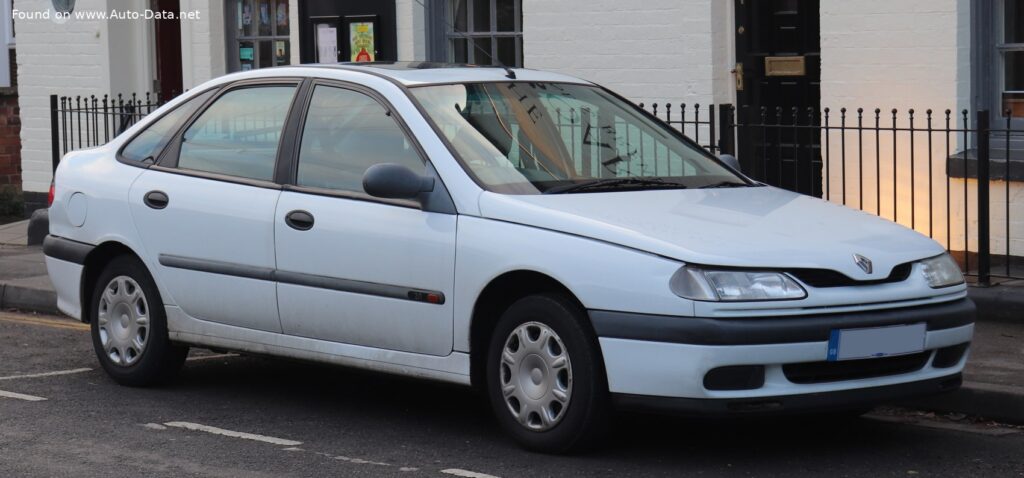
The Renault Laguna, a prominent D-segment (mid-size) family car in the European market, represented a significant offering from the French automaker during its production run. The specific variant under scrutiny, the Renault Laguna 1.9 dTi (98 Hp), was a noteworthy iteration of the first-generation Laguna, produced between 1997 and 2000. While not officially sold in the United States, the Laguna carved out a strong niche in its primary European and other international markets, serving as a versatile and practical option for families and fleet operators alike. This particular model, equipped with Renault’s Direct Turbo Injection (dTi) diesel engine, was lauded for its blend of fuel efficiency, robust performance for its class, and a comfortable driving experience, characteristic of French automotive design. Its hatchback body style offered considerable practicality, a key selling point in a competitive segment dominated by sedans and estates.
The Evolution and Market Position of the Renault Laguna 1.9 dTi (98 Hp)
The first-generation Renault Laguna, launched in 1994 as a replacement for the aging Renault 21, quickly established itself as a strong contender in the European mid-size segment. Its design, a departure from the angular aesthetics of its predecessor, featured smoother lines and a more aerodynamic profile, signaling Renault’s commitment to modern styling and improved efficiency. The introduction of the 1.9 dTi engine variant in 1997 marked a strategic move to capitalize on the growing demand for diesel powertrains, especially in Europe where diesel engines were increasingly favored for their superior fuel economy and torque characteristics. The Renault Laguna 1.9 dTi (98 Hp) was positioned as an economical yet capable choice within the Laguna lineup, offering a compelling balance for drivers covering long distances or seeking lower running costs without sacrificing everyday usability. It competed against models like the Ford Mondeo, Opel/Vauxhall Vectra, and Volkswagen Passat, distinguishing itself with its emphasis on comfort and ride quality.
Engine and Performance Characteristics
At the heart of the Renault Laguna 1.9 dTi (98 Hp) was the F9Q engine, a 1.9-liter (1870 cm3 or 114.11 cubic inches) inline four-cylinder diesel unit. This engine, featuring a direct turbo injection (dTi) fuel system, was designed to deliver a potent mix of power and efficiency. It produced 98 horsepower at 4000 rpm, which was a respectable output for a non-common rail diesel of its era. More significantly, the engine generated a substantial 200 Nm (147.51 lb.-ft.) of torque at a low 2000 rpm, providing strong pulling power and excellent drivability in various conditions. The presence of a turbocharger was crucial for enhancing both power delivery and fuel atomization, contributing to the engine’s responsive nature.
Power was delivered to the front wheels via a standard 5-speed manual transmission, a common and reliable setup for vehicles in this segment. This drivetrain architecture, coupled with the engine’s characteristics, allowed the Laguna 1.9 dTi to accelerate from 0 to 60 mph in a calculated 11.9 seconds (0-100 km/h in 12.5 seconds), with a maximum speed of 114.95 mph (185 km/h). While not a performance car, these figures underscored its capability for highway cruising and confident overtaking. The engine’s DOHC (Double Overhead Camshaft) valvetrain, despite having only two valves per cylinder, was a sophisticated design choice that contributed to efficient combustion and power delivery, showcasing Renault’s engineering prowess even in its more utilitarian diesel offerings.
Fuel economy was a major highlight of the 1.9 dTi. The urban cycle consumption was rated at an impressive 32.7 US mpg (7.2 l/100 km), while extra-urban driving saw this figure climb to an outstanding 51.1 US mpg (4.6 l/100 km). These figures positioned the Laguna 1.9 dTi as an exceptionally economical vehicle for its class, making it an attractive option for budget-conscious buyers and high-mileage drivers. The engine’s robust design also contributed to a favorable weight-to-power ratio of 14.3 kg/Hp (70 Hp/tonne) and a weight-to-torque ratio of 7 kg/Nm (142.9 Nm/tonne), indicating efficient utilization of its output.
Design and Features: Practicality Meets European Styling
The Renault Laguna 1.9 dTi (98 Hp) was offered exclusively as a 5-door hatchback, a body style that masterfully blended sedan-like aesthetics with the versatility of a wagon. Its exterior dimensions – a length of 177.56 inches (4510 mm), a width of 68.9 inches (1750 mm), and a height of 56.3 inches (1430 mm) – placed it squarely in the mid-size category, offering a substantial road presence without being overly cumbersome. The wheelbase of 105.12 inches (2670 mm) was crucial for providing a stable ride and a spacious cabin for its five occupants.
Inside, the Laguna emphasized comfort and ergonomic design, hallmarks of French automotive interiors. The five-seat configuration provided ample room for adults, making it a suitable family vehicle. The hatchback design truly shone in terms of cargo capacity, offering a minimum trunk volume of 15.89 cubic feet (450 liters) with the rear seats up, which could expand significantly to 47.15 cubic feet (1335 liters) when the rear seats were folded down. This flexibility made the Laguna highly practical for carrying luggage, groceries, or larger items, catering to a wide range of consumer needs.
From a safety standpoint, the Laguna 1.9 dTi was equipped with an Anti-lock Braking System (ABS) as a crucial assisting system, enhancing braking performance and driver control during emergency stops. The braking system itself consisted of disc brakes on both the front and rear axles, providing consistent and effective stopping power. The suspension system, featuring a spring strut design at the front and a torsion beam setup at the rear, was tuned to offer a compliant and comfortable ride, absorbing road imperfections with typical European finesse. Steering was managed by a hydraulic rack and pinion system, providing direct feedback and a connected feel to the road, a desirable trait for drivers.
The vehicle rode on 185/65 R14 tires mounted on 14-inch wheel rims, a common specification for mid-size cars of its era, balancing grip, comfort, and cost-effectiveness. The 66-liter (17.44 US gallons) fuel tank capacity, combined with the engine’s excellent fuel economy, provided a considerable driving range, further solidifying its appeal as a long-distance cruiser.
Technical Specifications
| Parameter | Specification |
|---|---|
| Brand | Renault |
| Model | Laguna |
| Generation | Laguna |
| Type (Engine) | 1.9 dTi (98 Hp) |
| Start of Production | 1997 year |
| End of Production | 2000 year |
| Powertrain Architecture | Internal Combustion engine |
| Body type | Hatchback |
| Seats | 5 |
| Doors | 5 |
| Fuel Consumption (Urban) | 7.2 l/100 km (32.7 US mpg) |
| Fuel Consumption (Extra Urban) | 4.6 l/100 km (51.1 US mpg) |
| Fuel Type | Diesel |
| Acceleration 0 – 60 mph | 11.9 sec |
| Maximum Speed | 185 km/h (114.95 mph) |
| Weight-to-Power Ratio | 14.3 kg/Hp, 70 Hp/tonne |
| Weight-to-Torque Ratio | 7 kg/Nm, 142.9 Nm/tonne |
| Power | 98 Hp @ 4000 rpm |
| Power per Liter | 52.4 Hp/l |
| Torque | 200 Nm (147.51 lb.-ft.) @ 2000 rpm |
| Engine Layout | Front, Transverse |
| Engine Model/Code | F9Q |
| Engine Displacement | 1870 cm3 (114.11 cu. in.) |
| Number of Cylinders | 4 |
| Engine Configuration | Inline |
| Cylinder Bore | 80 mm (3.15 in.) |
| Piston Stroke | 93 mm (3.66 in.) |
| Compression Ratio | 18.3:1 |
| Number of Valves per Cylinder | 2 |
| Fuel Injection System | Diesel Commonrail |
| Engine Aspiration | Turbocharger |
| Valvetrain | DOHC |
| Engine Oil Capacity | 5.5 l (5.81 US qt) |
| Coolant Capacity | 7.5 l (7.93 US qt) |
| Kerb Weight | 1400 kg (3086.47 lbs.) |
| Max. Weight | 1980 kg (4365.15 lbs.) |
| Max Load | 580 kg (1278.68 lbs.) |
| Trunk (boot) space – Minimum | 450 l (15.89 cu. ft.) |
| Trunk (boot) space – Maximum | 1335 l (47.15 cu. ft.) |
| Fuel Tank Capacity | 66 l (17.44 US gal) |
| Length | 4510 mm (177.56 in.) |
| Width | 1750 mm (68.9 in.) |
| Height | 1430 mm (56.3 in.) |
| Wheelbase | 2670 mm (105.12 in.) |
| Front Track | 1480 mm (58.27 in.) |
| Rear (Back) Track | 1460 mm (57.48 in.) |
| Drivetrain Architecture | Front-wheel drive, Internal Combustion engine |
| Drive Wheel | Front wheel drive |
| Number of Gears and Type of Gearbox | 5 gears, manual transmission |
| Front Suspension | Spring Strut |
| Rear Suspension | Torsion |
| Front Brakes | Disc |
| Rear Brakes | Disc |
| Assisting Systems | ABS (Anti-lock braking system) |
| Steering Type | Steering rack and pinion |
| Power Steering | Hydraulic Steering |
| Tires Size | 185/65 R14 |
| Wheel Rims Size | 14 inches |
