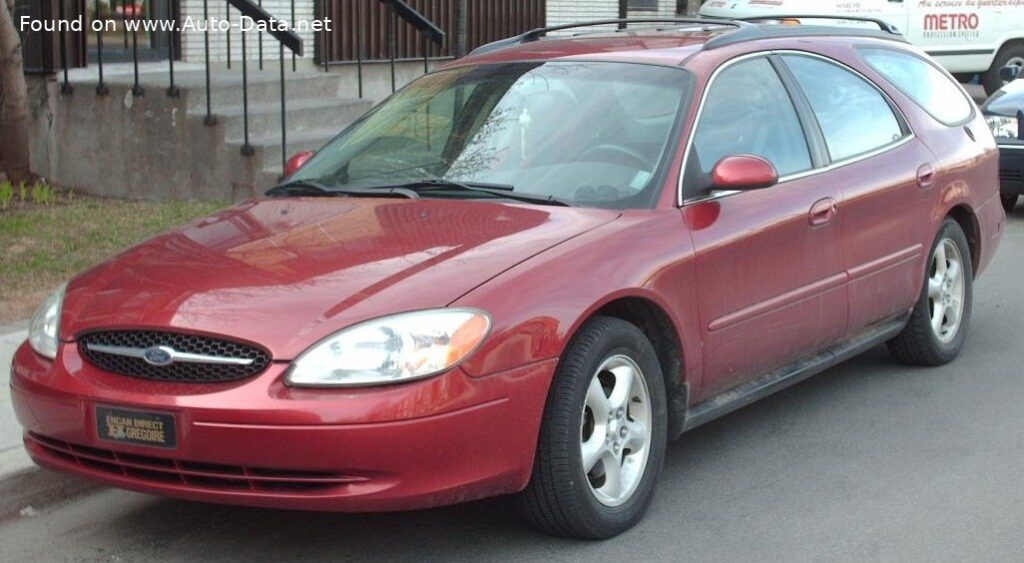
The Ford Taurus, a nameplate synonymous with American family motoring for decades, saw its fourth generation, often referred to as the “G4” or “Fourth Gen,” emerge onto the automotive landscape in the year 2000. Among its various configurations, the Ford Taurus IV Station Wagon 3.0 V6 (155 Hp) Automatic stood out as a highly practical and enduring choice for consumers seeking spaciousness, reliability, and value. Produced from 2000 to 2005, this iteration of the Taurus wagon maintained its position as a dominant force in the North American mid-size/full-size station wagon segment, offering a compelling blend of utility and comfortable transportation for families across the United States and Canada. While the sedan variant often garnered more attention, the station wagon provided an invaluable alternative for those requiring extensive cargo capacity without migrating to the burgeoning SUV market.
Engineering and Performance of the Ford Taurus IV Station Wagon 3.0 V6 (155 Hp) Automatic
At the heart of the Ford Taurus IV Station Wagon 3.0 V6 (155 Hp) Automatic lay Ford’s venerable 3.0-liter “Vulcan” V6 engine. This naturally aspirated, multi-port manifold injection powertrain was a cornerstone of Ford’s lineup for many years, renowned for its simplicity, durability, and robust performance in everyday driving scenarios. The engine, designated as the Vulcan, was configured in a V-engine layout with six cylinders, each featuring two valves. With an engine displacement of 2986 cubic centimeters, or approximately 182.22 cubic inches, it delivered a respectable 155 horsepower at 4900 revolutions per minute (rpm). Torque figures were equally competent for its class, peaking at 251 Newton-meters (185.13 lb.-ft.) at 3950 rpm, providing ample pulling power for daily commutes and family trips.
The engine’s front, transverse layout was a standard practice for front-wheel-drive vehicles of its era, optimizing packaging efficiency and interior space. Power was seamlessly transferred to the front wheels via a reliable 4-speed automatic transmission. This powertrain architecture, characterized by its front-wheel drive (FWD) system, was favored for its predictable handling, improved traction in adverse weather conditions, and overall efficiency, making it a suitable choice for a family-oriented vehicle. The combination of the Vulcan V6 and the automatic transmission yielded a 0 to 60 mph acceleration time of approximately 10.4 seconds, with a top speed electronically limited to 111.85 mph (180 km/h). While not a performance-oriented vehicle, these figures were more than adequate for highway cruising and merging with traffic.
Fuel economy for the Ford Taurus IV Station Wagon 3.0 V6 (155 Hp) Automatic was competitive for its size and era. Drivers could expect an estimated 19 US miles per gallon in urban driving conditions and a more efficient 25.8 US miles per gallon on the highway. These figures reflected the balance Ford struck between power and practicality, ensuring the Taurus wagon remained an economical choice for families. The vehicle’s weight-to-power ratio stood at 10.3 kilograms per horsepower, or 97.2 horsepower per tonne, further underscoring its role as a practical hauler rather than a high-performance machine. With a fuel tank capacity of 17.96 US gallons, the Taurus wagon offered a decent cruising range between fill-ups, an important consideration for long-distance travel.
Design, Features, and Practicality
The fourth-generation Ford Taurus wagon maintained a design philosophy that prioritized functionality and broad appeal. Moving away from the more polarizing “oval” design language of the preceding third generation, the G4 Taurus adopted a more conservative and conventional aesthetic, which resonated well with its target demographic. As a 5-door station wagon, it offered seating for five occupants, making it an ideal choice for families. Its exterior dimensions were substantial, with a total length of 197.72 inches, a width of 72.99 inches, and a height of 57.8 inches. The generous wheelbase of 108.5 inches contributed significantly to both ride comfort and interior volume.
Practicality was paramount in the design of the Ford Taurus IV Station Wagon 3.0 V6 (155 Hp) Automatic. Its defining characteristic was its cavernous cargo capacity. With the rear seats folded down, the wagon boasted an impressive maximum trunk space of 2302 liters, or 81.29 cubic feet. This made it exceptionally versatile for hauling groceries, sports equipment, luggage for family vacations, or even light furniture, positioning it as a compelling alternative to early SUVs or minivans. The kerb weight of the vehicle was 3516.37 pounds (1595 kg), with a maximum permissible weight of 4530.5 pounds (2055 kg), allowing for a substantial maximum load of 1014.13 pounds (460 kg).
In terms of chassis and suspension, the Taurus wagon featured a wishbone setup for both the front and rear suspensions, a common and effective design for passenger cars of its era, providing a comfortable and stable ride. Braking duties were handled by ventilated discs at the front and disc brakes at the rear, complemented by an Anti-lock Braking System (ABS) as a standard assisting system, enhancing safety during emergency braking maneuvers. Steering was managed by a hydraulic rack and pinion system, offering a familiar and responsive feel to the driver. The vehicle rode on 215/60 R16 tires mounted on 16-inch wheel rims, providing a good balance of ride comfort and handling stability. The drag coefficient (Cd) of 0.34 was respectable for a vehicle of its size and shape, contributing to its highway fuel efficiency. Its minimum turning circle of 39.7 feet (12.1 meters) was also reasonable for a vehicle of its stature, aiding maneuverability in urban environments.
Overall, the Ford Taurus IV Station Wagon 3.0 V6 (155 Hp) Automatic represented a robust and highly functional offering in the American automotive market. It appealed to a demographic that valued space, reliability, and straightforward engineering. Its enduring presence on American roads for years after its production ceased is a testament to its fundamental soundness and the practical utility it provided to countless families.
Technical Specifications
| Specification | Value |
|---|---|
| Brand | Ford |
| Model | Taurus |
| Generation | Taurus IV Station Wagon |
| Type (Engine) | 3.0 V6 (155 Hp) Automatic |
| Start of production | 2000 year |
| End of production | 2005 year |
| Powertrain Architecture | Internal Combustion engine |
| Body type | Station wagon (estate) |
| Seats | 5 |
| Doors | 5 |
| Fuel consumption (economy) – urban | 12.4 l/100 km (19 US mpg) |
| Fuel consumption (economy) – extra urban | 9.1 l/100 km (25.8 US mpg) |
| Fuel Type | Petrol (Gasoline) |
| Acceleration 0 – 60 mph | 10.4 sec |
| Maximum speed | 111.85 mph (180 km/h) |
| Weight-to-power ratio | 10.3 kg/Hp (97.2 Hp/tonne) |
| Weight-to-torque ratio | 6.4 kg/Nm (157.4 Nm/tonne) |
| Power | 155 Hp @ 4900 rpm |
| Power per liter | 51.9 Hp/l |
| Torque | 251 Nm (185.13 lb.-ft.) @ 3950 rpm |
| Engine layout | Front, Transverse |
| Engine Model/Code | Vulcan |
| Engine displacement | 2986 cm3 (182.22 cu. in.) |
| Number of cylinders | 6 |
| Engine configuration | V-engine |
| Cylinder Bore | 89 mm (3.5 in.) |
| Piston Stroke | 80 mm (3.15 in.) |
| Compression ratio | 9.3:1 |
| Number of valves per cylinder | 2 |
| Fuel injection system | Multi-port manifold injection |
| Engine aspiration | Naturally aspirated engine |
| Engine oil capacity | 4.25 l (4.49 US qt) |
| Coolant | 11 l (11.62 US qt) |
| Kerb Weight | 1595 kg (3516.37 lbs.) |
| Max. weight | 2055 kg (4530.5 lbs.) |
| Max load | 460 kg (1014.13 lbs.) |
| Trunk (boot) space – maximum | 2302 l (81.29 cu. ft.) |
| Fuel tank capacity | 68 l (17.96 US gal) |
| Length | 5022 mm (197.72 in.) |
| Width | 1854 mm (72.99 in.) |
| Height | 1468 mm (57.8 in.) |
| Wheelbase | 2756 mm (108.5 in.) |
| Front track | 1566 mm (61.65 in.) |
| Rear (Back) track | 1570 mm (61.81 in.) |
| Drag coefficient (Cd) | 0.34 |
| Minimum turning circle (turning diameter) | 12.1 m (39.7 ft.) |
| Drivetrain Architecture | Front wheel drive (ICE drives front wheels) |
| Drive wheel | Front wheel drive |
| Number of gears and type of gearbox | 4 gears, automatic transmission |
| Front suspension | Wishbone |
| Rear suspension | Wishbone |
| Front brakes | Ventilated discs |
| Rear brakes | Disc |
| Assisting systems | ABS (Anti-lock braking system) |
| Steering type | Steering rack and pinion |
| Power steering | Hydraulic Steering |
| Tires size | 215/60 R16 |
| Wheel rims size | 16 inches |