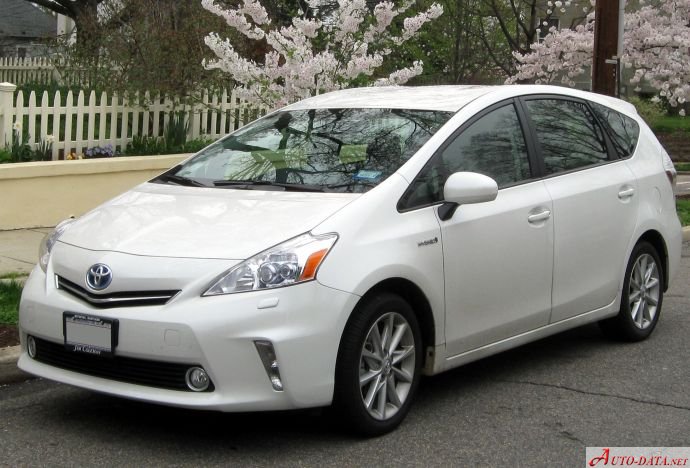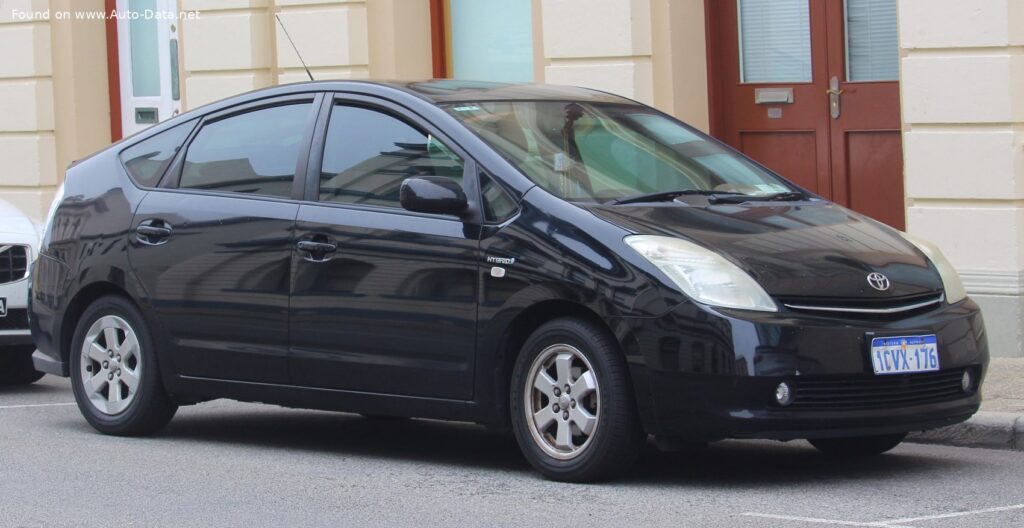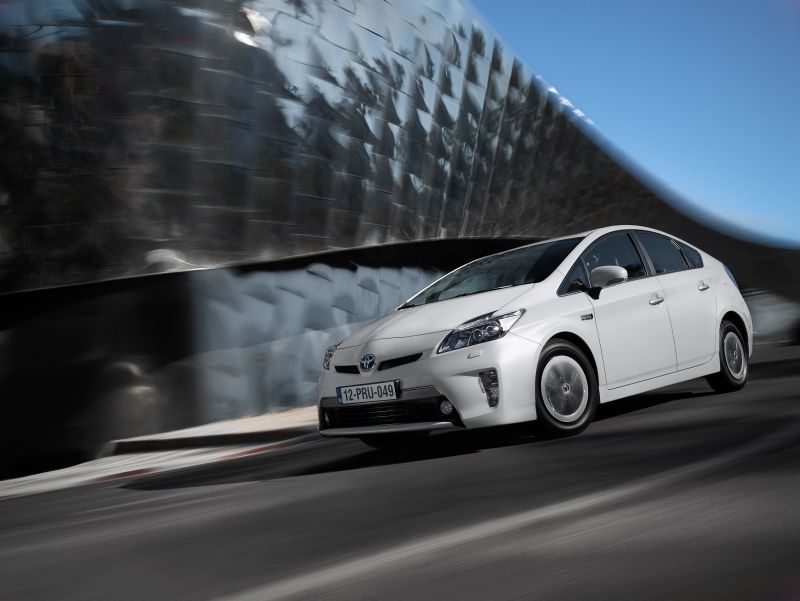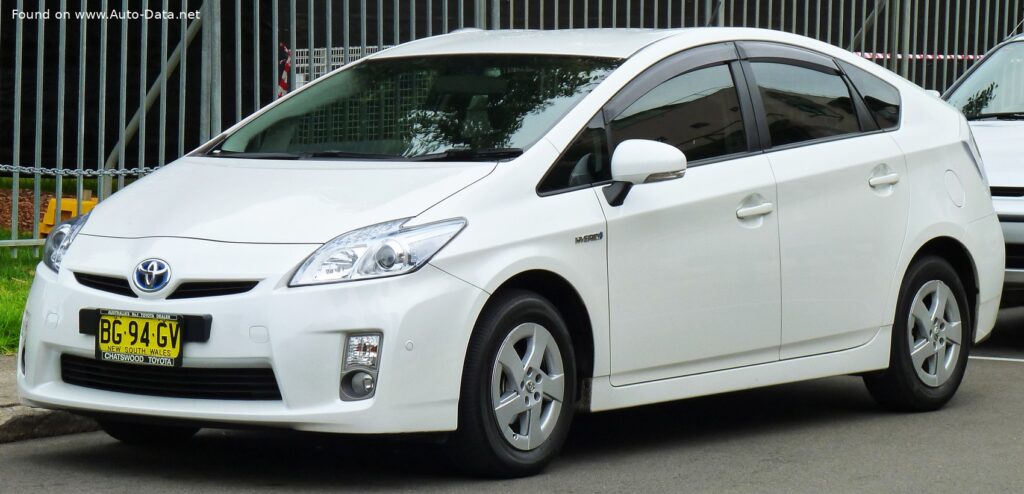
The Toyota Prius III (ZVW30) 1.8 VVT-i (136 Hp) Hybrid e-CVT represents a pivotal moment in automotive history, further cementing Toyota’s leadership in hybrid technology and ushering in a new era of mainstream eco-conscious driving. Produced between 2009 and 2012, this third-generation Prius built upon the groundbreaking success of its predecessors, evolving the full hybrid electric vehicle (FHEV) architecture and refining the formula that made the Prius a global icon. Positioned as a practical and efficient liftback for families and individuals seeking reduced environmental impact and lower running costs, the ZVW30 generation was a testament to Toyota’s commitment to sustainable mobility. It seamlessly blended a conventional gasoline engine with an electric motor, delivering impressive fuel economy and reduced emissions without compromising daily usability, making it a benchmark for efficiency in its class across markets including North America, Europe, and Asia.
The Powertrain of the Toyota Prius III (ZVW30): A Symphony of Efficiency
At the heart of the Toyota Prius III (ZVW30) lies a sophisticated FHEV powertrain, meticulously engineered to deliver an optimal balance of performance and fuel efficiency. This synergistic drive system couples a 1.8-liter (1798 cm³) 2ZR-FXE VVT-i (Variable Valve Timing-intelligent) gasoline engine with a potent electric motor, working in concert to propel the vehicle. The internal combustion engine, a naturally aspirated inline-four configuration, produces a respectable 99 horsepower at 5200 rpm and 104.73 lb.-ft. (142 Nm) of torque at 4000 rpm. Its design features a compression ratio of 13:1, DOHC valvetrain, and multi-port manifold injection, all tuned for efficiency.
Complementing the gasoline engine is an 82-horsepower electric motor, integrated directly into the transmission, which provides an instant 152.68 lb.-ft. (207 Nm) of torque. This electric motor is powered by a 201.6-volt Nickel-metal hydride (NiMH) battery, strategically located behind the passenger cabin’s rear wall for optimal weight distribution and interior space. The combined system output for the Toyota Prius III (ZVW30) 1.8 VVT-i (136 Hp) Hybrid e-CVT is a robust 136 horsepower, allowing for brisk acceleration and confident highway driving. This total system power is not a simple sum of the individual components, but rather a reflection of the hybrid system’s peak output under various operating conditions.
Power delivery to the front wheels is managed by Toyota’s renowned electronically controlled continuously variable transmission (e-CVT). This sophisticated gearbox ensures seamless transitions between electric, gasoline, and combined power modes, providing a smooth and responsive driving experience. The e-CVT is instrumental in maximizing efficiency by keeping the engine operating within its most economical range. Performance figures for the Prius III are impressive for a vehicle focused on economy: it accelerates from 0 to 60 mph in a quick 9.9 seconds and achieves a top speed of 111.85 mph (180 km/h).
Fuel economy is where the Toyota Prius III (ZVW30) truly shines. It boasts a combined fuel consumption rating of 60.3 to 58.8 US miles per gallon (3.9-4 liters/100 km), with urban figures ranging from 63.6 to 61.9 US mpg and extra-urban figures from 60.3 to 58.8 US mpg. These figures were class-leading at the time of its release and remain highly competitive today. Furthermore, its CO2 emissions of 89-92 g/km underscore its environmental credentials, meeting stringent Euro 5 emission standards. The inclusion of a Start & Stop system further enhances fuel savings in urban driving conditions, automatically shutting off the engine when the vehicle is stationary and restarting it seamlessly when the accelerator is pressed.
Design, Ergonomics, and Advanced Features of the Toyota Prius III (ZVW30)
The design philosophy of the Toyota Prius III (ZVW30) was driven by aerodynamic efficiency and practical utility. Its distinctive liftback body type is not merely an aesthetic choice but a functional one, meticulously sculpted to reduce drag and improve fuel economy. With a length of 175.59 inches (4460 mm), a width of 68.7 inches (1745 mm), and a height of 58.66 inches (1490 mm), the Prius III presents a sleek and modern profile. The extended wheelbase of 106.3 inches (2700 mm) contributes significantly to interior spaciousness and ride comfort, distinguishing it from smaller, less practical hybrid offerings.
Inside, the Prius III offers seating for five occupants with a focus on ergonomic design and user-friendly interfaces. The cabin environment is designed to be intuitive, with a centrally mounted digital display providing critical information on vehicle speed, fuel economy, and hybrid system operation. This futuristic dashboard layout was a hallmark of the Prius, offering drivers real-time feedback on their driving efficiency. The liftback configuration provides exceptional versatility, with a minimum trunk (boot) space of 15.72 cubic feet (445 liters) that expands to a cavernous 54.56 cubic feet (1545 liters) with the rear seats folded down, making it highly practical for hauling cargo, groceries, or luggage.
Beyond its powertrain, the Toyota Prius III (ZVW30) incorporated several advanced features for its era, emphasizing safety, comfort, and driving dynamics. The vehicle features an independent McPherson front suspension and a torsion-beam rear suspension, delivering a comfortable and stable ride. Braking performance is handled by ventilated discs at the front and solid discs at the rear, augmented by an Anti-lock Braking System (ABS) for enhanced control during emergency stops. Steering is managed by an electric power steering system, offering precise control and further contributing to fuel efficiency by eliminating the parasitic drag of a hydraulic pump.
The vehicle’s kerb weight ranges from 3020.33 to 3130.56 pounds (1370-1420 kg), contributing to its agile handling and efficient operation. Standard tire sizes varied, including 195/65 R15 and 215/45 R17 options, mounted on 6J x 15 and 7J x 17 wheel rims, respectively, allowing for customization based on performance and aesthetic preferences. The relatively tight minimum turning circle of 36.75 to 38.71 feet (11.2-11.8 m) further enhances its maneuverability in urban environments. Overall, the Toyota Prius III (ZVW30) 1.8 VVT-i (136 Hp) Hybrid e-CVT stood as a testament to Toyota’s engineering prowess, blending cutting-edge hybrid technology with practical design and a strong emphasis on environmental responsibility, solidifying its place as a leader in the green automotive landscape.
Comprehensive Technical Specifications
| Feature | Specification |
|---|---|
| Brand | Toyota |
| Model | Prius |
| Generation | Prius III (ZVW30) |
| Type (Engine) | 1.8 VVT-i (136 Hp) Hybrid e-CVT |
| Start of production | 2009 year |
| End of production | 2012 year |
| Powertrain Architecture | FHEV (Full Hybrid Electric Vehicle) |
| Body type | Liftback |
| Seats | 5 |
| Doors | 5 |
| Fuel consumption (economy) – urban | 63.6 – 61.9 US mpg (3.7-3.8 l/100 km) |
| Fuel consumption (economy) – extra urban | 60.3 – 58.8 US mpg (3.9-4 l/100 km) |
| Fuel consumption (economy) – combined | 60.3 – 58.8 US mpg (3.9-4 l/100 km) |
| CO2 emissions | 89-92 g/km |
| Fuel Type | Petrol (Gasoline) |
| Acceleration 0 – 60 mph | 9.9 sec |
| Acceleration 0 – 100 km/h | 10.4 sec |
| Maximum speed | 111.85 mph (180 km/h) |
| Emission standard | Euro 5 |
| Weight-to-power ratio | 10.1 kg/Hp, 99.3 Hp/tonne |
| Weight-to-torque ratio | 9.6 kg/Nm, 103.6 Nm/tonne |
| Battery voltage | 201.6 V |
| Battery technology | Nickel-metal hydride (NiMH) |
| Battery location | Behind the back wall of the passenger cabin |
| Electric motor power | 82 Hp |
| Electric motor Torque | 152.68 lb.-ft. (207 Nm) |
| Electric motor location | Integrated into the transmission |
| System power | 136 Hp |
| Internal combustion engine power | 99 Hp @ 5200 rpm |
| Power per liter | 55.1 Hp/l |
| Internal combustion engine torque | 104.73 lb.-ft. @ 4000 rpm (142 Nm @ 4000 rpm) |
| Engine layout | Front, Transverse |
| Engine Model/Code | 2ZR-FXE |
| Engine displacement | 1.8 l (1798 cm³, 109.72 cu. in.) |
| Number of cylinders | 4 |
| Engine configuration | Inline |
| Cylinder Bore | 3.17 in. (80.5 mm) |
| Piston Stroke | 3.48 in. (88.3 mm) |
| Compression ratio | 13:1 |
| Number of valves per cylinder | 4 |
| Fuel injection system | Multi-port manifold injection |
| Engine aspiration | Naturally aspirated engine |
| Valvetrain | DOHC |
| Engine oil capacity | 4.44 US qt (4.2 l) |
| Engine oil specification | Information not provided |
| Coolant capacity | 6.87 US qt (6.5 l) |
| Engine systems | Start & Stop System |
| Kerb Weight | 3020.33 – 3130.56 lbs. (1370-1420 kg) |
| Max. weight | 3979.34 lbs. (1805 kg) |
| Max load | 848.78 – 959.01 lbs. (385-435 kg) |
| Trunk (boot) space – minimum | 15.72 cu. ft. (445 l) |
| Trunk (boot) space – maximum | 54.56 cu. ft. (1545 l) |
| Fuel tank capacity | 11.89 US gal (45 l) |
| Max. roof load | 165.35 lbs. (75 kg) |
| Length | 175.59 in. (4460 mm) |
| Width | 68.7 in. (1745 mm) |
| Width including mirrors | 79.92 in. (2030 mm) |
| Height | 58.66 in. (1490 mm) |
| Wheelbase | 106.3 in. (2700 mm) |
| Front track | 59.65 – 60.04 in. (1515-1525 mm) |
| Rear (Back) track | 59.45 – 59.84 in. (1510-1520 mm) |
| Minimum turning circle (turning diameter) | 36.75 – 38.71 ft. (11.2-11.8 m) |
| Drivetrain Architecture | Internal combustion engine (ICE) and electric motor drive the front wheels of the car with the ability to work in full electric or mixed mode. |
| Drive wheel | Front wheel drive |
| Number of gears and type of gearbox | Automatic transmission e-CVT |
| Front suspension | Independent type McPherson |
| Rear suspension | Torsion |
| Front brakes | Ventilated discs |
| Rear brakes | Disc |
| Assisting systems | ABS (Anti-lock braking system) |
| Steering type | Steering rack and pinion |
| Power steering | Electric Steering |
| Tires size | 195/65 R15; 215/45 R17 |
| Wheel rims size | 6J x 15; 7J x 17 |