
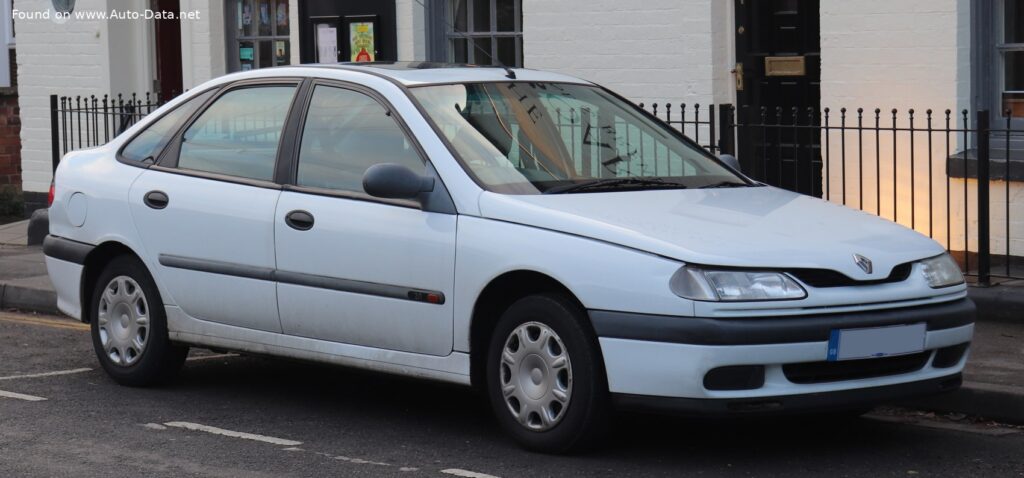
The Renault Laguna 2.0, produced between 1999 and 2001, represents the first generation of the Laguna model, a large family car designed and manufactured by the French automaker Renault. Positioned as a competitor to vehicles like the Ford Mondeo and Vauxhall/Opel Vectra, the Laguna aimed to offer a blend of comfort, practicality, and European styling. While not officially sold in the United States, the Laguna was a significant model in the European market, showcasing Renault’s advancements in design and engineering during the late 1990s and early 2000s. This generation established the Laguna as a key player in the mid-size segment, known for its spacious interior and relatively sophisticated features for its time.
Renault Laguna 2.0: An Overview
The Laguna was Renault’s attempt to move upmarket and compete more directly with established brands in the family car sector. The first generation, launched in 1998, was a departure from previous Renault offerings, featuring a more modern and aerodynamic design. The 2.0-liter engine variant, producing 114 horsepower, was a popular choice, offering a balance between performance and fuel economy. The Laguna’s five-door hatchback body style provided practicality, while its interior focused on comfort and space for passengers and luggage. It was a vehicle designed for the needs of European families, prioritizing versatility and a comfortable driving experience.
Engine & Performance
The Renault Laguna 2.0 is powered by a 1,998 cc (121.93 cu. in.) inline four-cylinder gasoline engine, designated the F3R. This naturally aspirated engine produces 114 horsepower (Hp) at 5,400 rpm and 168 Newton-meters (123.91 lb.-ft.) of torque at 4,250 rpm. The engine features a multi-port fuel injection system and an overhead camshaft (OHC) valvetrain with two valves per cylinder. Power is delivered to the front wheels via a four-speed automatic transmission. Performance figures include a 0-100 km/h (0-62 mph) acceleration time of 11.6 seconds and a maximum speed of 190 km/h (118.06 mph). The engine’s power-to-weight ratio is 11.3 kg/Hp, and its torque-to-weight ratio is 7.7 kg/Nm. Fuel economy is rated at 7.8 liters per 100 kilometers (30.2 US mpg) combined, with 13.1 l/100 km (18 US mpg) in urban conditions and 6.7 l/100 km (35.1 US mpg) on the extra-urban cycle.
Design & Features
The Renault Laguna 2.0 boasts a five-door hatchback body style, offering a practical and versatile layout. The vehicle seats five passengers and provides a generous 452 liters (15.96 cu. ft.) of trunk space, expandable to 1,335 liters (47.15 cu. ft.) with the rear seats folded down. The exterior design, typical of late-1990s European cars, emphasizes smooth lines and a relatively understated aesthetic. Inside, the Laguna offers a comfortable cabin with a focus on ergonomics. Key features include hydraulic power steering, ventilated front disc brakes, and disc brakes on the rear axle. An Anti-lock Braking System (ABS) is included as a standard safety feature. The suspension utilizes a spring strut setup at the front and a torsion beam at the rear, providing a balance between ride comfort and handling. The vehicle’s dimensions are 4,508 mm (177.48 in.) in length, 1,752 mm (68.98 in.) in width, and 1,430 mm (56.3 in.) in height, with a wheelbase of 2,670 mm (105.12 in.).
Technical Specifications
| Brand | Renault |
| Model | Laguna |
| Generation | Laguna |
| Type (Engine) | 2.0 (114 Hp) |
| Start of production | 1999 |
| End of production | 2001 |
| Powertrain Architecture | Internal Combustion engine |
| Body type | Hatchback |
| Seats | 5 |
| Doors | 5 |
| Fuel consumption (urban) | 13.1 l/100 km (18 US mpg, 21.6 UK mpg) |
| Fuel consumption (extra urban) | 6.7 l/100 km (35.1 US mpg, 42.2 UK mpg) |
| Fuel consumption (combined) | 7.8 l/100 km (30.2 US mpg, 36.2 UK mpg) |
| Fuel Type | Petrol (Gasoline) |
| Acceleration 0 – 100 km/h | 11.6 sec |
| Acceleration 0 – 62 mph | 11.6 sec |
| Acceleration 0 – 60 mph | 11 sec |
| Maximum speed | 190 km/h (118.06 mph) |
| Weight-to-power ratio | 11.3 kg/Hp |
| Weight-to-torque ratio | 7.7 kg/Nm |
| Power | 114 Hp @ 5400 rpm |
| Torque | 168 Nm @ 4250 rpm (123.91 lb.-ft. @ 4250 rpm) |
| Engine layout | Front, Transverse |
| Engine Model/Code | F3R |
| Engine displacement | 1998 cm3 (121.93 cu. in.) |
| Number of cylinders | 4 |
| Engine configuration | Inline |
| Cylinder Bore | 82.7 mm (3.26 in.) |
| Piston Stroke | 93 mm (3.66 in.) |
| Compression ratio | 9.7:1 |
| Number of valves per cylinder | 2 |
| Fuel injection system | Multi-port manifold injection |
| Engine aspiration | Naturally aspirated |
| Valvetrain | OHC |
| Engine oil capacity | 5.5 l (5.81 US qt | 4.84 UK qt) |
| Coolant | 9 l (9.51 US qt | 7.92 UK qt) |
| Kerb Weight | 1290 kg (2843.96 lbs.) |
| Max. weight | 1930 kg (4254.92 lbs.) |
| Max load | 640 kg (1410.96 lbs.) |
| Trunk (boot) space – minimum | 452 l (15.96 cu. ft.) |
| Trunk (boot) space – maximum | 1335 l (47.15 cu. ft.) |
| Fuel tank capacity | 66 l (17.44 US gal | 14.52 UK gal) |
| Length | 4508 mm (177.48 in.) |
| Width | 1752 mm (68.98 in.) |
| Height | 1430 mm (56.3 in.) |
| Wheelbase | 2670 mm (105.12 in.) |
| Front track | 1480 mm (58.27 in.) |
| Rear track | 1460 mm (57.48 in.) |
| Drivetrain Architecture | Front wheel drive |
| Number of gears | 4 |
| Gearbox type | Automatic transmission |
| Front suspension | Spring Strut |
| Rear suspension | Torsion |
| Front brakes | Ventilated discs |
| Rear brakes | Disc |
| Assisting systems | ABS (Anti-lock braking system) |
| Steering type | Steering rack and pinion |
| Power steering | Hydraulic |
| Tires size | 195/65 R15 |
| Wheel rims size | 15 |
The Renault Laguna 2.0, while not a performance car, offered a comfortable and practical driving experience for European families. Its blend of space, features, and reasonable fuel economy made it a popular choice in its segment. Although it never reached the US market, the Laguna represents a significant step in Renault’s development as a major automotive manufacturer.
