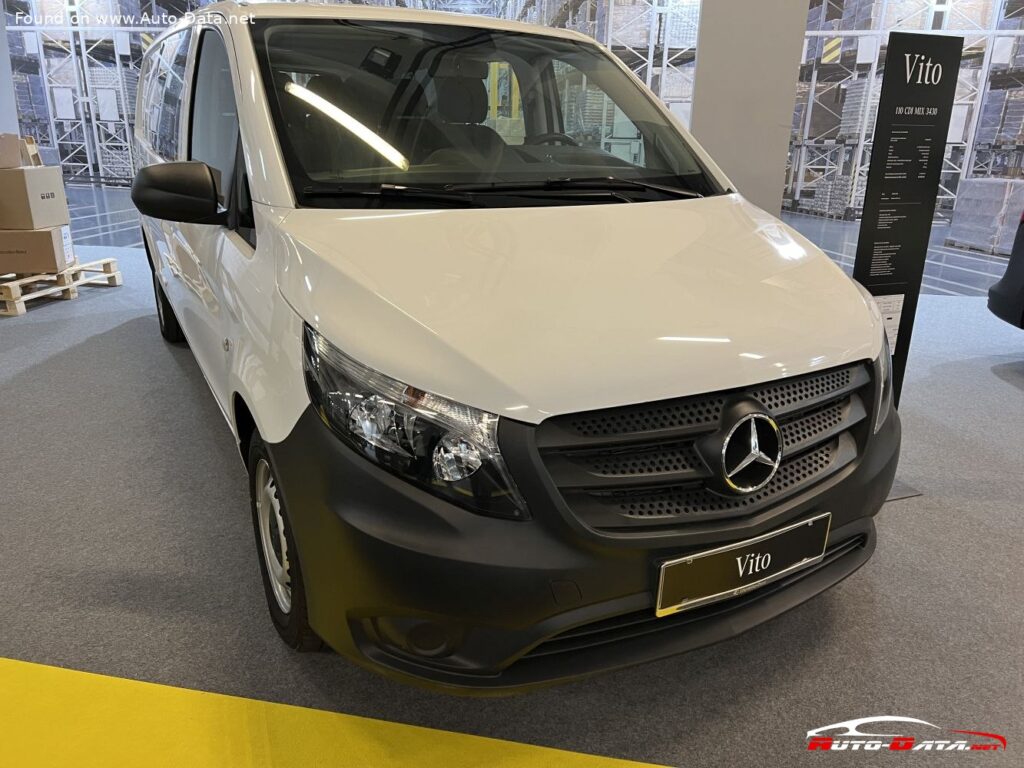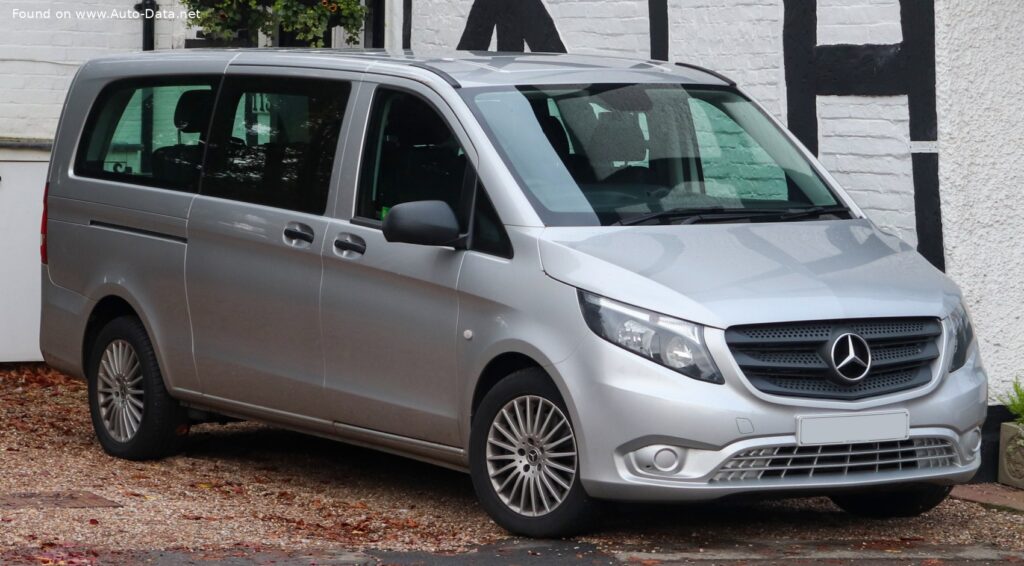
The Mercedes-Benz Vito (W447) Tourer Extra Long 116 CDI (163 Hp) Automatic represents a significant offering in the light commercial vehicle and passenger transport segment, primarily catering to markets outside the United States where versatility, robust construction, and efficient diesel powertrains are paramount. Introduced in October 2014 and produced until February 2019, this specific variant of the third-generation Vito, known internally as the W447, was engineered to combine the practicality of a large van with the comfort and refinement expected from the Mercedes-Benz brand. As a “Tourer Extra Long,” it was specifically configured for maximum passenger capacity, comfortably accommodating up to nine individuals, making it an ideal choice for shuttle services, large families, or businesses requiring ample space for both people and their accompanying luggage. Its role in the European and global markets emphasized its adaptability, serving as a reliable workhorse during the week and a capable family transporter on weekends, all while adhering to stringent European emission standards of its era.
Engine and Performance of the Mercedes-Benz Vito (W447) Tourer Extra Long 116 CDI (163 Hp) Automatic
At the heart of the Mercedes-Benz Vito (W447) Tourer Extra Long 116 CDI (163 Hp) Automatic lies a meticulously engineered powertrain designed for efficiency, durability, and responsive performance. This variant is equipped with Mercedes-Benz’s renowned OM651 DE22LA engine, a 2.1-liter (2143 cm3 or 130.77 cu. in.) inline four-cylinder diesel unit. This engine configuration is celebrated for its balance of power delivery and fuel economy, crucial attributes for a vehicle designed for frequent, heavy use.
The 116 CDI designation signifies a robust output of 163 horsepower, achieved at a relatively accessible 3800 revolutions per minute (rpm). More critically for a vehicle of this type, the engine generates a substantial 380 Nm (280.27 lb.-ft.) of torque across a broad and usable rev range, specifically from 1400 to 2400 rpm. This wide torque band is fundamental to the Vito’s character, providing excellent pulling power from low engine speeds, which is invaluable when the vehicle is fully loaded with passengers or cargo, or when towing. The power per liter stands at 76.1 Hp/l, indicating an efficient use of displacement.
Fuel delivery is managed by a sophisticated Diesel Commonrail injection system, which precisely controls fuel atomization and timing for optimal combustion, contributing to both power output and reduced emissions. Further enhancing performance and efficiency is the combination of a turbocharger and an intercooler. The turbocharger forces more air into the engine, increasing power, while the intercooler cools this compressed air, making it denser and further improving combustion efficiency. This setup ensures strong acceleration and sustained power even under demanding conditions.
Power is seamlessly transferred to the rear wheels via a 7-speed G-TRONIC PLUS automatic transmission. This advanced automatic gearbox is designed to optimize gear selection for both performance and fuel economy, providing smooth shifts and reducing driver fatigue, especially in urban environments. The rear-wheel-drive architecture is a traditional and highly effective choice for vans, offering superior traction when carrying heavy loads and contributing to a more balanced weight distribution, which can enhance handling stability.
Regarding fuel economy, the Vito 116 CDI demonstrates impressive figures for its class. The combined fuel consumption is rated at 6.6 liters per 100 kilometers, translating to approximately 35.6 US miles per gallon (mpg). In urban driving conditions, it achieves 6.9 l/100 km (34.1 US mpg), while on extra-urban routes, it improves to 6.4 l/100 km (36.8 US mpg). These figures underscore Mercedes-Benz’s commitment to efficiency, particularly for a vehicle of its size and capability. Complementing its efficiency, the Vito adheres to the Euro 6c emission standard, with CO2 emissions of 174 g/km, supported by an integrated particulate filter to reduce harmful exhaust particles. The engine oil capacity is 11.1 US quarts, and the cooling system holds 10.99 US quarts, indicating robust thermal management for sustained operation.
Design, Features, and Practicality of the Vito (W447) Tourer Extra Long
The design of the Mercedes-Benz Vito (W447) Tourer Extra Long is a testament to functional elegance, prioritizing maximum utility and passenger comfort within a robust and aesthetically pleasing package. As a van body type with 4 or 5 doors and seating for up to 9 occupants, its “Extra Long” designation is critical to its appeal, denoting an extended wheelbase and overall length that maximizes interior volume. The vehicle measures an impressive 211.42 inches in length, 75.91 inches in width, and stands between 74.41 and 75.2 inches in height, depending on specific configuration. This substantial footprint, combined with a generous 135.04-inch wheelbase, provides a stable and composed ride, crucial for passenger comfort and handling stability, particularly when fully loaded.
The exterior design is characterized by Mercedes-Benz’s contemporary styling cues, featuring a prominent grille and distinctive headlights that give it a sophisticated yet purposeful appearance. The van’s silhouette is aerodynamically optimized to improve fuel efficiency and reduce wind noise, enhancing the overall driving experience. The large doors facilitate easy ingress and egress for passengers and convenient loading of cargo.
Inside, the “Tourer” variant emphasizes passenger comfort and versatility. The seating for nine is arranged to maximize space and flexibility, allowing for various configurations to suit different needs. Even with all seats occupied, the Vito Tourer Extra Long offers a minimum trunk (boot) space of 49.09 cubic feet (1390 liters), demonstrating its capability to transport significant luggage alongside passengers. This makes it exceptionally well-suited for airport shuttles, hotel transfers, or any scenario requiring substantial people and cargo-moving ability. The maximum load capacity ranges from 2707.28 to 2766.8 lbs, with a gross vehicle weight of 7054.79 lbs, highlighting its robust construction.
Practicality extends to its utility features. The fuel tank holds 15.06 US gallons, providing a good range for long journeys, while an 3.04 US gallon AdBlue tank ensures compliance with emission standards. For additional carrying capacity, the Vito boasts a maximum roof load of 330.69 lbs. Furthermore, its towing capabilities are impressive, rated for a permitted trailer load of 4409.25 lbs with brakes and 1653.47 lbs without brakes, making it a versatile platform for various commercial or recreational hauling tasks.
Underpinning the Vito’s ride quality and handling is an advanced suspension system. The front features an independent McPherson strut setup with coil springs and an anti-roll bar, providing a balance of comfort and precise steering. Disc brakes are fitted at both the front and rear, ensuring powerful and consistent stopping performance, which is vital for a vehicle of its size and potential laden weight. An Anti-lock Braking System (ABS) is standard, enhancing safety by preventing wheel lock-up during emergency braking. The vehicle rides on 195/65 R16C or 205/65 R16C tires mounted on 6.5J x 16 wheel rims, providing a good balance of durability, load-carrying capacity, and ride comfort. Despite its lengthy dimensions, the Vito Tourer Extra Long maintains a respectable minimum turning circle of 44.95 feet, contributing to its maneuverability in urban environments and tight spaces.
Technical Specifications
| Brand | Mercedes-Benz |
| Model | Vito |
| Generation | Vito (W447) Tourer Extra Long |
| Type (Engine) | 116 CDI (163 Hp) Automatic |
| Start of production | October, 2014 year |
| End of production | February, 2019 year |
| Powertrain Architecture | Internal Combustion engine |
| Body type | Van |
| Seats | 9 |
| Doors | 4/5 |
| Fuel consumption (economy) – urban | 34.1 US mpg (6.9 l/100 km) |
| Fuel consumption (economy) – extra urban | 36.8 US mpg (6.4 l/100 km) |
| Fuel consumption (economy) – combined | 35.6 US mpg (6.6 l/100 km) |
| CO2 emissions | 174 g/km |
| Fuel Type | Diesel |
| Emission standard | Euro 6c |
| Weight-to-power ratio | 11.9 kg/Hp, 83.8 Hp/tonne |
| Weight-to-torque ratio | 5.1 kg/Nm, 195.4 Nm/tonne |
| Power | 163 Hp @ 3800 rpm. |
| Power per litre | 76.1 Hp/l |
| Torque | 280.27 lb.-ft. @ 1400-2400 rpm. (380 Nm) |
| Engine layout | Front, Longitudinal |
| Engine Model/Code | OM651 DE22LA |
| Engine displacement | 2.1 liters (130.77 cu. in. / 2143 cm3) |
| Number of cylinders | 4 |
| Engine configuration | Inline |
| Cylinder Bore | 3.27 in. (83 mm) |
| Piston Stroke | 3.9 in. (99 mm) |
| Compression ratio | 16.2:1 |
| Number of valves per cylinder | 4 |
| Fuel injection system | Diesel Commonrail |
| Engine aspiration | Turbocharger, Intercooler |
| Engine oil capacity | 11.1 US qt (10.5 l) |
| Coolant | 10.99 US qt (10.4 l) |
| Engine systems | Particulate filter |
| Kerb Weight | 4287.99 – 4347.52 lbs. (1945-1972 kg) |
| Max. weight | 7054.79 lbs. (3200 kg) |
| Max load | 2707.28 – 2766.8 lbs. (1228-1255 kg) |
| Trunk (boot) space – minimum | 49.09 cu. ft. (1390 l) |
| Fuel tank capacity | 15.06 US gal (57 l) |
| AdBlue tank | 3.04 US gal (11.5 l) |
| Max. roof load | 330.69 lbs. (150 kg) |
| Permitted trailer load with brakes (12%) | 4409.25 lbs. (2000 kg) |
| Permitted trailer load without brakes | 1653.47 lbs. (750 kg) |
| Length | 211.42 in. (5370 mm) |
| Width | 75.91 in. (1928 mm) |
| Height | 74.41 – 75.2 in. (1890-1910 mm) |
| Wheelbase | 135.04 in. (3430 mm) |
| Minimum turning circle (turning diameter) | 44.95 ft. (13.7 m) |
| Drivetrain Architecture | The Internal combustion engine (ICE) drives the rear wheels of the vehicle. |
| Drive wheel | Rear wheel drive |
| Number of gears and type of gearbox | 7 gears, automatic transmission G-TRONIC PLUS |
| Front suspension | Independent, type McPherson with coil spring and anti-roll bar |
| Front brakes | Disc |
| Rear brakes | Disc |
| Assisting systems | ABS (Anti-lock braking system) |
| Tires size | 195/65 R16C 100 T; 205/65 R16C 101H |
| Wheel rims size | 6.5J x 16 |