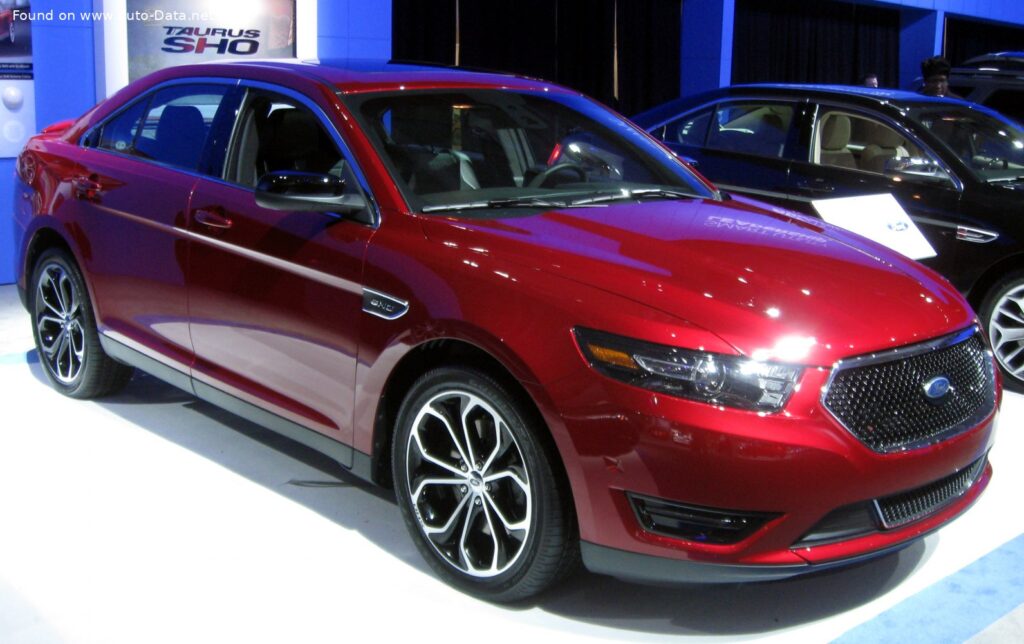
The Ford Taurus, a nameplate synonymous with American full-size sedans for decades, received a significant refresh for its sixth generation in 2013, ushering in a more sophisticated and technologically advanced iteration. This particular model, the Ford Taurus VI (facelift 2013) 2.0 EcoBoost (240 Hp) Automatic, represented a pivotal moment for the nameplate, combining substantial dimensions with a surprisingly efficient and powerful turbocharged four-cylinder engine. Positioned as a comfortable and spacious family sedan, or a capable vehicle for business professionals, the Taurus VI facelift aimed to solidify its presence in a highly competitive segment by offering a blend of traditional American comfort and modern engineering prowess. Produced from 2013 to 2019, this generation showcased Ford’s commitment to global powertrain strategies, bringing the acclaimed EcoBoost technology to its flagship sedan in North America.
Engineering Prowess: The 2.0 EcoBoost Powertrain and Performance of the Ford Taurus VI (facelift 2013) 2.0 EcoBoost (240 Hp) Automatic
At the heart of this particular Ford Taurus VI variant lies the advanced 2.0-liter EcoBoost engine, a testament to Ford’s commitment to delivering both robust performance and improved fuel efficiency. This inline four-cylinder powerplant, with its 1999 cm3 (121.99 cu. in.) displacement, is a marvel of modern engine design. It generates an impressive 240 horsepower at 5500 rpm, providing ample power for both city driving and highway cruising. Equally significant is its torque output, peaking at a substantial 269.95 lb.-ft. at a relatively low 3000 rpm. This broad torque band ensures responsive acceleration and confident passing maneuvers, making the large sedan feel lighter and more agile than its dimensions might suggest.
The EcoBoost engine’s efficiency is largely attributed to its sophisticated technologies, including a turbocharger and intercooler system that force-feeds air into the cylinders, enhancing power output without significantly increasing engine size. Direct injection further optimizes fuel delivery, precisely metering gasoline directly into the combustion chambers for improved combustion efficiency and reduced emissions. The engine also features a DOHC (Dual Overhead Camshaft) valvetrain with Ti-VCT (Twin Independent Variable Camshaft Timing), which dynamically adjusts valve timing on both intake and exhaust cycles to maximize power across the rev range and optimize fuel economy. With a compression ratio of 9.3:1 and four valves per cylinder, this engine is engineered for both performance and longevity. The engine oil capacity stands at 5.4 liters (5.71 US qt), while the cooling system requires 11 liters (11.62 US qt) of coolant, indicative of a robust thermal management system for consistent performance.
Power from the 2.0 EcoBoost engine is seamlessly managed by a 6-speed SelectShift automatic transmission. This advanced automatic gearbox provides smooth, precise shifts, contributing to both driving refinement and efficiency. The SelectShift feature also allows the driver to manually select gears, offering a more engaging driving experience when desired. The powertrain architecture is front-wheel drive, a common configuration for full-size sedans that prioritizes interior space and provides predictable handling characteristics. This combination of a potent EcoBoost engine and a well-matched automatic transmission results in a commendable weight-to-power ratio of 7.5 kg/Hp (133.5 Hp/tonne) and a weight-to-torque ratio of 4.9 kg/Nm (203.6 Nm/tonne), indicating a well-balanced performance package for a vehicle of its stature.
Fuel economy figures for the 2.0 EcoBoost Taurus are competitive for its class. The urban consumption is rated at 10.6 l/100 km (22.2 US mpg), while extra-urban driving sees consumption drop to 7.3 l/100 km (32.2 US mpg). The combined cycle yields 9.4 l/100 km (25 US mpg), making it a relatively economical choice for a large sedan running on gasoline. The generous 72-liter (19.02 US gal) fuel tank capacity ensures an excellent cruising range, further enhancing its appeal for long-distance travel.
Design, Comfort, and Features of the Ford Taurus VI Facelift
The 2013 facelift brought a more assertive and contemporary aesthetic to the Ford Taurus VI. As a traditional four-door sedan with seating for five occupants, it maintained its reputation for spaciousness and comfort. The exterior dimensions underscore its full-size presence: a substantial length of 5154 mm (202.91 in.), a width of 1935 mm (76.18 in.), and a height of 1542 mm (60.71 in.). The generous wheelbase of 2868 mm (112.91 in.) is a key contributor to the Taurus’s stable ride quality and expansive interior volume, particularly for rear-seat passengers. The design was also aerodynamically conscious, boasting a drag coefficient (Cd) of 0.3, which aids in reducing wind noise and improving highway fuel efficiency.
Inside, the Taurus VI offered a cabin designed for comfort and practicality. The trunk space is particularly noteworthy, providing a cavernous 569 liters (20.09 cu. ft.) of cargo volume, capable of accommodating multiple suitcases or large grocery hauls. This ample storage capacity reinforces its utility as a family vehicle or for those who frequently transport luggage. The driver-focused cockpit featured a steering rack and pinion system, offering precise and predictable steering response, while the minimum turning circle of 12.1 meters (39.7 ft.) made maneuvering this large sedan surprisingly manageable in urban environments. The vehicle’s kerb weight of 1798 kg (3963.91 lbs.) reflects its robust construction and substantial size, contributing to a solid and planted feel on the road.
Safety and driving dynamics were also key considerations in the Taurus’s design. The vehicle is equipped with ventilated disc brakes at the front and solid disc brakes at the rear, coupled with an Anti-lock Braking System (ABS) for confident stopping power in various conditions. The substantial 255/45 R19 tires mounted on 19-inch wheel rims not only contribute to the vehicle’s commanding stance but also provide excellent grip and handling stability. The front and rear tracks, measuring 1659 mm (65.31 in.) and 1664 mm (65.51 in.) respectively, further enhance its road presence and stability.
Overall, the Ford Taurus VI (facelift 2013) 2.0 EcoBoost (240 Hp) Automatic presented a compelling package for buyers seeking a large, comfortable, and well-equipped sedan. Its blend of a powerful yet efficient EcoBoost engine, spacious interior, robust safety features, and refined driving dynamics made it a strong contender in the full-size segment, upholding the Taurus legacy while embracing modern automotive technologies.