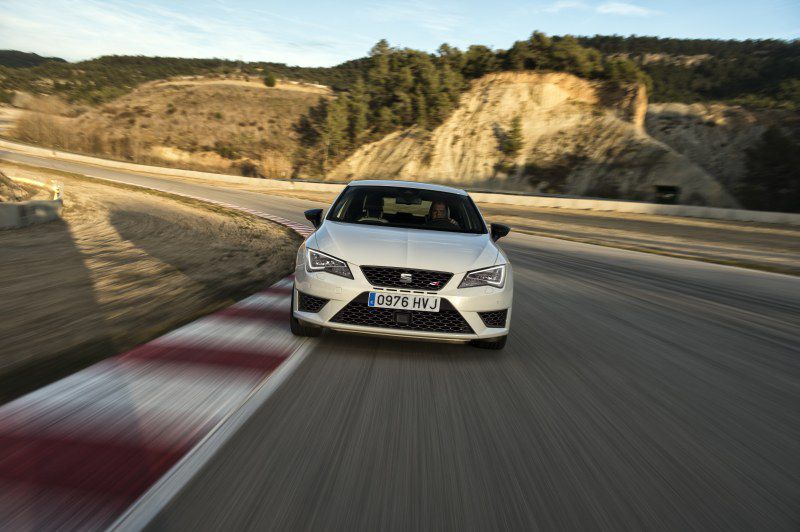
The Seat Leon III SC FR 2.0 TDI (184 Hp) start/stop embodies a dynamic and efficient offering from the Spanish automaker, SEAT, a prominent member of the Volkswagen Group. Launched in March 2013 and produced until 2016, this particular iteration represented the third generation of the Leon model line, specifically in its Sport Coupe (SC) variant. While SEAT vehicles are not typically sold in the United States, the Leon has carved out a significant niche in the European compact car segment, known for blending Volkswagen Group engineering with a more emotive, sport-oriented design language. The FR trim level, standing for “Formula Racing,” further accentuated this sporty character, positioning the Leon SC FR as an appealing choice for drivers seeking both performance and practicality in a stylish, three-door package. This generation of the Leon was lauded for its sharp handling, sophisticated chassis based on VW’s MQB platform, and a range of efficient powertrains, with the 2.0 TDI diesel engine being a standout for its potent combination of power and fuel economy.
Engine and Performance of the Seat Leon III SC FR 2.0 TDI (184 Hp) start/stop
At the heart of the Seat Leon III SC FR 2.0 TDI (184 Hp) start/stop lies a robust 2.0-liter (1968 cm3 or 120.09 cu. in.) inline-four turbodiesel engine, identified by the CUPA or CUNA engine code. This powerplant is a testament to modern diesel engineering, delivering a formidable 184 horsepower at a relatively broad band of 3500-4000 rpm. More impressively, it generates a substantial 280.27 lb.-ft. of torque, available from a low 1750 rpm up to 3000 rpm. This wide torque plateau ensures strong, linear acceleration across the rev range, making the car feel responsive and eager both in city driving and on the open highway.
The engine’s configuration features four valves per cylinder and a common rail direct fuel injection system, optimized for efficiency and power delivery. A turbocharger with an intercooler ensures dense air delivery, contributing to the engine’s impressive output and maintaining performance even at higher altitudes. With a compression ratio of 15.8:1, the engine is finely tuned for diesel operation. The powertrain architecture is front, transverse, driving the front wheels through a precise 6-speed manual transmission, a choice that appeals to enthusiasts who prefer direct engagement with the driving experience.
Performance figures for the Leon SC FR 2.0 TDI are genuinely impressive for a compact diesel coupe. It accelerates from 0 to 60 mph in a swift 7.0 seconds, with 0-62 mph (0-100 km/h) achieved in 7.4 seconds. The vehicle can reach a maximum speed of 141.67 mph (228 km/h), demonstrating its capability for sustained high-speed cruising. Despite its spirited performance, efficiency remains a core tenet. The inclusion of a Start & Stop system significantly contributes to reducing fuel consumption and emissions in urban environments by automatically shutting off the engine when the vehicle is stationary and restarting it seamlessly when the driver intends to move. A particulate filter is also standard, ensuring compliance with Euro 5 emission standards, which were stringent for its production era.
Fuel economy is a major highlight, reflecting the advanced diesel technology. The combined cycle fuel consumption is rated at an excellent 56 US mpg (4.2 l/100 km), while extra-urban driving can see figures as high as 61.9 US mpg (3.8 l/100 km). Even in urban settings, it achieves a commendable 45.2 US mpg (5.2 l/100 km). These figures translate to CO2 emissions of just 109 g/km, underscoring its environmental consciousness for its class and era. The weight-to-power ratio stands at a favorable 7.3 kg/Hp (136.3 Hp/tonne), and the weight-to-torque ratio is an even more impressive 3.6 kg/Nm (281.5 Nm/tonne), indicating that the vehicle is well-balanced for both acceleration and agile handling.
Design and Features
The Seat Leon III SC FR 2.0 TDI (184 Hp) start/stop distinguishes itself with its “Sport Coupe” (SC) designation, featuring a sleek three-door body style that enhances its sporty appeal compared to the more conventional five-door hatchback. With a length of 166.77 inches (4236 mm), a width of 71.26 inches (1810 mm), and a height of 56.34 inches (1431 mm), the Leon SC FR boasts compact dimensions ideal for navigating European city streets while maintaining a planted stance. The wheelbase measures 102.32 inches (2599 mm), contributing to both interior space and dynamic stability. The FR trim level typically includes specific exterior enhancements such as unique alloy wheels, a more aggressive front bumper, and FR badging, further emphasizing its performance-oriented character.
Despite its coupe designation, the Leon SC is designed to accommodate five occupants, offering a degree of practicality not always found in three-door vehicles. The trunk space is generous for its class, offering a minimum of 13.42 cu. ft. (380 liters) with the rear seats in place, expandable to a substantial 40.61 cu. ft. (1150 liters) when the rear seats are folded down. This flexibility makes it suitable for anything from daily commutes to weekend getaways. The interior design, while sharing elements with its Volkswagen Group siblings, features a distinct SEAT aesthetic with sporty touches, quality materials, and user-friendly ergonomics.
Safety and driver assistance systems, while not as advanced as contemporary vehicles, were comprehensive for its time. The Leon SC FR comes equipped with an Anti-lock Braking System (ABS) for enhanced stopping power and control. The steering utilizes a rack and pinion system, providing precise and direct feedback to the driver, a characteristic highly valued in a sporty car. The front-wheel-drive architecture, combined with a well-tuned suspension, ensures predictable handling and an engaging driving experience. The car’s kerb weight of 2976.24 lbs. (1350 kg) contributes to its agility, while a maximum permissible weight of 4056.51 lbs. (1840 kg) indicates a robust construction capable of handling significant loads.
Other practical features include a 13.21 US gallon (50-liter) fuel tank, offering a considerable range given its excellent fuel economy. The engine oil capacity is 4.86 US quarts (4.6 liters), and the coolant system holds 8.45 US quarts (8 liters). These details underscore the thorough engineering that went into making the Leon SC FR a reliable and efficient daily driver for its target market.
Technical Specifications
| Brand | Seat |
| Model | Leon |
| Generation | Leon III SC |
| Type (Engine) | FR 2.0 TDI (184 Hp) start/stop |
| Start of production | March, 2013 year |
| End of production | 2016 year |
| Powertrain Architecture | Internal Combustion engine |
| Body type | Coupe |
| Seats | 5 |
| Doors | 3 |
| Fuel consumption (economy) – urban | 5.2 l/100 km (45.2 US mpg) |
| Fuel consumption (economy) – extra urban | 3.8 l/100 km (61.9 US mpg) |
| Fuel consumption (economy) – combined | 4.2 l/100 km (56 US mpg) |
| CO2 emissions | 109 g/km |
| Fuel Type | Diesel |
| Acceleration 0 – 60 mph | 7 sec |
| Acceleration 0 – 100 km/h | 7.4 sec |
| Maximum speed | 228 km/h (141.67 mph) |
| Emission standard | Euro 5 |
| Weight-to-power ratio | 7.3 kg/Hp (136.3 Hp/tonne) |
| Weight-to-torque ratio | 3.6 kg/Nm (281.5 Nm/tonne) |
| Power | 184 Hp @ 3500-4000 rpm |
| Power per litre | 93.5 Hp/l |
| Torque | 380 Nm (280.27 lb.-ft.) @ 1750-3000 rpm |
| Engine layout | Front, Transverse |
| Engine Model/Code | CUPA, CUNA |
| Engine displacement | 1968 cm3 (120.09 cu. in.) |
| Number of cylinders | 4 |
| Engine configuration | Inline |
| Cylinder Bore | 81 mm (3.19 in.) |
| Piston Stroke | 95.5 mm (3.76 in.) |
| Compression ratio | 15.8:1 |
| Number of valves per cylinder | 4 |
| Fuel injection system | Diesel Commonrail |
| Engine aspiration | Turbocharger, Intercooler |
| Engine oil capacity | 4.6 l (4.86 US qt) |
| Coolant | 8 l (8.45 US qt) |
| Engine systems | Start & Stop System, Particulate filter |
| Kerb Weight | 1350 kg (2976.24 lbs.) |
| Max. weight | 1840 kg (4056.51 lbs.) |
| Max load | 490 kg (1080.27 lbs.) |
| Trunk (boot) space – minimum | 380 l (13.42 cu. ft.) |
| Trunk (boot) space – maximum | 1150 l (40.61 cu. ft.) |
| Fuel tank capacity | 50 l (13.21 US gal) |
| Length | 4236 mm (166.77 in.) |
| Width | 1810 mm (71.26 in.) |
| Height | 1431 mm (56.34 in.) |
| Wheelbase | 2599 mm (102.32 in.) |
| Front track | 1534 mm (60.39 in.) |
| Rear (Back) track | 1508 mm (59.37 in.) |
| Drivetrain Architecture | The Internal combustion engine (ICE) drives the front wheels of the vehicle. |
| Drive wheel | Front wheel drive |
| Number of gears and type of gearbox | 6 gears, manual transmission |
| Assisting systems | ABS (Anti-lock braking system) |
| Steering type | Steering rack and pinion |