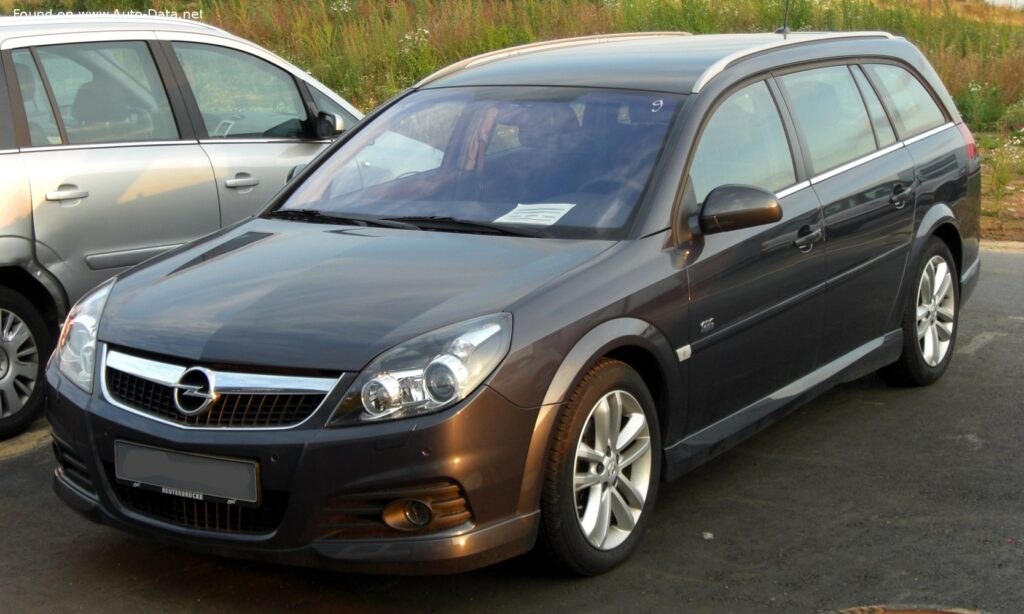
The Opel Vectra C Caravan, particularly the facelifted model from 2005 featuring the robust 3.0 V6 CDTI (184 Hp) engine, represented a significant offering in the competitive European D-segment. While not directly sold in the United States, this generation of the Vectra, produced by General Motors’ German subsidiary Opel, was a cornerstone of the brand’s lineup across Europe, the UK (as the Vauxhall Vectra), and other international markets. The Caravan variant, a station wagon, catered to a demographic prioritizing practicality, space, and comfort, often serving as a family hauler or a reliable fleet vehicle for businesses. The 2005 facelift introduced subtle yet impactful design revisions and technological enhancements, ensuring the Vectra C remained contemporary against rivals, while the potent 3.0-liter V6 common-rail diesel engine underscored its capability for long-distance cruising with impressive efficiency and strong performance.
The Opel Vectra C Caravan: A European Mainstay
Launched in 2003, the Opel Vectra C Caravan quickly established itself as a formidable contender in the mid-size station wagon category, succeeding the Vectra B. The 2005 facelift, which commenced production in July of that year, brought a refreshed aesthetic and updated mechanicals to the third-generation platform. This mid-cycle refresh was crucial for maintaining the model’s appeal in a market segment characterized by stiff competition from Ford, Volkswagen, and various premium brands. The Opel Vectra C Caravan was designed with a clear emphasis on utility, offering substantial cargo volume and comfortable seating for five adults, making it an ideal choice for European families and professionals who frequently traveled with luggage or equipment.
The design philosophy behind the Vectra C Caravan was rooted in functional elegance. Its elongated profile, characteristic of European station wagons, was not merely for aesthetics but was meticulously engineered to maximize interior volume. The 2005 facelift brought a more assertive front fascia, revised headlamps, and a subtly reshaped grille, aligning its appearance with Opel’s evolving design language. Inside, improvements were made to materials and ergonomics, enhancing the overall cabin ambiance and user experience. As a front-wheel-drive vehicle, it offered predictable handling and good traction, traits highly valued in diverse European driving conditions.
Powertrain and Performance of the Opel Vectra C Caravan 3.0 V6 CDTI
At the heart of this particular model was the formidable 3.0 V6 CDTI (Common Rail Diesel Injection) engine, designated with the internal code Z30DT. This V6 diesel powerplant was a testament to Opel’s commitment to offering high-performance, yet fuel-efficient, options for its larger models, particularly significant in a European market where diesel engines held a substantial share due to their superior fuel economy and torque characteristics. Generating 184 horsepower at 4000 rpm, the engine delivered robust acceleration and effortless cruising capability. More impressively, it produced a substantial 295.02 lb.-ft. of torque, available across a broad rev range from 1900 to 2700 rpm. This wide torque band was instrumental in the vehicle’s strong in-gear acceleration and its ability to effortlessly manage heavy loads or challenging inclines.
The performance figures for the Opel Vectra C Caravan (facelift 2005) 3.0 V6 CDTI (184 Hp) were commendable for a vehicle of its size and segment. It could accelerate from 0 to 60 mph in a swift 8.6 seconds, with a top speed reaching 139.81 mph. These figures underscored its capacity for dynamic driving while still maintaining the practicality expected of a station wagon. Fuel efficiency was a key selling point, especially for a diesel. The urban fuel consumption was rated at 24 US mpg, while on the extra-urban cycle, it achieved an impressive 45.2 US mpg. This combination of power, torque, and efficiency, coupled with a 15.85 US gallon fuel tank, provided excellent range, making it a favorite for long-distance travel across continents.
The engine’s layout was front, transverse, driving the front wheels through a precise 6-speed manual transmission. This configuration was typical for the segment, offering a good balance of packaging efficiency and driving dynamics. The 2958 cm³ (180.51 cu. in.) displacement, combined with a turbocharger and intercooler, ensured optimal combustion and power delivery. The compression ratio of 18.5:1 is characteristic of a high-performance diesel, while the direct injection fuel system maximized efficiency and reduced emissions for its time. With a kerb weight of 3560.47 lbs., the power-to-weight ratio stood at 8.8 kg/Hp (113.9 Hp/tonne), further highlighting its capable performance.
Design, Utility, and Features
The body type of the Opel Vectra C Caravan is a classic station wagon, offering five doors and comfortable seating for five occupants. Its generous dimensions, with a length of 190.51 inches and a width of 70.79 inches, contributed to a spacious interior. The wheelbase of 111.42 inches provided a stable ride and ample legroom for rear passengers. However, it was the cargo capacity that truly set the Caravan apart. With a minimum trunk space of 18.72 cubic feet (530 liters), it could easily accommodate everyday luggage. When the rear seats were folded down, this expanded dramatically to a cavernous 65.33 cubic feet (1850 liters), rivaling many SUVs in terms of load-carrying capability. This versatility made it incredibly popular with families, outdoor enthusiasts, and tradespeople.
In terms of features, the 2005 Vectra C Caravan was well-equipped for its era. Standard safety systems included an Anti-lock Braking System (ABS), providing enhanced control during emergency braking. The vehicle featured disc brakes on both the front and rear axles, ensuring strong and consistent stopping power. The suspension system, comprising independent coil springs at both the front and rear, was tuned to offer a comfortable ride without sacrificing too much in terms of handling stability. It rode on 215/55 R16 tires fitted to 16-inch wheel rims, a common specification for balancing ride comfort, grip, and cost-effectiveness.
Driving Dynamics and Safety
The driving experience of the Opel Vectra C Caravan was characterized by its composure and stability, particularly at higher speeds on autobahns and motorways, which was a critical attribute for its primary European market. The independent coil spring suspension, combined with a well-calibrated chassis, provided a comfortable ride quality, absorbing road imperfections effectively. While not designed as a sports car, its front-wheel-drive architecture offered predictable handling and a sense of security for the driver. The precise 6-speed manual transmission allowed the driver to effectively manage the engine’s considerable torque, ensuring optimal performance and efficiency in various driving scenarios.
Safety was a paramount consideration for a family-oriented vehicle like the Vectra C Caravan. Beyond the standard ABS, Opel typically equipped its vehicles with a comprehensive suite of passive safety features, including multiple airbags, pre-tensioning seatbelts, and a robust body structure designed to absorb impact energy. Although specific details on additional safety features beyond ABS are not provided in the technical data, it can be inferred that the vehicle met contemporary European safety standards for its production years of 2005 to 2008. The combination of strong brakes, stable handling, and essential safety systems contributed to making the Vectra C Caravan a reliable and secure choice for its owners.
Technical Specifications: Opel Vectra C Caravan (facelift 2005) 3.0 V6 CDTI (184 Hp)
| Brand | Opel |
| Model | Vectra |
| Generation | Vectra C Caravan (facelift 2005) |
| Type (Engine) | 3.0 V6 CDTI (184 Hp) |
| Start of production | July, 2005 year |
| End of production | August, 2008 year |
| Powertrain Architecture | Internal Combustion engine |
| Body type | Station wagon (estate) |
| Seats | 5 |
| Doors | 5 |
| Fuel consumption (economy) – urban | 9.8 l/100 km (24 US mpg) |
| Fuel consumption (economy) – extra urban | 5.2 l/100 km (45.2 US mpg) |
| Fuel Type | Diesel |
| Acceleration 0 – 60 mph | 8.6 sec |
| Maximum speed | 225 km/h (139.81 mph) |
| Weight-to-power ratio | 8.8 kg/Hp (113.9 Hp/tonne) |
| Weight-to-torque ratio | 4 kg/Nm (247.7 Nm/tonne) |
| Power | 184 Hp @ 4000 rpm |
| Power per liter | 62.2 Hp/l |
| Torque | 400 Nm (295.02 lb.-ft.) @ 1900-2700 rpm |
| Engine layout | Front, Transverse |
| Engine Model/Code | Z30DT |
| Engine displacement | 2958 cm³ (180.51 cu. in.) |
| Number of cylinders | 6 |
| Engine configuration | V-engine |
| Cylinder Bore | 87.5 mm (3.44 in.) |
| Piston Stroke | 82 mm (3.23 in.) |
| Compression ratio | 18.5:1 |
| Number of valves per cylinder | 4 |
| Fuel injection system | Direct injection |
| Engine aspiration | Turbocharger, Intercooler |
| Engine oil capacity | 7.5 l (7.93 US qt) |
| Coolant | 8.3 l (8.77 US qt) |
| Kerb Weight | 1615 kg (3560.47 lbs.) |
| Max. weight | 2240 kg (4938.35 lbs.) |
| Max load | 625 kg (1377.89 lbs.) |
| Trunk (boot) space – minimum | 530 l (18.72 cu. ft.) |
| Trunk (boot) space – maximum | 1850 l (65.33 cu. ft.) |
| Fuel tank capacity | 60 l (15.85 US gal) |
| Length | 4839 mm (190.51 in.) |
| Width | 1798 mm (70.79 in.) |
| Height | 1500 mm (59.06 in.) |
| Wheelbase | 2830 mm (111.42 in.) |
| Front track | 1536 mm (60.47 in.) |
| Rear (Back) track | 1525 mm (60.04 in.) |
| Drivetrain Architecture | Front wheel drive, Internal Combustion engine |
| Drive wheel | Front wheel drive |
| Number of gears and type of gearbox | 6 gears, manual transmission |
| Front suspension | Independent coil spring |
| Rear suspension | Independent coil spring |
| Front brakes | Disc |
| Rear brakes | Disc |
| Assisting systems | ABS (Anti-lock braking system) |
| Tires size | 215/55 R16 |
| Wheel rims size | 16 |