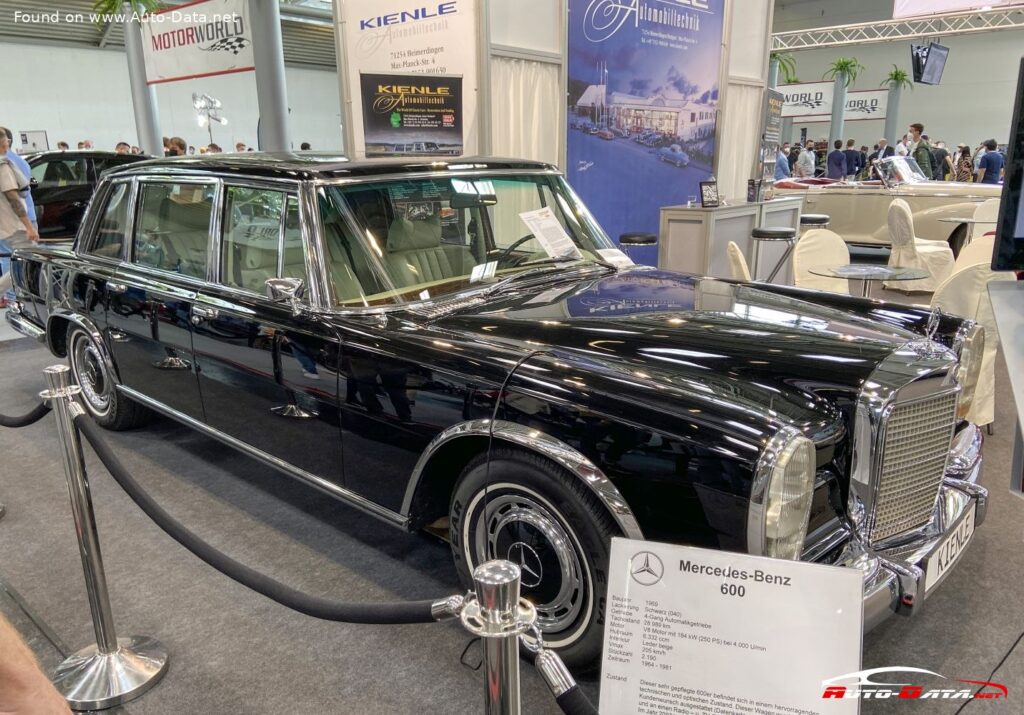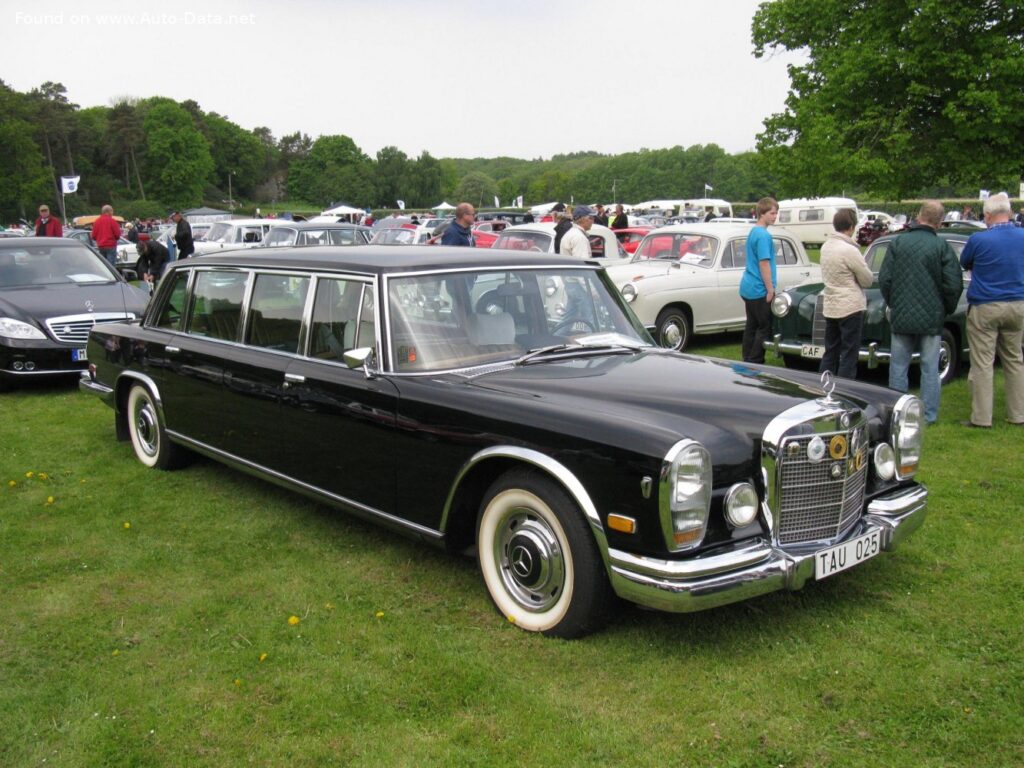
The Mercedes-Benz W100 Pullman 600, produced from 1963 to 1981, represents the pinnacle of German automotive engineering and luxury during its era. This ultra-exclusive, large sedan was not intended for the mass market; instead, it catered to heads of state, dignitaries, and wealthy individuals seeking unparalleled comfort and prestige. The “Pullman” designation signified an extended wheelbase and a more opulent interior, distinguishing it from the standard W100. The 600 model, powered by a sophisticated V8 engine, became synonymous with power, status, and discreet transportation. It remains a highly sought-after collector’s car, celebrated for its engineering innovation and historical significance.
The Mercedes-Benz W100 Pullman 600: A Legacy of Luxury
The W100 Pullman 600 was more than just a car; it was a statement. Developed as a replacement for the Adenauer models (W220), the W100 aimed to provide a new level of refinement and security. Its extended length allowed for a spacious interior, often configured with facing seats to facilitate conversation. The car’s robust construction and advanced features for the time, including optional features like a dividing partition, a wet bar, and even a telephone, made it ideal for official use. While officially a Mercedes-Benz, the Pullman versions were often hand-built and customized, adding to their exclusivity and cost. The W100 Pullman 600 was a symbol of post-war prosperity and German industrial prowess.
Engine & Performance
At the heart of the W100 Pullman 600 lies the M 100.980 6.3-liter (386.4 cu. in.) V8 engine. This powerplant produced 250 horsepower at 4000 rpm and a substantial 500 Nm (368.78 lb.-ft.) of torque at 2800 rpm. The engine featured a single overhead camshaft (SOHC) valvetrain and multi-port manifold fuel injection, technologies considered advanced for the early 1960s. Power was delivered to the rear wheels through a four-speed automatic transmission. Despite its considerable weight – approximately 2660 kg (5864.3 lbs) – the Pullman 600 could accelerate from 0 to 100 km/h (0-62 mph) in 9.7 seconds and achieve a top speed of 205 km/h (127.38 mph). The weight-to-power ratio of 10.6 kg/Hp and a weight-to-torque ratio of 5.3 kg/Nm demonstrated a strong performance capability for a vehicle of its size and intended purpose. Fuel economy, however, was unsurprisingly low, averaging 17.8 l/100 km (13.2 US mpg).
Design & Features
The W100 Pullman 600 is a classic example of 1960s automotive design, characterized by its imposing size, elegant lines, and understated luxury. The sedan body style, with its four doors and seating for seven to eight passengers, was designed to convey authority and sophistication. The extended wheelbase, a defining feature of the Pullman variant, provided ample legroom and a more comfortable ride. The car’s interior was lavishly appointed with high-quality materials, including leather upholstery, wood trim, and deep-pile carpeting. Safety features, while limited by the standards of today, included disc brakes on all four wheels, a significant advancement for the time. The hydraulic power steering made maneuvering the large vehicle easier, and the air suspension provided a remarkably smooth and comfortable ride, absorbing road imperfections effectively. The car’s overall design emphasized a sense of timeless elegance and enduring quality.
Technical Specifications
| Brand | Mercedes-Benz |
| Model | W100 |
| Generation | W100 Pullman |
| Type (Engine) | 600 V8 (250 Hp) Automatic |
| Start of production | 1963 |
| End of production | 1981 |
| Powertrain Architecture | Internal Combustion engine |
| Body type | Sedan |
| Seats | 7-8 |
| Doors | 4 |
| Fuel consumption (combined) | 17.8 l/100 km |
| Fuel consumption (US mpg) | 13.2 |
| Fuel consumption (UK mpg) | 15.9 |
| Fuel Type | Petrol (Gasoline) |
| Acceleration 0 – 100 km/h | 9.7 sec |
| Acceleration 0 – 62 mph | 9.7 sec |
| Acceleration 0 – 60 mph | 9.2 sec |
| Maximum speed | 205 km/h (127.38 mph) |
| Weight-to-power ratio | 10.6 kg/Hp |
| Weight-to-torque ratio | 5.3 kg/Nm |
| Power | 250 Hp @ 4000 rpm |
| Power per litre | 39.5 Hp/l |
| Torque | 500 Nm @ 2800 rpm (368.78 lb.-ft. @ 2800 rpm) |
| Engine layout | Front, Longitudinal |
| Engine Model/Code | M 100.980 |
| Engine displacement | 6332 cm3 (386.4 cu. in.) |
| Number of cylinders | 8 |
| Engine configuration | V-engine |
| Cylinder Bore | 103 mm (4.06 in.) |
| Piston Stroke | 95 mm (3.74 in.) |
| Compression ratio | 9:1 |
| Number of valves per cylinder | 2 |
| Fuel injection system | Multi-port manifold injection |
| Engine aspiration | Naturally aspirated engine |
| Valvetrain | SOHC |
| Engine oil capacity | 7 l (7.4 US qt | 6.16 UK qt) |
| Coolant | 23 l (24.3 US qt | 20.24 UK qt) |
| Kerb Weight | 2660 kg (5864.3 lbs.) |
| Max. weight | 3360 kg (7407.53 lbs.) |
| Max load | 700 kg (1543.24 lbs.) |
| Trunk (boot) space – minimum | 580 l (20.48 cu. ft.) |
| Fuel tank capacity | 112 l (29.59 US gal | 24.64 UK gal) |
| Length | 6240 mm (245.67 in.) |
| Width | 1950 mm (76.77 in.) |
| Height | 1500 mm (59.06 in.) |
| Wheelbase | 3900 mm (153.54 in.) |
| Front track | 1587 mm (62.48 in.) |
| Rear (Back) track | 1581 mm (62.24 in.) |
| Ride height (ground clearance) | 200 mm (7.87 in.) |
| Minimum turning circle (turning diameter) | 14.6 m (47.9 ft.) |
| Drivetrain Architecture | Rear wheel drive |
| Number of gears and type of gearbox | 4 gears, automatic transmission |
| Front suspension | Double wishbone, Air suspension |
| Rear suspension | Air suspension |
| Front brakes | Disc |
| Rear brakes | Disc |
| Steering type | Cone worm with recirculation balls |
| Power steering | Hydraulic Steering |
| Tires size | 230/80 R15 |
| Wheel rims size | 6.5J x 15 |
The Mercedes-Benz W100 Pullman 600 remains a testament to an era of automotive grandeur and engineering excellence. Its enduring appeal lies in its combination of luxurious comfort, powerful performance, and historical significance, solidifying its place as a true icon of the automotive world.