
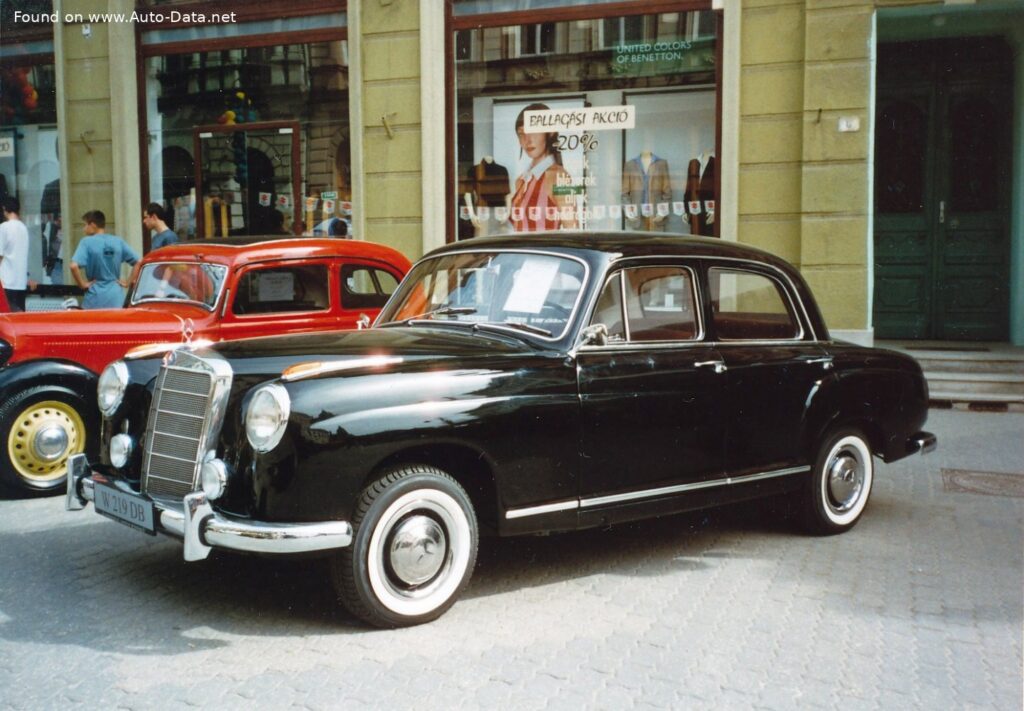
The Mercedes-Benz W105, often referred to as the “Ponton” (meaning “pontoon” in German due to its rounded styling), represents a pivotal moment in post-war Mercedes-Benz history. Produced from 1957 to 1959, the W105 Sedan 219, powered by a 2.2-liter inline-six engine producing 90 horsepower, was a significant departure from the pre-war designs and the immediate post-war models. It established a new design language for the brand and broadened its appeal to a wider market. The Ponton series, including the W105, was crucial in re-establishing Mercedes-Benz as a leading automotive manufacturer, particularly in the burgeoning economies of the late 1950s. While not initially a major seller in the United States, the Ponton series laid the groundwork for the brand’s future success in the American market.
Mercedes-Benz W105 Sedan 219 (90 Hp): A Detailed Overview
The W105 Sedan 219 was part of the first generation of the Ponton series, characterized by its unibody construction – a relatively new technique at the time – and its fully integrated body and fender design. This contrasted sharply with the separate fenders common on earlier Mercedes-Benz models. The “219” designation referred to the model’s engine displacement, signifying a 2.2-liter variant. This model aimed to provide comfortable and reliable transportation for families and business professionals, embodying the post-war desire for stability and progress.
Engine & Performance
The heart of the W105 Sedan 219 is its 2.2-liter (2195 cm³) inline-six cylinder engine, designated the M180 II / 180.921. This naturally aspirated engine produces 90 horsepower at 4800 rpm and 167 Nm (123.17 lb.-ft.) of torque at 2400 rpm. While these figures may seem modest by modern standards, they were competitive for the era. The engine features a single overhead camshaft (SOHC) valvetrain and a compression ratio of 8.7:1. Fuel is delivered via a carburetor. Power is sent to the rear wheels through a four-speed manual transmission. Performance is characterized by smooth, albeit leisurely, acceleration. The 0-60 mph (0-96 km/h) time is approximately 16.2 seconds, and the car has a top speed of around 92 mph (148 km/h). The weight-to-power ratio of 14 kg/Hp and weight-to-torque ratio of 7.5 kg/Nm reflect the car’s substantial weight relative to its output.
Design & Features
The W105 Sedan is a four-door, five-seater sedan with a classic, elegant design. Its rounded body shape, integrated fenders, and relatively low roofline contribute to its distinctive appearance. The interior is typically appointed with comfortable seating and a functional dashboard. While not lavishly equipped by today’s standards, the W105 offered a reasonable level of comfort and refinement for its time. Safety features were limited compared to modern vehicles, consisting primarily of robust construction and reliable braking systems. The car’s suspension utilizes a double wishbone setup with a transverse stabilizer at the front and a trailing arm configuration at the rear, providing a comfortable ride. Brakes are drum brakes on all four wheels. The steering system employs a cone worm with recirculation balls. The Ponton’s design prioritized practicality and durability, making it a popular choice for everyday use.
Technical Specifications
| Brand | Mercedes-Benz |
| Model | Ponton |
| Generation | W105 Sedan |
| Type (Engine) | 219 (90 Hp) |
| Start of production | August, 1957 |
| End of production | July, 1959 |
| Powertrain Architecture | Internal Combustion engine |
| Body type | Sedan |
| Seats | 5 |
| Doors | 4 |
| Fuel consumption (combined) | 11.2 l/100 km |
| Fuel consumption (US mpg) | 21 US mpg |
| Fuel consumption (UK mpg) | 25.2 UK mpg |
| Fuel consumption (km/l) | 8.9 km/l |
| Fuel Type | Petrol (Gasoline) |
| Acceleration 0 – 100 km/h | 17 sec |
| Acceleration 0 – 62 mph | 17 sec |
| Acceleration 0 – 60 mph | 16.2 sec |
| Maximum speed | 148 km/h / 91.96 mph |
| Weight-to-power ratio | 14 kg/Hp |
| Weight-to-torque ratio | 7.5 kg/Nm |
| Power | 90 Hp @ 4800 rpm |
| Power per litre | 41 Hp/l |
| Torque | 167 Nm @ 2400 rpm / 123.17 lb.-ft. @ 2400 rpm |
| Engine layout | Front, Longitudinal |
| Engine Model/Code | M 180 II / 180.921 |
| Engine displacement | 2195 cm3 / 133.95 cu. in. |
| Number of cylinders | 6 |
| Engine configuration | Inline |
| Cylinder Bore | 80 mm / 3.15 in. |
| Piston Stroke | 72.8 mm / 2.87 in. |
| Compression ratio | 8.7:1 |
| Number of valves per cylinder | 2 |
| Fuel injection system | Carburettor |
| Engine aspiration | Naturally aspirated engine |
| Valvetrain | SOHC |
| Kerb Weight | 1260 kg / 2777.82 lbs |
| Max. weight | 1725 kg / 3802.97 lbs |
| Max load | 465 kg / 1025.15 lbs |
| Fuel tank capacity | 56 l / 14.79 US gal | 12.32 UK gal |
| Length | 4680 mm / 184.25 in. |
| Width | 1740 mm / 68.5 in. |
| Height | 1560 mm / 61.42 in. |
| Wheelbase | 2750 mm / 108.27 in. |
| Front track | 1430 mm / 56.3 in. |
| Rear track | 1470 mm / 57.87 in. |
| Drivetrain Architecture | The Internal combustion engine (ICE) drives the rear wheels of the vehicle. |
| Drive wheel | Rear wheel drive |
| Number of gears and type of gearbox | 4 gears, manual transmission |
| Front suspension | Double wishbone, Transverse stabilizer |
| Rear suspension | Trailing arm |
| Front brakes | Drum |
| Rear brakes | Drum |
| Steering type | Cone worm with recirculation balls |
The Mercedes-Benz W105 Sedan 219 represents a significant step forward in the evolution of the brand. Its innovative construction, elegant design, and reliable powertrain established a new standard for Mercedes-Benz automobiles and paved the way for its future success in the global automotive market. Today, the Ponton series is highly sought after by collectors and enthusiasts, representing a charming and historically important chapter in automotive history.
