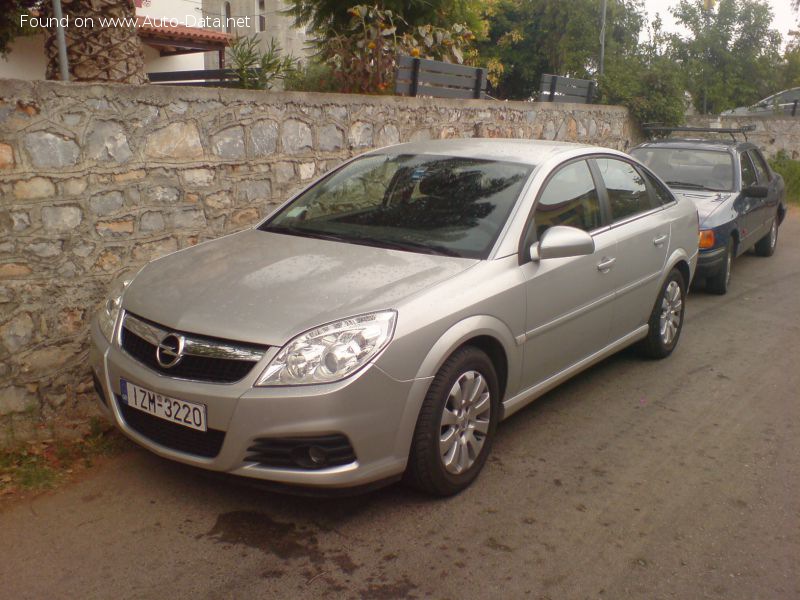
The Opel Vectra C CC (facelift 2005) represents a significant chapter in the history of Opel’s D-segment offerings, particularly with its potent 2.8i V6 24V Turbo (250 Hp) variant. Launched in November 2006 as part of the refreshed C-generation Vectra lineup, this model was a cornerstone of Opel’s strategy in the highly competitive European mid-size car market. While not officially sold in the United States, the Vectra C played a crucial role for General Motors’ European arm, providing a blend of practicality, comfort, and, in this specific iteration, surprising performance. The “CC” designation, often referring to a “Compact Coupe” or “Caravan Coupe” in Opel’s nomenclature, here denotes a sleek five-door hatchback body style, offering enhanced versatility without sacrificing a dynamic profile. This particular model, produced until August 2008, stood out for its turbocharged V6 engine, presenting a compelling option for drivers seeking executive-level power in a family-friendly package, a true ‘sleeper’ in its class.
The Opel Vectra C CC (facelift 2005): A European Performance Hatchback
The third generation of the Opel Vectra, designated “C,” underwent a significant facelift in 2005, bringing updated styling, improved interior materials, and a revised engine lineup. The 2.8i V6 24V Turbo, specifically, was a halo engine, offering a level of performance that transformed the Vectra from a mere family hauler into a genuine sport-oriented vehicle. This variant was designed to appeal to buyers who desired the practicality of a hatchback but refused to compromise on exhilarating acceleration and high-speed cruising capabilities. Its position in the market was distinct: a front-wheel-drive, V6-powered hatchback that offered a compelling alternative to more premium, often rear-wheel-drive, executive sedans and wagons from competitors. The Vectra C CC, with its facelift, demonstrated Opel’s commitment to offering a broad range of options, from economical diesels to powerful gasoline engines, catering to diverse European consumer demands.
Engine & Performance
At the heart of the Opel Vectra C CC (facelift 2005) 2.8i V6 24V Turbo lies a formidable 2.8-liter (2792 cm3 or 170.38 cu. in.) V6 engine, internally designated Z28NET. This powerplant is a testament to sophisticated engineering, featuring a turbocharger and intercooler that significantly enhance its output. The engine delivers an impressive 250 horsepower at 5500 rpm, translating to a robust 89.5 horsepower per liter, an excellent specific output for its era. More critically, the engine produces a substantial 350 Newton-meters (258.15 lb.-ft.) of torque across a broad and accessible range, from 1800 to 4500 rpm. This wide torque band ensures strong pulling power from low revs, making for effortless overtaking and spirited acceleration.
Mated to a precise 6-speed manual transmission, this front-wheel-drive architecture allows the Vectra C CC to achieve remarkable performance figures. The sprint from 0 to 60 mph is dispatched in a swift 6.6 seconds, while the 0 to 100 km/h acceleration takes 6.9 seconds. These figures position the Vectra C CC firmly in the realm of performance cars, capable of challenging many sport sedans of its time. The top speed is electronically limited to 255 km/h, which translates to approximately 158.45 mph, underscoring its Autobahn-ready credentials. Despite its performance potential, Opel also engineered the vehicle for reasonable fuel efficiency, with a combined cycle consumption of 10.3 liters per 100 km (22.8 US mpg). This balance of power and efficiency, especially for a turbocharged V6, was a key selling point in the European market, where fuel costs are a significant consideration. The engine’s layout is front, transverse, contributing to the vehicle’s efficient packaging and handling characteristics.
Design & Features
The Opel Vectra C CC (facelift 2005) adopted a contemporary and aerodynamic design, characteristic of European mid-size vehicles from the mid-2000s. Its five-door hatchback body style, while inherently practical, was styled with a sleek, almost coupe-like roofline that distinguished it from its sedan and wagon siblings. The facelift introduced refreshed front and rear fascias, including new headlights, grilles, and taillights, giving the car a more modern and assertive presence. With a length of 4611 mm (181.54 in.), a width of 1798 mm (70.79 in.), and a height of 1460 mm (57.48 in.), the Vectra C CC offered generous interior space for five occupants, making it a viable family vehicle.
Inside, the Vectra C CC provided a comfortable and well-appointed cabin. The 500 liters (17.66 cu. ft.) of trunk space, expandable by folding the rear seats, highlighted its practical nature, suitable for both daily commutes and longer journeys with luggage. Key features contributing to its driving dynamics and safety included an independent coil spring suspension system at both the front and rear, ensuring a balanced ride and competent handling. Braking performance was handled by ventilated discs on both front and rear axles, coupled with an Anti-lock Braking System (ABS) for enhanced stopping power and control in adverse conditions. The vehicle rode on 16-inch wheel rims, fitted with 215/55 R16 tires, offering a good compromise between ride comfort and road holding. The kerb weight of 1495 kg (3295.91 lbs.) combined with its powerful engine resulted in a favorable weight-to-power ratio of 6 kg/Hp, further emphasizing its performance capabilities. The 61-liter (16.11 US gal) fuel tank provided a respectable cruising range, making it suitable for long-distance travel across Europe.
Technical Specifications: Opel Vectra C CC (facelift 2005) 2.8i V6 24V Turbo (250 Hp)
| Brand | Opel |
| Model | Vectra |
| Generation | Vectra C CC (facelift 2005) |
| Engine Type | 2.8i V6 24V Turbo (250 Hp) |
| Production Start | November, 2006 |
| Production End | August, 2008 |
| Powertrain Architecture | Internal Combustion engine |
| Body Type | Hatchback |
| Seats | 5 |
| Doors | 5 |
| Fuel Consumption (Urban) | 15.4 l/100 km (15.3 US mpg) |
| Fuel Consumption (Extra Urban) | 7.3 l/100 km (32.2 US mpg) |
| Fuel Consumption (Combined) | 10.3 l/100 km (22.8 US mpg) |
| Fuel Type | Petrol (Gasoline) |
| Acceleration 0-60 mph | 6.6 sec |
| Acceleration 0-100 km/h | 6.9 sec |
| Maximum Speed | 255 km/h (158.45 mph) |
| Weight-to-Power Ratio | 6 kg/Hp (167.2 Hp/tonne) |
| Weight-to-Torque Ratio | 4.3 kg/Nm (234.1 Nm/tonne) |
| Power | 250 Hp @ 5500 rpm |
| Power per Litre | 89.5 Hp/l |
| Torque | 350 Nm (258.15 lb.-ft.) @ 1800-4500 rpm |
| Engine Layout | Front, Transverse |
| Engine Model/Code | Z28NET |
| Engine Displacement | 2792 cm3 (170.38 cu. in.) |
| Number of Cylinders | 6 |
| Engine Configuration | V-engine |
| Cylinder Bore | 89 mm (3.5 in.) |
| Piston Stroke | 74.8 mm (2.94 in.) |
| Compression Ratio | 9.5:1 |
| Valves per Cylinder | 4 |
| Fuel Injection System | Multi-port manifold injection |
| Engine Aspiration | Turbocharger, Intercooler |
| Engine Oil Capacity | 6 l (6.34 US qt) |
| Coolant Capacity | 7.5 l (7.93 US qt) |
| Kerb Weight | 1495 kg (3295.91 lbs.) |
| Max. Weight | 2040 kg (4497.43 lbs.) |
| Max Load | 545 kg (1201.52 lbs.) |
| Trunk (Boot) Space – Maximum | 500

|