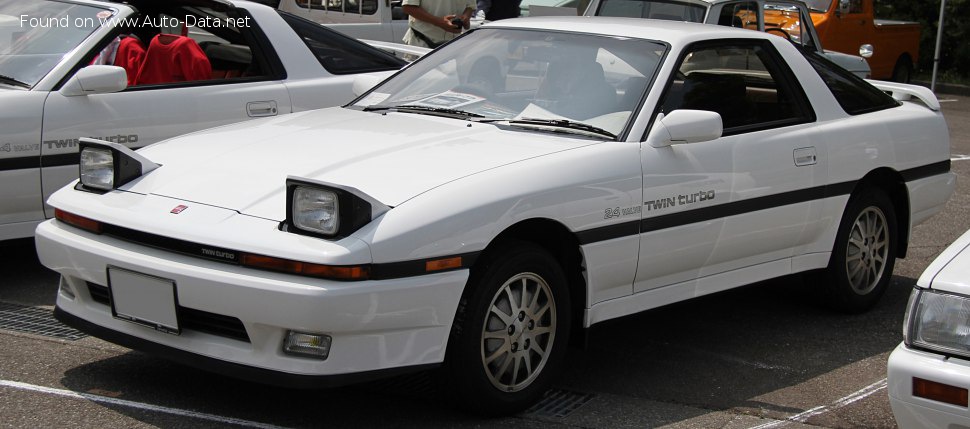
The Toyota Supra III (A70), produced between 1986 and 1988, represents a pivotal generation in the Supra lineage. Positioned as a grand tourer, the A70 moved the Supra further upmarket, distinguishing itself from the more accessible Celica with which it had previously shared a platform. This generation marked a significant step towards the sophisticated, performance-focused image the Supra would ultimately become known for, particularly in enthusiast circles. While not initially a huge seller in the United States, the A70 Supra laid the groundwork for the later, more popular generations that would achieve iconic status.
Toyota Supra III (A70): A Grand Touring Evolution
The A70 Supra was a deliberate attempt by Toyota to create a more refined and powerful sports coupe. It represented a departure from the earlier, more Celica-based Supras, adopting a longer wheelbase and a more luxurious interior. The focus shifted towards providing a comfortable yet engaging driving experience, appealing to buyers seeking a blend of performance and sophistication. The A70’s styling, while distinctly 1980s, was sleek and modern for its time, featuring pop-up headlights and a relatively low-slung profile. It served as a technological stepping stone for Toyota, incorporating features that would become hallmarks of the Supra nameplate.
Engine & Performance
The heart of the Supra III (A70) 3.0 24V was the 7M-GE 3.0-liter inline-six engine. This naturally aspirated powerplant produced 190 horsepower at 5800 rpm and 180.7 lb.-ft. of torque at 4800 rpm. While not groundbreaking in terms of outright power compared to some contemporary sports cars, the 7M-GE offered a smooth and responsive power delivery. The engine featured single-point fuel injection and a 9.2:1 compression ratio. Power was sent to the rear wheels via a 5-speed manual transmission, contributing to a spirited driving experience. The A70 achieved a maximum speed of 136.7 mph (220 km/h). The weight-to-power ratio of 7.9 kg/Hp and a weight-to-torque ratio of 6.2 kg/Nm indicated a reasonably balanced performance profile for the era.
Design & Features
The A70 Supra was exclusively offered as a three-door coupe with seating for four passengers. Its body style was characterized by clean lines and a relatively understated elegance. Pop-up headlights were a defining feature of the design, common for sports cars of the 1980s. Inside, the A70 offered a more upscale interior compared to its predecessors, with comfortable seating and a well-appointed dashboard. Safety features, while limited by the standards of today, included an Anti-lock Braking System (ABS), which was becoming increasingly common on performance vehicles. The suspension utilized a double wishbone setup at both the front and rear, providing a comfortable ride and competent handling. Power steering, utilizing a hydraulic system, further enhanced the driving experience. The vehicle’s dimensions – a length of 181.89 inches, a width of 68.7 inches, and a height of 51.57 inches – positioned it as a relatively large coupe for its time.
Technical Specifications
| Brand | Toyota |
| Model | Supra |
| Generation | Supra III (A70) |
| Type (Engine) | 3.0 24V (190 Hp) |
| Start of production | 1986 |
| End of production | 1988 |
| Powertrain Architecture | Internal Combustion engine |
| Body type | Coupe |
| Seats | 4 |
| Doors | 3 |
| Fuel Type | Petrol (Gasoline) |
| Maximum speed | 136.7 mph (220 km/h) |
| Weight-to-power ratio | 7.9 kg/Hp |
| Weight-to-torque ratio | 6.2 kg/Nm |
| Power | 190 Hp @ 5800 rpm |
| Power per litre | 64.3 Hp/l |
| Torque | 245 Nm @ 4800 rpm (180.7 lb.-ft. @ 4800 rpm) |
| Engine layout | Front, Longitudinal |
| Engine Model/Code | 7M-GE |
| Engine displacement | 2954 cm3 (180.26 cu. in.) |
| Number of cylinders | 6 |
| Engine configuration | Inline |
| Cylinder Bore | 83 mm (3.27 in.) |
| Piston Stroke | 91 mm (3.58 in.) |
| Compression ratio | 9.2:1 |
| Number of valves per cylinder | 4 |
| Fuel injection system | Single-point injection |
| Engine aspiration | Naturally aspirated engine |
| Engine oil capacity | 4.4 l (4.65 US qt | 3.87 UK qt) |
| Coolant | 8.1 l (8.56 US qt | 7.13 UK qt) |
| Kerb Weight | 1510 kg (3328.98 lbs.) |
| Max. weight | 1945 kg (4287.99 lbs.) |
| Max load | 435 kg (959.01 lbs.) |
| Fuel tank capacity | 70 l (18.49 US gal | 15.4 UK gal) |
| Length | 4620 mm (181.89 in.) |
| Width | 1745 mm (68.7 in.) |
| Height | 1310 mm (51.57 in.) |
| Wheelbase | 2595 mm (102.17 in.) |
| Front track | 1485 mm (58.46 in.) |
| Rear (Back) track | 1480 mm (58.27 in.) |
| Ride height (ground clearance) | 155 mm (6.1 in.) |
| Minimum turning circle (turning diameter) | 10.8 m (35.43 ft.) |
| Drivetrain Architecture | Rear wheel drive |
| Drive wheel | Rear wheel drive |
| Number of gears and type of gearbox | 5 gears, manual transmission |
| Front suspension | Double wishbone |
| Rear suspension | Double wishbone |
| Front brakes | Ventilated discs |
| Rear brakes | Ventilated discs |
| Assisting systems | ABS (Anti-lock braking system) |
| Steering type | Steering rack and pinion |
| Power steering | Hydraulic Steering |
| Tires size | 225/50 R16 |
| Wheel rims size | 7J x 16 |
The Toyota Supra III (A70) represents a crucial link in the Supra’s evolutionary chain. While it may not possess the outright performance or iconic status of later generations, it established the foundation for the Supra’s future success as a sophisticated and capable grand tourer. Its blend of comfort, performance, and technology made it a compelling option for buyers seeking a refined sports coupe in the late 1980s.