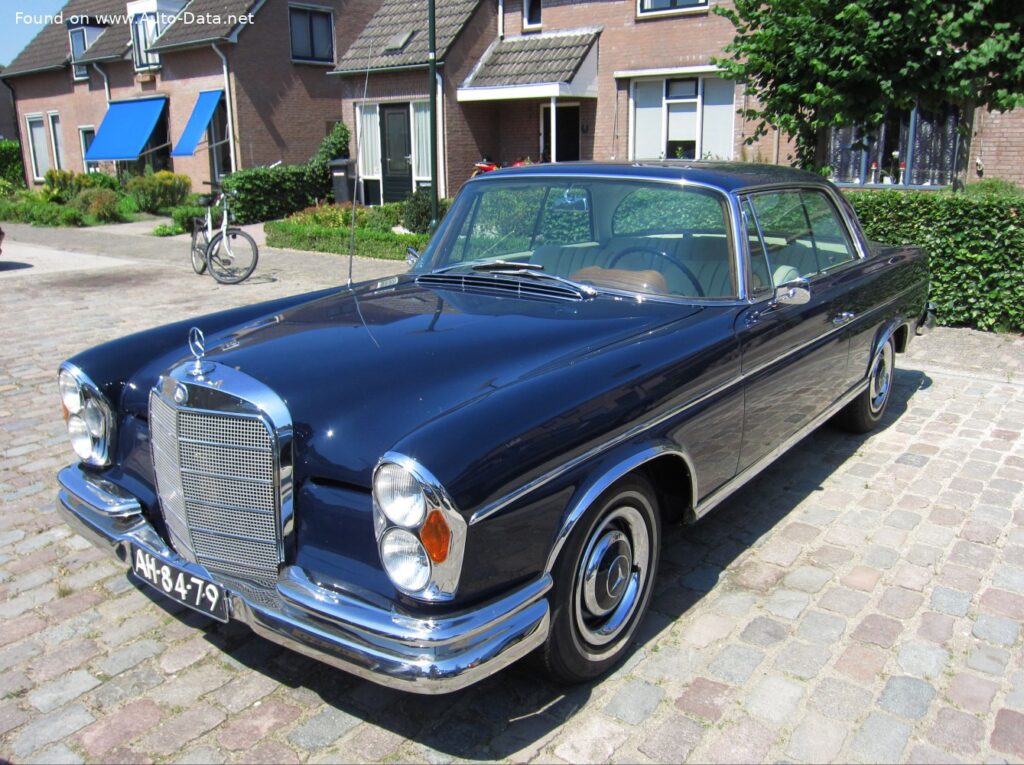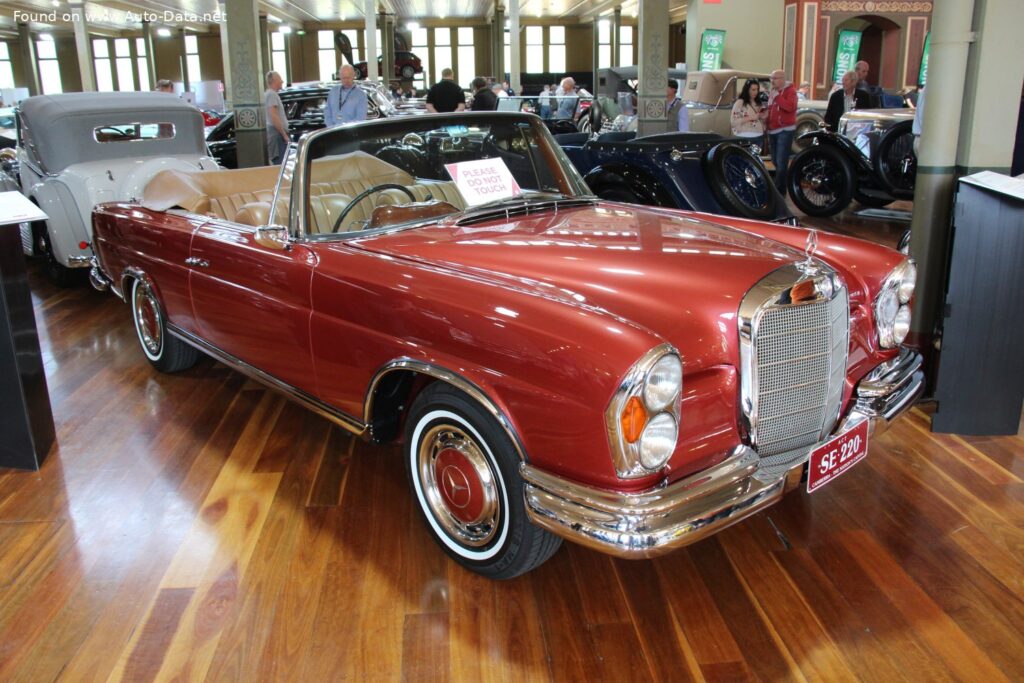
The Mercedes-Benz W112 Cabriolet 300 SE represents the pinnacle of 1960s German luxury and engineering. Produced between January 1964 and December 1967, this model was the open-top variant of the prestigious W112 series, itself a refinement of the earlier W111 “Fintail” sedans. The 300 SE Cabriolet was not a mass-market vehicle; it catered to a discerning clientele seeking sophisticated styling, advanced technology for its time, and a smooth, powerful driving experience. While not officially exported in large numbers to the United States, the W112 series, including the Cabriolet, gained a following among American enthusiasts who appreciated its quality and exclusivity. The 300 SE Cabriolet stands as a testament to Mercedes-Benz’s commitment to automotive excellence during a period of significant design and technological advancement.
Mercedes-Benz W112 Cabriolet 300 SE: A Legacy of Luxury
The W112 series was conceived as a more luxurious and technologically advanced alternative to the W111 “Fintail” models. The Cabriolet, in particular, embodied this ambition. It featured a fully automatic, hydraulically operated soft top, a sophisticated air suspension system, and a powerful inline-six engine with multi-port fuel injection. The car’s design was elegant and understated, reflecting a departure from the more pronounced tailfins of American cars of the era. The 300 SE Cabriolet was positioned above the standard 300 SE sedan in terms of price and exclusivity, making it a status symbol for those who could afford it.
Engine & Performance
The heart of the 300 SE Cabriolet is its 2,996 cc (182.83 cu. in.) inline-six cylinder engine, designated M 189 VI / 189.987. This engine produced 170 horsepower at 5,400 rpm and 249 Nm (183.65 lb.-ft.) of torque at 4,000 rpm. The engine’s most notable feature was its multi-port manifold fuel injection system, a relatively advanced technology for the mid-1960s that contributed to smooth power delivery and improved fuel efficiency compared to carbureted engines. Power is sent to the rear wheels via a four-speed manual transmission. Acceleration from 0 to 100 km/h (0-62 mph) takes 12.4 seconds, and the car has a top speed of 200 km/h (124.27 mph). The weight-to-power ratio of 10.1 kg/Hp and a weight-to-torque ratio of 6.9 kg/Nm demonstrate a respectable balance for a luxury vehicle of this era. The engine’s power per liter is 56.7 Hp/l.
Design & Features
The W112 Cabriolet is a two-door, five-seat convertible. Its body lines are characterized by a graceful profile, a relatively long hood, and a spacious cabin. The car’s design emphasizes elegance and refinement rather than overt sportiness. The fully automatic soft top, a key feature of the Cabriolet, could be raised or lowered with ease, providing open-air motoring enjoyment. Inside, the cabin is appointed with high-quality materials, including leather upholstery and wood trim. The air suspension system, a significant technological innovation, provided a remarkably smooth and comfortable ride, absorbing road imperfections effectively. Disc brakes on all four wheels offered improved stopping power compared to drum brakes. The steering system utilized a cone worm with recirculation balls, providing precise and responsive handling. The car’s overall design and features reflected Mercedes-Benz’s commitment to providing a luxurious and sophisticated motoring experience.
Technical Specifications
| Brand | Mercedes-Benz |
| Model | W112 |
| Generation | W112 Cabriolet |
| Type (Engine) | 300 SE (170 Hp) |
| Start of production | January, 1964 |
| End of production | December, 1967 |
| Powertrain Architecture | Internal Combustion engine |
| Body type | Cabriolet |
| Seats | 5 |
| Doors | 2 |
| Fuel consumption (combined) | 11.8-12.5 l/100 km |
| Fuel consumption (US mpg) | 19.9 – 18.8 |
| Fuel consumption (UK mpg) | 23.9 – 22.6 |
| Fuel consumption (km/l) | 8.5 – 8 |
| Fuel Type | Petrol (Gasoline) |
| Acceleration 0 – 100 km/h | 12.4 sec |
| Acceleration 0 – 62 mph | 12.4 sec |
| Acceleration 0 – 60 mph | 11.8 sec |
| Maximum speed | 200 km/h (124.27 mph) |
| Weight-to-power ratio | 10.1 kg/Hp |
| Hp/tonne | 99.1 |
| Weight-to-torque ratio | 6.9 kg/Nm |
| Nm/tonne | 145.2 |
| Power | 170 Hp @ 5400 rpm |
| Power per litre | 56.7 Hp/l |
| Torque | 249 Nm @ 4000 rpm (183.65 lb.-ft. @ 4000 rpm) |
| Engine layout | Front, Longitudinal |
| Engine Model/Code | M 189 VI / 189.987 |
| Engine displacement | 2996 cm3 (182.83 cu. in.) |
| Number of cylinders | 6 |
| Engine configuration | Inline |
| Cylinder Bore | 85 mm (3.35 in.) |
| Piston Stroke | 88 mm (3.46 in.) |
| Compression ratio | 8.8:1 |
| Number of valves per cylinder | 2 |
| Fuel injection system | Multi-port manifold injection |
| Engine aspiration | Naturally aspirated engine |
| Valvetrain | SOHC |
| Kerb Weight | 1715 kg (3780.93 lbs.) |
| Max. weight | 2185 kg (4817.1 lbs.) |
| Max load | 470 kg (1036.17 lbs.) |
| Fuel tank capacity | 82 l (21.66 US gal | 18.04 UK gal) |
| Length | 4880 mm (192.13 in.) |
| Width | 1845 mm (72.64 in.) |
| Height | 1400 mm (55.12 in.) |
| Wheelbase | 2750 mm (108.27 in.) |
| Front track | 1482 mm (58.35 in.) |
| Rear track | 1490 mm (58.66 in.) |
| Drivetrain Architecture | Rear wheel drive |
| Number of gears and type of gearbox | 4 gears, manual transmission |
| Front suspension | Double wishbone, Transverse stabilizer, Air suspension |
| Rear suspension | Air suspension, Transverse stabilizer, Trailing arm |
| Front brakes | Disc |
| Rear brakes | Disc |
| Steering type | Cone worm with recirculation balls |
| Tires size | 6J x 14 |