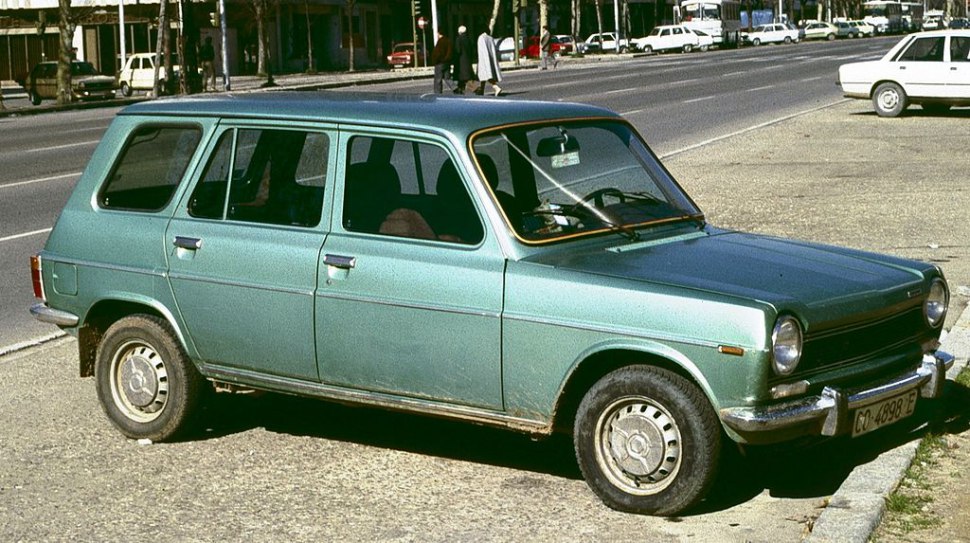
The Talbot Simca 1100 Break/Tourisme 1.1, produced between 1976 and 1980, represents a practical and economical offering from the short-lived Talbot marque. This station wagon, based on the Simca 1100, was aimed at the European family car market, providing a versatile and affordable vehicle during a period of economic uncertainty. The “Break” designation signified the estate (station wagon) body style, while “Tourisme” simply indicated its passenger-carrying role. The 1.1-liter engine variant, producing 50 horsepower, was a common choice for buyers prioritizing fuel efficiency and everyday usability over outright performance. The car’s history is intertwined with the complex ownership changes within the European automotive industry of the 1970s, ultimately becoming a product of the Peugeot-Simca-Talbot (PSA) conglomerate.
The Talbot Simca 1100 Break/Tourisme: A European Family Vehicle
The Talbot Simca 1100 range, and specifically the Break/Tourisme variant, occupied a crucial segment of the European automotive landscape. It competed with vehicles like the Renault 12 Estate, the Fiat 131 Familiare, and the Ford Cortina Estate. Unlike the American market, where large station wagons were common, European buyers generally favored more compact and fuel-efficient options. The 1100 Break catered to this demand, offering a reasonable amount of cargo space within a relatively small footprint. The car was never officially sold in the United States, due to differing market preferences and regulatory requirements. Its significance lies in its representation of European automotive design and engineering during the late 1970s, a period marked by increasing fuel costs and a growing emphasis on practicality.
Origins and the Talbot Brand
The Simca brand had a long history in France, initially as a manufacturer of motorcycles and then automobiles. In 1958, Simca was acquired by Chrysler Europe. The 1100, launched in 1967, was a groundbreaking design for Simca, featuring a transversely mounted engine and front-wheel drive – a configuration that was becoming increasingly popular for its space-saving benefits. In 1978, Chrysler Europe was in financial difficulty and was partially nationalized by the French government, leading to the formation of Talbot. The Talbot name was resurrected, having previously been used by a British manufacturer acquired by Chrysler. The Simca 1100 was rebranded as the Talbot Simca 1100, and production continued until 1981, when it was replaced by the Talbot Horizon.
Engine & Performance
The Talbot Simca 1100 Break/Tourisme 1.1 was powered by a 1,118cc (68.5 cubic inch) inline-four cylinder, naturally aspirated gasoline engine. This engine, derived from the original Simca 1100 powerplant, produced 50 horsepower (37 kW) at approximately 5,300 rpm. Torque figures were modest, around 68 lb-ft (92 Nm) at 3,000 rpm. The engine featured a single overhead camshaft and a two-barrel carburetor. Performance was geared towards economy rather than speed. Acceleration to 60 mph (97 km/h) took around 16-18 seconds, and the top speed was approximately 87 mph (140 km/h). The engine was mated to a four-speed manual transmission, which was standard. A three-speed automatic transmission was offered as an optional extra, but it was less common due to its impact on fuel economy. The front-wheel-drive layout contributed to reasonable handling, although the suspension – consisting of independent front suspension with MacPherson struts and a twist-beam rear axle – was relatively basic. Fuel economy was a key selling point, averaging around 35-40 mpg (6.7-7.1 L/100km) in typical driving conditions.
Design & Features
The Talbot Simca 1100 Break/Tourisme was a compact station wagon, measuring approximately 168 inches (4.27 meters) in length. The body style offered a practical and versatile cargo area, accessible through a large rear tailgate. The interior was functional and designed for durability, with cloth upholstery and simple plastic trim. Features were relatively sparse by modern standards, reflecting the car’s price point and target market. Standard equipment typically included basic instrumentation (speedometer, fuel gauge, temperature gauge), front and rear windscreen wipers, and manually adjustable seats. Optional extras could include a radio, heated rear window, and upgraded upholstery. Safety features were limited, consisting primarily of seat belts. The car’s design was characterized by clean lines and a relatively boxy shape, typical of European station wagons of the era. The front end featured a distinctive grille and headlights, while the rear end was dominated by the large tailgate and vertically oriented taillights. The car’s relatively small size made it easy to maneuver in urban environments, and its front-wheel-drive layout provided good traction in adverse weather conditions.
Technical Specifications
| Specification | Detail |
| Brand | Talbot Simca |
| Model | 1100 Break/Tourisme 1.1 |
| Generation | Simca 1100 Break/Tourisme |
| Engine Type | 1.1L Inline-Four Cylinder Petrol (Gasoline) |
| Engine Displacement | 1,118 cc (68.5 cu in) |
| Power Output | 50 Hp (37 kW) @ 5,300 rpm |
| Torque | 68 lb-ft (92 Nm) @ 3,000 rpm |
| Fuel System | Two-barrel Carburetor |
| Aspiration | Naturally Aspirated |
| Transmission | 4-Speed Manual (Standard), 3-Speed Automatic (Optional) |
| Drivetrain | Front-Wheel Drive |
| Body Type | Station Wagon (Estate) |
| Production Years | 1976 – 1980 |
| Approximate Top Speed | 87 mph (140 km/h) |
| Approximate 0-60 mph Time | 16-18 seconds |
| Fuel Economy (Average) | 35-40 mpg (6.7-7.1 L/100km) |