
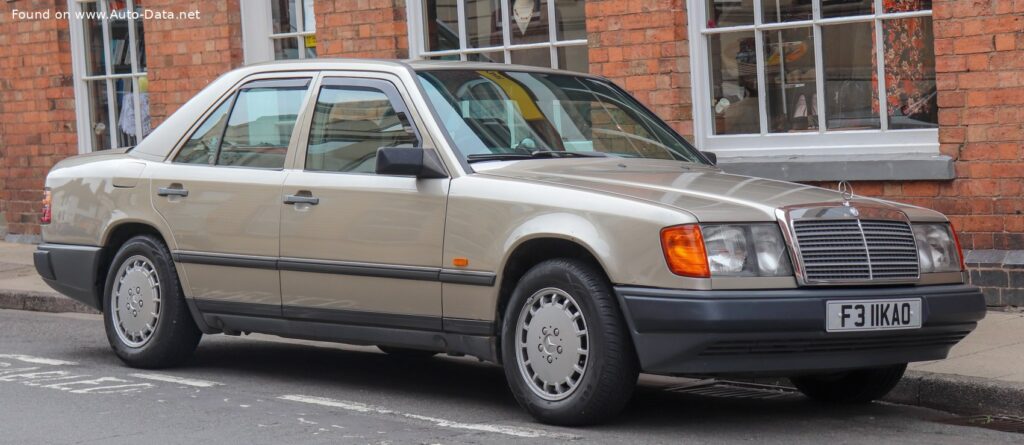
The Mercedes-Benz W124 300 D, produced from March 1984 to August 1989, represents a pivotal generation in the lineage of Mercedes-Benz sedans. Falling into the mid-size executive car segment, the W124 was designed to succeed the W116, offering a blend of engineering refinement, robust build quality, and understated luxury. The 300 D variant, powered by a 3.0-liter inline-six diesel engine, was particularly notable for its fuel efficiency and durability, making it a popular choice in Europe and other markets where diesel engines were favored. While not initially a major seller in the United States due to evolving emissions regulations and a preference for gasoline engines, the W124 established a benchmark for safety and build quality that influenced automotive design for years to come.
The Mercedes-Benz W124 300 D: A Legacy of Engineering
The W124 series was a significant departure from its predecessor, the W116, incorporating a more modern and aerodynamic design. Mercedes-Benz prioritized safety, and the W124 featured numerous advancements in this area, including reinforced passenger cell construction and anti-lock braking systems (ABS). The 300 D specifically, distinguished itself with its OM603 D 30 engine, a robust and reliable powerplant known for its longevity. This engine, coupled with an automatic transmission, provided a comfortable and efficient driving experience, appealing to buyers seeking a practical yet refined vehicle.
Engine & Performance
The heart of the W124 300 D is its 2,996 cc (182.83 cu. in.) inline-six cylinder diesel engine, designated the OM 603 D 30 / 603.912. This naturally aspirated engine produces 109 horsepower at 5000 rpm and 210 Nm (154.89 lb.-ft.) of torque at 2200 rpm. While its horsepower figure might seem modest by modern standards, the engine’s torque delivery provides ample power for comfortable cruising and everyday driving. The engine utilizes precombustion chamber injection, a technology common in Mercedes-Benz diesels of the era, to improve combustion efficiency and reduce emissions. Power is delivered to the rear wheels via a four-speed automatic transmission. Performance figures include a 0-100 km/h (0-62 mph) acceleration time of 14.1 seconds and a maximum speed of 185 km/h (114.95 mph). The weight-to-power ratio stands at 14.3 kg/Hp, and the weight-to-torque ratio is 7.4 kg/Nm.
Design & Features
The W124 300 D is a four-door sedan with a classic, understated design. Its body lines are clean and elegant, reflecting the design philosophy of the 1980s. The interior is characterized by its high-quality materials and comfortable seating for five passengers. Key features included power steering, disc brakes on all four wheels, and a spacious trunk offering 520 liters (18.36 cu. ft.) of cargo space. The W124’s focus was on providing a comfortable and safe driving experience, rather than flashy aesthetics. The robust build quality and attention to detail were hallmarks of the Mercedes-Benz brand during this period. The vehicle’s dimensions are: length 4740 mm (186.61 in.), width 1740 mm (68.5 in.), and height 1431 mm (56.34 in.), with a wheelbase of 2800 mm (110.24 in.).
Technical Specifications
| Brand | Mercedes-Benz |
| Model | W124 |
| Generation | W124 |
| Type (Engine) | 300 D (109 Hp) Automatic |
| Start of production | March, 1984 |
| End of production | August, 1989 |
| Powertrain Architecture | Internal Combustion engine |
| Body type | Sedan |
| Seats | 5 |
| Doors | 4 |
| Fuel consumption (urban) | 6.2 l/100 km (37.9 US mpg, 45.6 UK mpg, 16.1 km/l) |
| Fuel consumption (extra urban) | 9.3 l/100 km (25.3 US mpg, 30.4 UK mpg, 10.8 km/l) |
| Fuel Type | Diesel |
| Acceleration 0 – 100 km/h | 14.1 sec |
| Acceleration 0 – 62 mph | 14.1 sec |
| Acceleration 0 – 60 mph | 13.4 sec |
| Maximum speed | 185 km/h (114.95 mph) |
| Weight-to-power ratio | 14.3 kg/Hp |
| Weight-to-torque ratio | 7.4 kg/Nm |
| Power | 109 Hp @ 5000 rpm |
| Power per litre | 36.4 Hp/l |
| Torque | 210 Nm @ 2200 rpm (154.89 lb.-ft. @ 2200 rpm) |
| Engine layout | Front, Longitudinal |
| Engine Model/Code | OM 603 D 30 / 603.912 |
| Engine displacement | 2996 cm3 (182.83 cu. in.) |
| Number of cylinders | 6 |
| Engine configuration | Inline |
| Cylinder Bore | 87 mm (3.43 in.) |
| Piston Stroke | 84 mm (3.31 in.) |
| Compression ratio | 22:1 |
| Number of valves per cylinder | 2 |
| Fuel injection system | Precombustion chamber injection |
| Engine aspiration | Naturally aspirated engine |
| Valvetrain | SOHC |
| Engine oil capacity | 7.5 l (7.93 US qt | 6.6 UK qt) |
| Coolant | 9.5 l (10.04 US qt | 8.36 UK qt) |
| Kerb Weight | 1560 kg (3439.21 lbs.) |
| Max. weight | 2050 kg (4519.48 lbs.) |
| Max load | 490 kg (1080.27 lbs.) |
| Trunk (boot) space – minimum | 520 l (18.36 cu. ft.) |
| Fuel tank capacity | 70 l (18.49 US gal | 15.4 UK gal) |
| Length | 4740 mm (186.61 in.) |
| Width | 1740 mm (68.5 in.) |
| Height | 1431 mm (56.34 in.) |
| Wheelbase | 2800 mm (110.24 in.) |
| Front track | 1501 mm (59.09 in.) |
| Rear (Back) track | 1491 mm (58.7 in.) |
| Drivetrain Architecture | Rear wheel drive |
| Drive wheel | Rear wheel drive |
| Number of gears and type of gearbox | 4 gears, automatic transmission |
| Front suspension | Wishbone |
| Rear suspension | Independent multi-link suspension, Coil spring |
| Front brakes | Disc |
| Rear brakes | Disc |
| Steering type | Cone worm with recirculation balls |
| Power steering | Hydraulic Steering |
| Tires size | Front wheel tires: 195/65 R15Rear wheel tires: 195/65 R15 |
| Wheel rims size | Front wheel rims: 6.5J x 15Rear wheel rims: 6.5J x 15 |
The Mercedes-Benz W124 300 D remains a highly regarded vehicle among enthusiasts, celebrated for its durability, comfort, and timeless design. Its robust engineering and fuel-efficient diesel engine ensured its longevity and cemented its place as a classic in the world of automotive history.
