
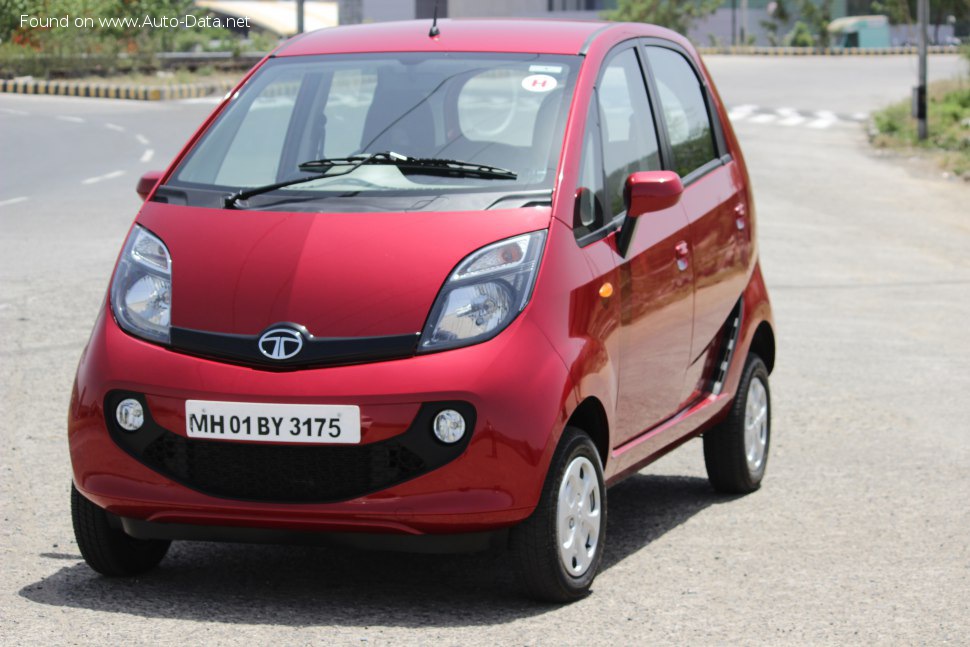
The Tata GenX Nano, a facelift of the original Tata Nano, represents a significant attempt to revitalize the world’s cheapest car. Introduced in 2015 and produced until 2018, the GenX Nano aimed to address criticisms of the initial model while retaining its core affordability. Primarily marketed in India, the GenX Nano was designed as a compact, fuel-efficient city car, intended to provide basic transportation for a rapidly growing middle class. This iteration featured several improvements over its predecessor, including revised styling, an automated manual transmission option, and enhanced interior features. While not officially sold in the United States, understanding the GenX Nano provides insight into the challenges and innovations of automotive engineering in emerging markets.
The Tata GenX Nano: A Detailed Overview
The GenX Nano was positioned as a hatchback, offering a practical and economical solution for urban commuting. It was a five-door vehicle with seating for four passengers, designed to navigate congested city streets with ease. The 2015 facelift was a response to initial market reception, focusing on improving the car’s aesthetics, functionality, and perceived quality. The GenX Nano sought to overcome the initial Nano’s reputation for being overly basic, offering a more refined and appealing package to potential buyers.
Engine & Performance
The GenX Nano was powered by a small, naturally aspirated 0.6-liter inline two-cylinder petrol engine. This engine produced 38 horsepower at 5500 rpm and 51 Nm (37.62 lb.-ft.) of torque at 4000 rpm. While modest by Western standards, this powertrain was sufficient for city driving conditions in India. The engine utilized a multi-port manifold fuel injection system. The power-to-weight ratio was 18.3 kg/Hp, or 54.7 Hp/tonne, and the torque-to-weight ratio was 13.6 kg/Nm, or 73.4 Nm/tonne. The car’s kerb weight ranged from 695 to 735 kg (1532.21 to 1620.4 lbs.). The GenX Nano featured a rear-wheel-drive layout and a four-speed manual transmission. Its maximum speed was limited to 105 km/h (65.24 mph). The engine’s small displacement resulted in a power-per-liter figure of 60.9 Hp/l.
Design & Features
The GenX Nano’s design was a significant departure from the original Nano, featuring a more contemporary and visually appealing front fascia. The revised front bumper, larger air dam, and new headlamps contributed to a more modern aesthetic. The interior also received updates, including improved dashboard materials and a more ergonomic layout. While still focused on affordability, the GenX Nano offered features such as power steering, air conditioning (optional), and a basic audio system. Safety features were limited, reflecting the car’s price point and target market. The hatchback body style provided a practical cargo space of 110 liters (3.88 cu. ft.). The car’s compact dimensions – a length of 3164 mm (124.57 in.), a width of 1750 mm (68.9 in.), and a height of 1652 mm (65.04 in.) – made it easy to maneuver in crowded urban environments. Ride height, or ground clearance, was 100 mm (3.94 in.).
Technical Specifications
| Specification | Value |
| Brand | Tata |
| Model | Nano |
| Generation | GenX Nano (facelift 2015) |
| Type (Engine) | 0.6i (38 Hp) |
| Start of production | 2015 |
| End of production | 2018 |
| Powertrain Architecture | Internal Combustion engine |
| Body type | Hatchback |
| Seats | 4 |
| Doors | 5 |
| Fuel Type | Petrol (Gasoline) |
| Maximum speed | 105 km/h (65.24 mph) |
| Weight-to-power ratio | 18.3 kg/Hp |
| Weight-to-torque ratio | 13.6 kg/Nm |
| Power | 38 Hp @ 5500 rpm |
| Torque | 51 Nm @ 4000 rpm (37.62 lb.-ft. @ 4000 rpm) |
| Engine displacement | 624 cm3 (38.08 cu. in.) |
| Number of cylinders | 2 |
| Engine configuration | Inline |
| Number of valves per cylinder | 2 |
| Fuel injection system | Multi-port manifold injection |
| Engine aspiration | Naturally aspirated |
| Engine oil capacity | 2.2 l (2.32 US qt | 1.94 UK qt) |
| Coolant capacity | 2.4 l (2.54 US qt | 2.11 UK qt) |
| Kerb Weight | 695-735 kg (1532.21 – 1620.4 lbs.) |
| Trunk (boot) space – minimum | 110 l (3.88 cu. ft.) |
| Fuel tank capacity | 24 l (6.34 US gal | 5.28 UK gal) |
| Length | 3164 mm (124.57 in.) |
| Width | 1750 mm (68.9 in.) |
| Height | 1652 mm (65.04 in.) |
| Wheelbase | 2230 mm (87.8 in.) |
| Ride height (ground clearance) | 100 mm (3.94 in.) |
| Minimum turning circle | 8.0 m (26.25 ft.) |
| Drivetrain Architecture | Rear wheel drive |
| Number of gears | 4 |
| Gearbox type | Manual transmission |
| Front suspension | Independent type McPherson |
| Rear suspension | Independent coil spring |
| Front brakes | Drum |
| Rear brakes | Drum |
| Steering type | Steering rack and pinion |
| Power steering | Electric |
| Tires size | 135/70 R12; 155/65 R12 |
| Wheel rims size | 12 |
The Tata GenX Nano, despite its limited success in achieving widespread sales, remains a noteworthy example of automotive engineering focused on affordability and practicality. It demonstrated the potential for creating a functional and accessible vehicle for emerging markets, even with significant constraints on cost and technology. While the original Nano and its GenX facelift are no longer in production, they continue to be studied as case studies in automotive innovation and the challenges of serving a diverse global market.
