
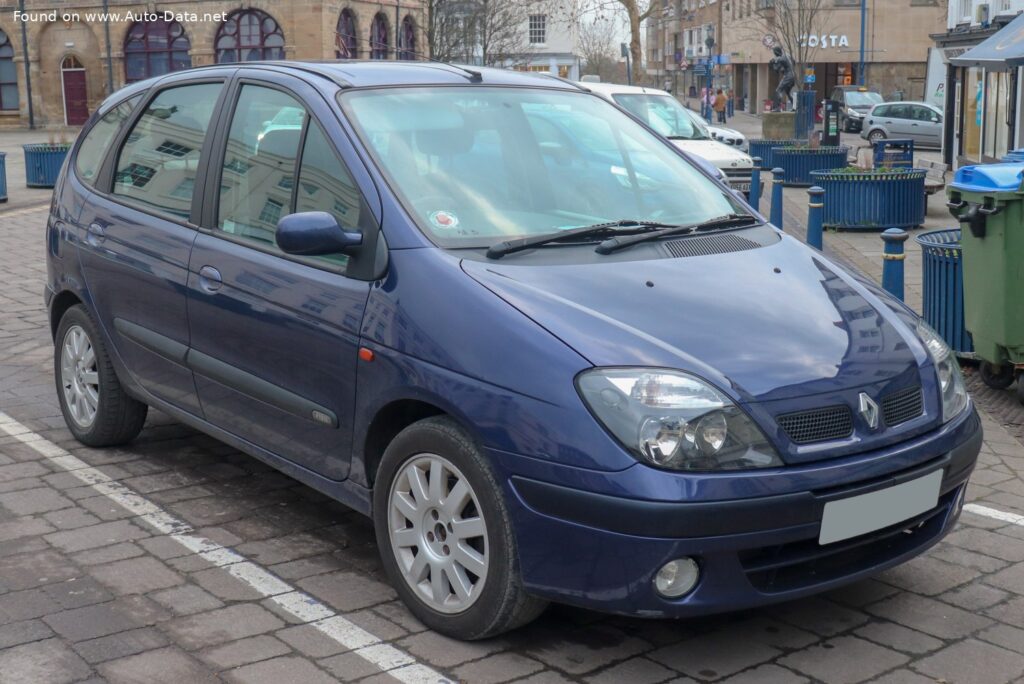
The Renault Scenic I (Phase II) 1.4 is a compact minivan produced by the French manufacturer Renault between 1999 and 2000. Representing the second iteration of the first-generation Scenic, this model built upon the innovative design of its predecessor, offering a practical and family-oriented vehicle. While not officially sold in the United States, the Scenic was a popular choice in Europe, pioneering the compact minivan segment and establishing Renault as a key player in the multi-purpose vehicle (MPV) market. The Phase II updates brought refinements to the original design, enhancing both aesthetics and functionality. This particular variant, equipped with a 1.4-liter engine producing 75 horsepower, was aimed at buyers prioritizing fuel efficiency and affordability.
Renault Scenic I (Phase II): A European Compact MPV
The Renault Scenic I, launched in 1996, was a groundbreaking vehicle. It’s often credited with popularizing the compact minivan segment in Europe. The Phase II update, spanning 1999-2000, introduced subtle styling changes, improved interior materials, and enhanced safety features. The Scenic I was designed to appeal to families seeking a versatile vehicle that could comfortably accommodate passengers and cargo. Its modular interior, with removable seats, allowed for a variety of configurations to suit different needs. The 1.4-liter engine option provided a balance between performance and economy, making it a sensible choice for everyday driving.
Engine & Performance
The Renault Scenic I (Phase II) 1.4 is powered by a 1.4-liter inline four-cylinder gasoline engine, designated the E7J. This naturally aspirated engine produces 75 horsepower at 5500 rpm and 112 Nm (82.61 lb.-ft.) of torque at 3000 rpm. While not a performance-oriented engine, it provides adequate power for typical urban and highway driving. The engine’s power-to-weight ratio is 67.9 horsepower per tonne, and its torque-to-weight ratio is 101.4 Nm per tonne. The engine features multi-port fuel injection and a compression ratio of 9.5:1. Power is delivered to the front wheels via a five-speed manual transmission. The engine’s relatively small displacement contributes to reasonable fuel economy, a key consideration for European buyers facing higher fuel prices. The engine oil capacity is 4.5 liters (4.76 US qt / 3.96 UK qt) and requires a specification that should be checked in the vehicle’s manual.
Design & Features
The Renault Scenic I (Phase II) is a five-door minivan with a practical and functional design. Its compact dimensions – 4168 mm (164.09 in) in length, 1719 mm (67.68 in) in width, and 1609 mm (63.35 in) in height – make it relatively easy to maneuver in urban environments. The vehicle’s wheelbase measures 2580 mm (101.57 in). The interior is characterized by its modularity, with seats that can be folded, removed, or repositioned to create a variety of seating and cargo configurations. The trunk (boot) space ranges from a minimum of 410 liters (14.48 cu. ft.) to a maximum of 1800 liters (63.57 cu. ft.) with the rear seats folded down. Safety features for the time included an Anti-lock Braking System (ABS). The steering is rack and pinion with hydraulic power assistance. The vehicle rides on 14-inch wheels fitted with 175/70 R14 H tires.
Technical Specifications
| General Information | |
| Brand | Renault |
| Model | Scenic |
| Generation | Scenic I (Phase II) |
| Type (Engine) | 1.4 (75 Hp) |
| Start of production | 1999 |
| End of production | 2000 |
| Powertrain Architecture | Internal Combustion engine |
| Body type | Minivan |
| Seats | 5 |
| Doors | 5 |
| Performance Specs | |
| Fuel Type | Petrol (Gasoline) |
| Weight-to-power ratio | 14.7 kg/Hp |
| Weight-to-torque ratio | 9.9 kg/Nm |
| Engine Specs | |
| Power | 75 Hp @ 5500 rpm |
| Power per litre | 54 Hp/l |
| Torque | 112 Nm @ 3000 rpm / 82.61 lb.-ft. @ 3000 rpm |
| Engine layout | Front, Transverse |
| Engine Model/Code | E7J |
| Engine displacement | 1390 cm3 / 84.82 cu. in. |
| Number of cylinders | 4 |
| Engine configuration | Inline |
| Cylinder Bore | 79.5 mm / 3.13 in. |
| Piston Stroke | 70 mm / 2.76 in. |
| Compression ratio | 9.5:1 |
| Number of valves per cylinder | 2 |
| Fuel injection system | Multi-port manifold injection |
| Engine aspiration | Naturally aspirated engine |
| Engine oil capacity | 4.5 l / 4.76 US qt | 3.96 UK qt |
| Coolant | 6 l / 6.34 US qt | 5.28 UK qt |
| Space, Volume and Weights | |
| Kerb Weight | 1105 kg / 2436.11 lbs. |
| Max. weight | 1585 kg / 3494.33 lbs. |
| Max load | 480 kg / 1058.22 lbs. |
| Trunk (boot) space – minimum | 410 l / 14.48 cu. ft. |
| Trunk (boot) space – maximum | 1800 l / 63.57 cu. ft. |
| Fuel tank capacity | 60 l / 15.85 US gal | 13.2 UK gal |
| Dimensions | |
| Length | 4168 mm / 164.09 in. |
| Width | 1719 mm / 67.68 in. |
| Height | 1609 mm / 63.35 in. |
| Wheelbase | 2580 mm / 101.57 in. |
| Front track | 1446 mm / 56.93 in. |
| Rear (Back) track | 1458 mm / 57.4 in. |
| Drivetrain, Brakes and Suspension Specs | |
| Drivetrain Architecture | The Internal combustion engine (ICE) drives the front wheels of the vehicle. |
| Drive wheel | Front wheel drive |
| Number of gears and type of gearbox | 5 gears, manual transmission |
| Front suspension | Spring Strut |
| Rear suspension | Torsion |
| Front brakes | Ventilated discs |
| Rear brakes | Drum |
| Assisting systems | ABS (Anti-lock braking system) |
| Steering type | Steering rack and pinion |
| Power steering | Hydraulic Steering |
| Tires size | 175/70 R14 H |
| Wheel rims size | 14 |
