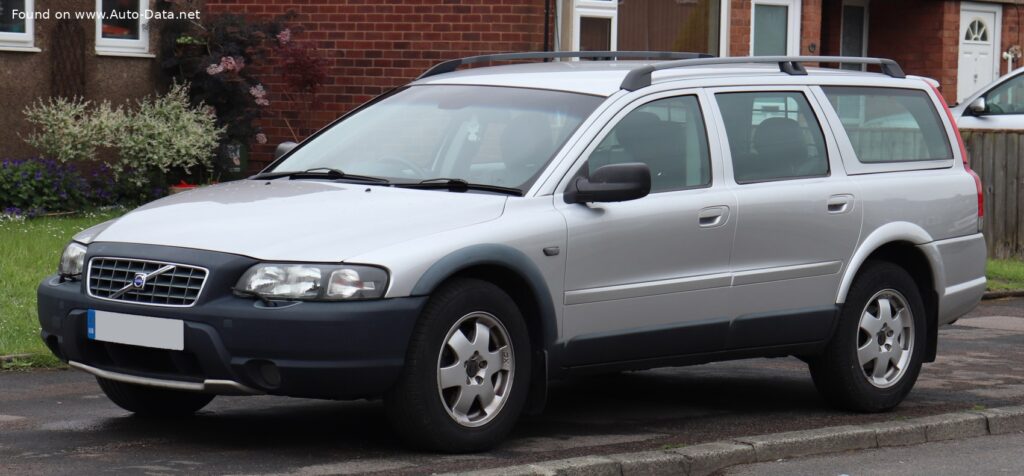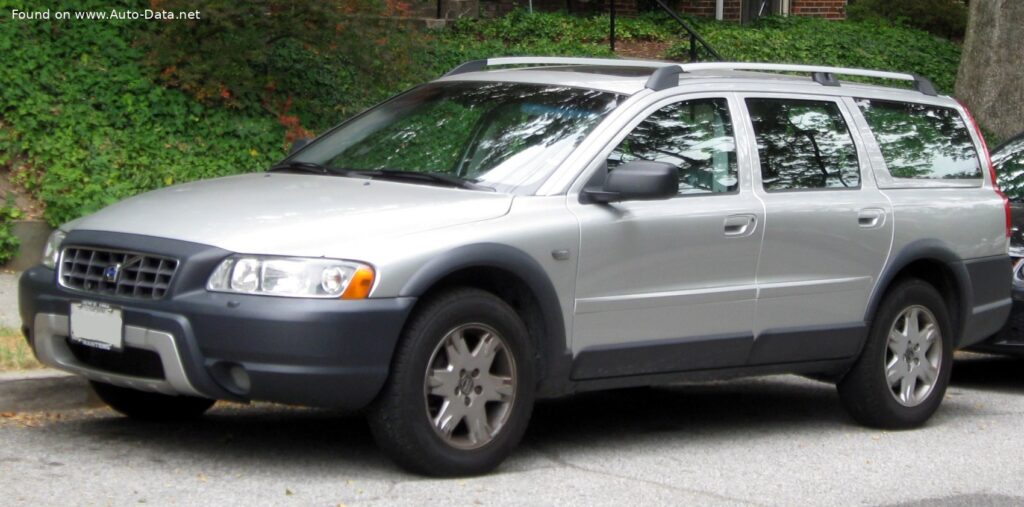
The Volvo XC70 I (facelift 2004) 2.5T AWD represents Volvo’s foray into the burgeoning luxury crossover market. Introduced as a more rugged, all-wheel-drive variant of the V70 station wagon, the XC70 aimed to blend the practicality of a wagon with the capability and aesthetic appeal of an SUV. This particular facelift, released in 2004, brought updated styling and refinements to the original XC70, solidifying its position as a popular choice for buyers seeking a versatile and safe vehicle. While not initially a major seller in the United States, the XC70 carved out a niche for itself among those prioritizing Scandinavian design, robust construction, and all-weather capability.
Volvo XC70 I (Facelift 2004) 2.5T AWD: An Overview
The XC70 I, specifically the 2004 facelifted 2.5T AWD model, is a five-door, five-seat station wagon (marketed as a crossover) powered by a turbocharged 2.5-liter inline-five engine. It was produced from 2004 to 2007. Positioned above the standard V70 wagon, the XC70 featured increased ground clearance, protective body cladding, and standard all-wheel drive, giving it a more adventurous character. The 2.5T designation indicates the engine displacement and the presence of a turbocharger, delivering a balance of performance and fuel efficiency. This model was primarily sold in Europe and other international markets, where the demand for practical, all-weather vehicles was high.
Engine & Performance
The heart of the XC70 I 2.5T AWD is Volvo’s B5254T2 2.5-liter inline-five cylinder engine. This engine produces 210 horsepower at 5000 rpm and 320 Nm (236.02 lb.-ft.) of torque between 1500 and 4500 rpm. The turbocharger and intercooler significantly enhance performance, providing responsive acceleration and ample power for both on-road driving and light off-road excursions. Power is delivered to all four wheels via a six-speed manual transmission, contributing to a 0-100 km/h (0-62 mph) acceleration time of 8.1 seconds. The 0-60 mph time is calculated at 7.7 seconds. The engine’s transverse front-engine layout optimizes space utilization within the vehicle. The engine’s specific output is 83.3 horsepower per liter, demonstrating a good level of efficiency for a turbocharged engine of this era. The weight-to-power ratio of 8 kg/Hp and weight-to-torque ratio of 5.3 kg/Nm further highlight the vehicle’s performance characteristics.
Design & Features
The XC70 I (facelift 2004) boasts a distinctive Scandinavian design aesthetic, characterized by clean lines, a robust build, and a focus on functionality. The body style is a station wagon, but with crossover-inspired elements such as increased ride height and protective lower body cladding. This cladding, along with the standard roof rails, reinforces the vehicle’s adventurous image. Inside, the XC70 offers a comfortable and spacious cabin with seating for five passengers. The interior emphasizes safety and practicality, with a focus on ergonomic design and durable materials. Key features include a spacious cargo area (485 liters minimum, expanding to 1641 liters with the rear seats folded), a user-friendly dashboard layout, and a comprehensive suite of safety features, including ABS (Anti-lock Braking System). The vehicle’s dimensions – 4733 mm in length, 1860 mm in width, and 1562 mm in height – provide ample space for passengers and cargo. The XC70’s approach, departure, and ramp-over angles (20°, 23°, and 18° respectively) enhance its off-road capability.
Technical Specifications
| Brand | Volvo |
| Model | XC70 |
| Generation | XC70 I (facelift 2004) |
| Type (Engine) | 2.5T (210 Hp) AWD |
| Start of production | 2004 |
| End of production | 2007 |
| Powertrain Architecture | Internal Combustion engine |
| Body type | Station wagon (estate), Crossover |
| Seats | 5 |
| Doors | 5 |
| Fuel consumption (economy) – urban (NEDC) | 14.1 l/100 km (16.7 US mpg, 20 UK mpg, 7.1 km/l) |
| Fuel consumption (economy) – extra urban (NEDC) | 7.9 l/100 km (29.8 US mpg, 35.8 UK mpg, 12.7 km/l) |
| Fuel consumption (economy) – combined (NEDC) | 10.2 l/100 km (23.1 US mpg, 27.7 UK mpg, 9.8 km/l) |
| CO2 emissions (NEDC) | 244 g/km |
| Fuel Type | Petrol (Gasoline) |
| Acceleration 0 – 100 km/h | 8.1 sec |
| Acceleration 0 – 62 mph | 8.1 sec |
| Acceleration 0 – 60 mph | 7.7 sec |
| Maximum speed | 210 km/h (130.49 mph) |
| Emission standard | Euro 4 |
| Weight-to-power ratio | 8 kg/Hp |
| Weight-to-torque ratio | 5.3 kg/Nm |
| Power | 210 Hp @ 5000 rpm |
| Torque | 320 Nm @ 1500-4500 rpm (236.02 lb.-ft. @ 1500-4500 rpm) |
| Engine layout | Front, Transverse |
| Engine Model/Code | B5254T2 |
| Engine displacement | 2521 cm3 (153.84 cu. in.) |
| Number of cylinders | 5 |
| Engine configuration | Inline |
| Cylinder Bore | 83 mm (3.27 in.) |
| Piston Stroke | 93.2 mm (3.67 in.) |
| Number of valves per cylinder | 4 |
| Fuel injection system | Multi-port manifold injection |
| Engine aspiration | Turbocharger, Intercooler |
| Valvetrain | DOHC |
| Engine oil capacity | 5.5 l (5.81 US qt | 4.84 UK qt) |
| Coolant | 7 l (7.4 US qt | 6.16 UK qt) |
| Kerb Weight | 1689 kg (3723.61 lbs.) |
| Max. weight | 2220 kg (4894.26 lbs.) |
| Max load | 531 kg (1170.65 lbs.) |
| Trunk (boot) space – minimum | 485 l (17.13 cu. ft.) |
| Trunk (boot) space – maximum | 1641 l (57.95 cu. ft.) |
| Fuel tank capacity | 68 l (17.96 US gal | 14.96 UK gal) |
| Max. roof load | 100 kg (220.46 lbs.) |
| Permitted trailer load with brakes (12%) | 1800 kg (3968.32 lbs.) |
| Permitted trailer load without brakes | 750 kg (1653.47 lbs.) |
| Permitted towbar download | 75 kg (165.35 lbs.) |
| Length | 4733 mm (186.34 in.) |
| Width | 1860 mm (73.23 in.) |
| Height | 1562 mm (61.5 in.) |
| Wheelbase | 2763 mm (108.78 in.) |
| Front track | 1611 mm (63.43 in.) |
| Rear (Back) track | 1548 mm (60.94 in.) |
| Minimum turning circle (turning diameter) | 11.9 m (39.04 ft.) |
| Drivetrain Architecture | All wheel drive (4×4). Internal Combustion engine. |
| Number of gears and type of gearbox | 6 gears, manual transmission |
| Front suspension | Independent, type McPherson with coil spring and anti-roll bar |
| Rear suspension | Independent multi-link suspension, Transverse stabilizer |
| Front brakes | Ventilated discs |
| Rear brakes | Disc |
| Tires size | 215/65 R16 |
| Wheel rims size | 7J x 16 |