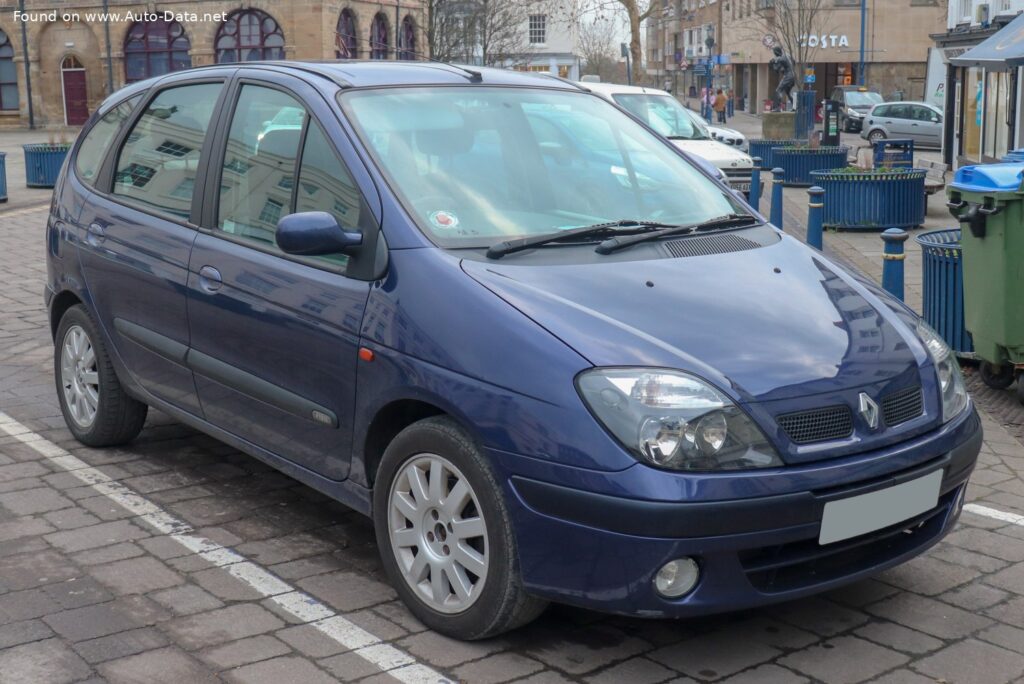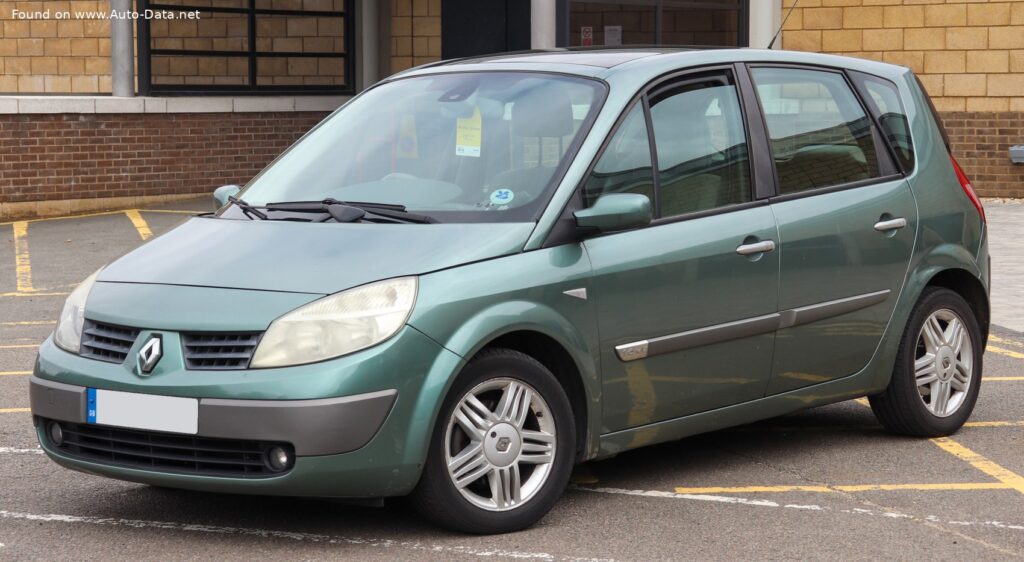
The Renault Scenic II (Phase I) 1.9 dCi (130 Hp) FAP is a compact minivan produced by the French automaker Renault from 2005 to 2006. As the second generation of the Scenic model, it built upon the success of its predecessor, offering increased space, improved features, and a more refined driving experience. The Scenic II was primarily marketed in Europe, where compact minivans, often referred to as multi-purpose vehicles (MPVs), were a popular choice for families. It competed with vehicles like the Citroën Xsara Picasso, Opel/Vauxhall Zafira, and Ford Focus C-Max. This model represented Renault’s commitment to providing practical and versatile transportation solutions for modern families.
Renault Scenic II (Phase I) 1.9 dCi: A Detailed Overview
The Scenic II Phase I represented a significant step forward in design and functionality for Renault. It retained the core principles of the original Scenic – a spacious interior, modular seating, and a focus on practicality – but with a more contemporary aesthetic and enhanced technology. The Phase I designation refers to the initial iteration of the second-generation model, with subsequent phases introducing further refinements and updates. The 1.9 dCi engine variant, equipped with a Diesel Particulate Filter (DPF – FAP in French terminology), was a popular choice due to its balance of performance and fuel efficiency.
Engine & Performance
The Renault Scenic II 1.9 dCi (130 Hp) FAP is powered by a 1.9-liter inline-four cylinder diesel engine, designated the F9Q. This engine produces 130 horsepower at 4,000 rpm and 300 Nm (221.27 lb.-ft.) of torque at 2,000 rpm. The engine utilizes a turbocharger with an intercooler to enhance power output and efficiency. The common rail direct fuel injection system contributes to smooth power delivery and reduced emissions. The inclusion of a Diesel Particulate Filter (DPF) – marketed as FAP by Renault – was crucial for meeting increasingly stringent Euro 4 emission standards. Performance figures include a 0-100 km/h (0-62 mph) acceleration time of 9.6 seconds and a maximum speed of 192 km/h (119.3 mph). The 0-60 mph time is calculated at 9.1 seconds. The engine’s power-to-weight ratio is 11 kg/Hp, and the torque-to-weight ratio is 4.8 kg/Nm.
Design & Features
The Scenic II Phase I features a distinctive minivan body style with five doors and seating for five passengers. Its design emphasized practicality and spaciousness, with a high roofline and a relatively short front overhang. The interior was designed to be versatile, with a modular seating system that allowed for various configurations to maximize cargo space. Key features included a panoramic sunroof (optional), air conditioning, power windows, and a radio/CD player. Safety features, increasingly important in the mid-2000s, included ABS (Anti-lock Braking System) and driver/passenger airbags. The trunk (boot) space offered between 430 liters (15.19 cu. ft.) with the rear seats up and 1840 liters (64.98 cu. ft.) with the rear seats folded down. The vehicle’s dimensions are 4259 mm (167.68 in.) in length, 1810 mm (71.26 in.) in width, and 1620 mm (63.78 in.) in height. The wheelbase measures 2685 mm (105.71 in.).
Technical Specifications
| Brand | Renault |
| Model | Scenic |
| Generation | Scenic II (Phase I) |
| Type (Engine) | 1.9 dCi (130 Hp) FAP |
| Start of production | 2005 |
| End of production | 2006 |
| Powertrain Architecture | Internal Combustion engine |
| Body type | Minivan |
| Seats | 5 |
| Doors | 5 |
| Fuel consumption (urban) | 7.3 l/100 km (32.2 US mpg, 38.7 UK mpg, 13.7 km/l) |
| Fuel consumption (extra urban) | 5.3 l/100 km (44.4 US mpg, 53.3 UK mpg, 18.9 km/l) |
| Fuel consumption (combined) | 6.0 l/100 km (39.2 US mpg, 47.1 UK mpg, 16.7 km/l) |
| CO2 emissions | 159 g/km |
| Fuel Type | Diesel |
| Acceleration 0 – 100 km/h | 9.6 sec |
| Acceleration 0 – 62 mph | 9.6 sec |
| Acceleration 0 – 60 mph | 9.1 sec |
| Maximum speed | 192 km/h (119.3 mph) |
| Emission standard | Euro 4 |
| Weight-to-power ratio | 11 kg/Hp |
| Weight-to-torque ratio | 4.8 kg/Nm |
| Power | 130 Hp @ 4000 rpm |
| Torque | 300 Nm @ 2000 rpm (221.27 lb.-ft. @ 2000 rpm) |
| Engine layout | Front, Transverse |
| Engine Model/Code | F9Q |
| Engine displacement | 1870 cm3 (114.11 cu. in.) |
| Number of cylinders | 4 |
| Engine configuration | Inline |
| Cylinder Bore | 80 mm (3.15 in.) |
| Piston Stroke | 93 mm (3.66 in.) |
| Compression ratio | 19:1 |
| Number of valves per cylinder | 2 |
| Fuel injection system | Diesel Commonrail |
| Engine aspiration | Turbocharger, Intercooler |
| Engine oil capacity | 4.9 l (5.18 US qt | 4.31 UK qt) |
| Coolant | 7.6 l (8.03 US qt | 6.69 UK qt) |
| Kerb Weight | 1430 kg (3152.61 lbs.) |
| Max. weight | 2010 kg (4431.29 lbs.) |
| Max load | 580 kg (1278.68 lbs.) |
| Trunk (boot) space – minimum | 430 l (15.19 cu. ft.) |
| Trunk (boot) space – maximum | 1840 l (64.98 cu. ft.) |
| Fuel tank capacity | 60 l (15.85 US gal | 13.2 UK gal) |
| Max. roof load | 80 kg (176.37 lbs.) |
| Permitted trailer load with brakes (12%) | 1300 kg (2866.01 lbs.) |
| Permitted trailer load without brakes | 650 kg (1433 lbs.) |
| Permitted towbar download | 75 kg (165.35 lbs.) |
| Length | 4259 mm (167.68 in.) |
| Width | 1810 mm (71.26 in.) |
| Width including mirrors | 2087 mm (82.17 in.) |
| Height | 1620 mm (63.78 in.) |
| Wheelbase | 2685 mm (105.71 in.) |
| Front track | 1514 mm (59.61 in.) |
| Rear (Back) track | 1514 mm (59.61 in.) |
| Front overhang | 851 mm (33.5 in.) |
| Rear overhang | 723 mm (28.46 in.) |
| Ride height (ground clearance) | 130 mm (5.12 in.) |
| Minimum turning circle (turning diameter) | 10.7 m (35.1 ft.) |
| Drivetrain Architecture | Front wheel drive |
| Number of gears and type of gearbox | 6 gears, manual transmission |
| Front suspension | Independent type McPherson |
| Rear suspension | Elastic beam |
| Front brakes | Ventilated discs, 300 mm |
| Rear brakes | Disc, 270 mm |
| Assisting systems | ABS (Anti-lock braking system) |
| Steering type | Steering rack and pinion |
| Power steering | Electric Steering |
| Tires size | 205/60 R16 |
| Wheel rims size | 16 |